Showing posts with label training. Show all posts

Monday, February 9, 2015

Happy Valentine's With Pongu!

Pongu and I finished his goofy little Valentine's Day trick yesterday, about a week ahead of schedule. We haven't been able to make it to agility class the last few weeks because of terrible weather (which, for some reason, always hits on Mondays lately) and we're not training in Rally or obedience anymore, so once I figured out a trick that Pongu could actually do, it went pretty quickly.


My how-to post on teaching this one (well, part of it, anyhow) is scheduled to go up on Team Unruly in about a week. Till then, Happy Valentine's from Pongu!

(And Crooky, too, even if he didn't get so much as a cameo this time.)

Thursday, August 28, 2014

The McRib Analogy

On occasion, some of my force-based trainer friends (of which I do have a small, select handful) will start singing the praises of compulsion-based training to me. It's so fast! It's so easy! It's so effective! and so on.

Every time this happens, I feel a little like a vegetarian Jew* listening to a carnivore buddy talking about how delicious the McRib sandwich is. A little bit grossed out, a little bit curious, but mostly just running through these three thoughts:

(1) I have never tasted a McRib, and I am never going to taste a McRib, but I have been around them. I have smelled them and I have looked at them, and somehow I feel pretty safe that your definition of "delicious" is not the same as my definition of "delicious" here.

(2) Even if I'm wrong, and by some inconceivable warping of space-time reality a McRib sandwich really is delicious, taste is aaaaactually not the main reason I'm refusing to eat one.

I do have some other considerations to factor into this decision, you know. Animal welfare, general ethics, concerns about the environment, concerns about the gross side effects of putting those chemicals in your body (which yes, sure, might not happen, especially if you only eat McRibs occasionally instead of making them an everyday thing... but personally I still feel better not doing that at all), concerns about what kinds of practices and businesses I want to support, and what kind of world I want to live in.

My personal appetites are not the only thing on the planet.

(3) My life is not actually deprived by the omission of McRibs.

I know! This might be hard to believe! But I am totally happy and healthy without them! I do not feel sad or starved! I can have a healthy, satisfying, balanced diet without McRibs! And yes, I can still be active, and no, my body is not deprived of precious minerals or micronutrients, and in fact I think those are sort of disingenuous fake concerns when people purport to raise them, because let's be honest: you don't really care about my personal nutrition, you just want to make me feel bad about not eating reconstituted pork goop. Moreover, having to put together a complete and balanced vegetarian diet requires me to be more educated and proactive in making my choices than the average person.

It is even (gasp) possible that I eat healthier because I don't touch McRibs.

and as an occasional bonus, I'll add:

(4) I'm not trying to convert you, dude. You can have your McRibs. I might think they're gross but I'm not trying to get them outlawed. Go on, pig out (hur hur, see what I did there?), have a ball. Eat twenty of them. Your life, your choices.

I just don't understand what the point is of trying to "open my eyes" to something I really don't want or need.


(* -- I am not actually either of these things. Hopefully my analogy doesn't offend those who are.)

Tuesday, June 3, 2014

An Epiphany to Everest

This morning I was reflecting on some things our obedience instructor had told us yesterday, and I had an epiphany: I think I finally realized why I've been feeling so down about Pongu's and my progress in obedience training.

We've been working on one of Silvia Trkman's tricks DVDs recently, and that is going beautifully even though the behaviors are way crazier than anything asked in the obedience ring. (For context, our current projects are parastanding and the backwards figure 8.) We're nowhere near finished with any of the tricks, but Pongu's progressing quickly and I'm happy with our work and it's just been really fun.


(2on/2off: baby steps! But fun baby steps!)

I haven't felt "fun" about our obedience training in a while. It's not about ring nerves or wanting to get a 200-point perfect picture (it will be about those things later, because I can't help myself, but that's not where we are today); it's just about training and proofing the exercises to a basic level of proficiency in the ring.

And the reason I haven't felt "fun" about that is, I finally realized, because the task is so monumental. When it comes to trick shaping, I know what progress looks like, I know how close we are to the final picture, and I am correspondingly confident that we can get there.

When it comes to obedience, I have no freaking clue. First, I've never done it before. Second, it's a huge topic. There are a lot of exercises, and every single one of them is way more complicated than it seemed when I was a clueless newb going "hur the dog just walks next to me, that is so easy, hurr de durr." On top of that, every piece in the chain has to be proofed to ring-readiness, which is another monumental task, particularly for ol' scaredybutt and me.

It's like I'm trying to climb Mt. Everest and I've gone 10 feet and there's still 10,000 feet ahead, every one of them harder and higher and steeper than the 10 feet I've already gone, and it's like "AAAAAGGGH WHAT AM I EVEN DOING SCREW IT."

In short, I've been trying to do everything at once and it's not a good strategy because it makes me feel like we're not getting anywhere. What I need to do is break things down a lot smaller. Not just for my dog, but (this is the epiphany!) for me.

When you're writing a novel, you don't focus on finishing the entire book. Lots of newbies make that mistake and they feel like they're not getting anywhere and so they give up. You can't do that. What you do is focus on each chapter. Set smaller, concrete benchmarks to measure your progress to the end.

So that's what I'm going to do. That is my new plan for working with Pongu. Every week we are going to set one little bitty benchmark and if we hit that goal, I am going to force my stupid brain to accept that as a success. I am going to find a way to measure and mark what we're doing. Not just recording it in a journal, because I've done that and it doesn't feel like progress to me, but setting target goals in advance and hitting them on the way.

If I can get Pongu to nose a correct scent article outside the house this week, WE WIN. He doesn't have to pick it up. He doesn't have to do the full retrieve chain. It isn't going to be on cue. If he offers the behavior of identifying the correct one in some way -- yeah, that's right, we are going all the way back to OB SB 1 on this -- WE WIN.

So there. That's my epiphany.We will start on that first thing tomorrow!

Monday, May 26, 2014

Queenie the Foster Dog, NTD

Today Queenie finished the requirements to qualify for her Novice Trick Dog title: she learned 15 beginner tricks (well, 14 beginner tricks and one slightly more difficult one, since according to the Trick Dog scale, the file-your-nails scratch board trick counts as "Advanced") to a reasonable degree of proficiency. She did this in just under four weeks, start to finish, with absolutely no prior training as far as I could discern.

Here's the video I made to showcase her achievement:


I've been so busy that I haven't had time to blog about her much, but the more I see of her, the more convinced I become that Queenie is a really special little dog. Just about every one of those tricks took her five minutes or less to learn; rarely did she need more than a couple of repetitions to grasp an idea.

Queenie is the first foster dog that I've had long enough to train up to a title (and, honestly, one of the few where I genuinely wanted to put the time in, because not all foster dogs are that much fun to train). Granted, the NTD is a very easy title in the grand scheme of things: it's a beginner title in a sport that you can do at home with super flexible requirements. But the process of getting it tells you some things about your dog.

For example, the seemingly trivial "dunking for hot dogs" trick told me that Queenie has no problem dunking her face into a bucket of water to grab some weenie slices, as opposed to Pongu, for whom hot dogs were nowhere near worth the trouble, or poor Crookytail, whose completely unsuccessful strategy for getting the weenie bits was to try drinking the bucket dry. And she had no problem jumping up on a windy bench outside to do it. That's a focused, clever, highly motivated, and environmentally steady dog.

Training the Tug/Out sequence told me that she's a dog who enjoys playing tug and for whom that is a useful motivator and relationship builder, but who also has enough impulse control (today, not three weeks ago) to release the tug instantly on cue. That's another really valuable combination of traits.

She's just a fun, happy, willing little dog. I really don't have anything bad to say about her at this point. She doesn't steal my socks anymore (she knows which toys are dog-approved), she doesn't bite my kneecaps, she jumps only on cue (which we do a lot, because she likes it), her garbage-snarfling is getting much better, and all in all she's more than ready to go on to a real home.

Wednesday, May 7, 2014

That Magic Moment: Foster Dogs and Love at First Sight

Do you believe in love at first sight?

Many (maybe even most?) dog lovers do believe in serendipity and the magic of instant connections. I have heard countless stories of a stray dog turning up on a country porch the day after a beloved old pet was laid to rest, of eyes meeting through kennel bars in an overcrowded shelter, of seeing a picture posted on the Internet and knowing, as everyone knows in these stories, that this is the one.

And I have seen it happen in real life, with my own foster dogs, time and again.

Gremlin actively sabotaged my attempts to get her adopted -- even going so far as to growl and snap at several prospective adopters -- until she met the person who had driven 20 hours from Minneapolis to meet her (and had me holding my breath in semi-silent prayer that she would please, please not tank this one), at which point she was immediately charmed and had no further use for me.

Others -- Mab, Foozie/Lolly, Sydney -- clicked in the same way with their adopters and trotted off just as happily at the moment of first meeting. Penny (who became Skunky) ran across a dog park and jumped into her eventual adopter's lap. They knew.

So I do believe that those instant, electric connections happen, and sometimes dogs truly do choose their owners. But I also believe that they don't always happen, that they can be intentionally manufactured, and that they can be artificially prevented, too. As a foster, you can try to use this cultural phenomenon to your advantage. As an adopter, it can help to be aware of the pitfalls that lie in spending too much time looking for sparks, rather than looking at the dog.

The practice of manufacturing these magic moments is pretty straightforward. Many adopters are primed to accept the existence of a deep-yet-instantaneous connection with very little prompting. Like lovelorn hopefuls walking into a palm-reader's parlor, they are looking for magic to happen.

Knowing this, savvy rescuers and shelter workers will, if they have the time and opportunity, try to photograph dogs making eye contact with the camera in an inviting fashion. Some shelter workers also train dogs to sit at the doors of their kennels and make eye contact with any approaching human -- a deliberately indiscriminate practice (because it has to be intentionally trained as a response to any approaching person, especially strangers and infrequent visitors, rather than the more-natural response to focus on familiar faces) that is intended to evoke a response from adopters by mimicking an individual bond.


And it works. It works very, very well, so much so that this is a standard recommended practice for those shelters and rescues fortunate enough to have the personnel and resources to do it. Adoption rates increase significantly when the dogs make calm, inviting eye contact with strangers, because the natural human response is to interpret this behavior as a sign of that magical bond... even when it's intentionally and artificially trained.

My point in noting this practice is not to criticize it (to the contrary, I think it's a brilliant idea and helps set the dogs up for post-adoptive success by reinforcing Sit-and-wait as a strong default behavior), but to encourage other rescue volunteers to do it, and also underscore that sometimes the "magical moment" is entirely one-sided, even imaginary.

It can be totally faked. And that doesn't matter. The dogs who are adopted through this minor subterfuge don't get returned. Their people love them just as deeply, and the dogs reciprocate that love just as intensely. Whether or not a bond existed in that first moment of meeting, it develops shortly afterward.

Love at first sight can be prevented, too. It may even be outright impossible for a given dog in a given circumstance.

I didn't have a magic moment with Pongu. Initially, I wasn't even sure I wanted him; I surely did not know much about dogs back then, but I still had some inkling the puppy might have problems. I went back and forth for days before I finally decided to adopt my little guy. At no point, until he actually came home, was I certain that we'd have any connection.

Today, of course, there is no question that we have an extraordinary connection, and I can't imagine life without him. Our first meetings were not predictive of whether we'd develop that depth of relationship. Everything that followed later was.

What I know now is that it would never have been possible for Pongu to give me the calm, sustained eye contact that is often interpreted as "love at first sight." He is a fearful dog, and he was much worse as a puppy. He was terrified in the noisy, unfamiliar shelter; the environment was far too overwhelming for him to accept a stranger calmly.

This, too, has implications for the placement of foster dogs.

Every time I have had a foster dog click instantaneously with adopters, the initial meeting was in a relatively quiet place where the foster dog felt comfortable. For this reason, I typically use nearby parks to introduce dogs to prospective families; the dogs are familiar with the area, there are as few distractions as possible in a city setting, the open space allows them to choose their proximity (to some extent), and it's much easier for them to focus on the new people in a welcoming, relaxed way.

When I have foster dogs bomb out on that initial meeting, by contrast, it's usually because they are encountering strangers when they are already near or over threshold: most commonly, it's a chance encounter on a crowded street or at a noisy, chaotic, crowded adoption event. These are difficult environments for dogs and not conducive to creating good first impressions (which is one of the main reasons that I so seldom bring my foster dogs to adoption fairs).

But, of course, people who stop and ask about a dog wearing an "Adopt Me" vest on the street are very likely the exact ones hoping for some sign of serendipity -- some indication that this is a cosmic "meet cute" worthy of a canine rom-com. And they are the least likely to get it, unless they have the luck (or foresight) to stop the dog in a quiet park while she's still under threshold.

I don't have an easy solution for this. Of course I always try to explain to the adopter what is happening and why the dog doesn't seem immediately smitten with them, but that doesn't change the fact that the dog isn't smitten, and that the prospective adopter is likely to conclude that therefore the dog isn't the right match. In this scenario, the weight of cultural expectation is likely to torpedo the match no matter how good it might actually have been. That's unfortunate, but easy to understand and difficult to change.

As a foster, I think pretty much all you can do is offer those explanations, hand out a card with contact information and a blog link (where the adopter might be able to get a more accurate picture of the dog's personality), and hope that cosmic coincidence leads people to stop you in environments where the dog can show well.

The other major downside of the "love at first sight" expectation, and the last thought I want to touch on, is when people fall in love with the wrong dog.

Probably everyone who has placed a litter of puppies has had some version of the experience where a doting, dewy-eyed, slightly fluttery person has been immediately smitten by the puppy who trotted out to greet them ahead of the pack because "that's the one! he picked me!"

...when, of course, that puppy is the devil in a small fuzzy jacket, struts out with the same brazen confidence to greet all interlopers into his domain, and would undoubtedly eat this person alive within 48 hours of going home.

I think (hope?) this sort of thing is less common than it used to be, as public awareness spreads that some dogs are really just not appropriate for some homes, and probably to some extent as puppies become less common in rescue (in my experience, this is much less of an issue with adult dogs). It still does happen on occasion, however, that somebody falls in love with a completely unsuitable dog and then is extremely reluctant to be talked out of it. From the adopter's point of view, this sucks, but from the fostering side it is actually one of the easiest problems to handle. In the words of Nancy Reagan, just say no.

First impressions matter. It's as true in the world of dog adoption as any other realm of human experience. For foster homes, I think the important thing is to recognize that it's possible to encourage behaviors in the dogs that will facilitate a good first impression. Conversely, be aware when the dog is unlikely to be able to succeed in a particular environment, or when and why an adopter might be acting on an inaccurate impression, and try to avoid setting that dog up to fail.

Above all, though, I think it is useful to be aware of the power of this cultural idea, and how it can be harnessed to help our dogs find homes. Sometimes the magic happens spontaneously, but sometimes it needs a little help.

Friday, September 20, 2013

Pound Puppies and Performance Land

Recently, Team Unruly wrote a long and thoughtful post on "Ten Reasons Why Your Next Sport Dog Should Be A Rescue." It's a good piece; it deserves reading.

It got me to thinking about why my next sport dog won't be a rescue.

I think it's important for shelter and rescue dogs to be welcomed in sport venues -- and their people, too. I remember vividly how much it bummed me out when I got the runlist for the first Rally trial we ever entered and, out of 55 or or so teams, there were three dogs that had obvious one-word pound puppy names and the other 52-ish were all fancy-schmancy craft-beer-sounding purebred names. (Later I discovered that some of those fancy-schmancy names actually belonged to rescue dogs whose owners felt they deserved to be saddled with the same silliness as any pedigreed AKC scion... but that first impression really stuck with me, and so did seeing only two or three other mutts at the show.)

I hold a strong conviction that sports are a good thing for dogs (all dogs! all of the dogs!!), and that sometimes people feel discouraged about entering them with pound puppies, and there is NO REASON this feeling should exist. For all the reasons discussed in that Team Unruly post, rescue and shelter dogs can do very well in many dog sports, and they deserve serious consideration as candidates.

But I'm still not planning to get one, and after reading that post, I felt a little guilty about it and thought I should examine my reasons more closely. I've been in rescue for a while now. I feel strongly that people who want family companions should look to rescues and shelters first, and that just about any kind of dog you could conceivably want is find-able in the shelter system eventually. And, of course, I don't dispute that strong sport candidates are dumped in pounds across the country every day. Many of these dogs, as the TU crew points out, are literally dying for want of homes that can handle their energy and drive.

So, having talked the talk, why am I not walking the walk?

Some good reasons, some not-so-good, some just idiosyncratic to my personal goals and past experiences. Originally I had intended to cover them all in one post, but it got way long even by my blatherful standards, so I'll break the discussion up into a couple of smaller posts and see where we get from there.

Again, this post is not meant to persuade anyone of anything. Nobody needs to be persuaded that purebreds are preferable as sport dogs; they already dominate all the sport venues massively. It's just sort of thinking aloud about why my own thoughts on that front have changed over time.

Thursday, September 5, 2013

Choices and Comfort Zones

Yesterday I enrolled in a competition obedience class that lies a little outside my comfort zone.

The instructor is extremely skilled and extraordinarily accomplished, and it's clear that she is very effective with her chosen methods -- both personally and as a teacher. For this reason, I'm trying to take the class with an open mind, because even if I opt not to use some of those techniques in my own training (and there are several that I can't imagine I'll ever want to use), there should be a lot for me to learn here.

One of the things I've already learned -- and this is something I'd already suspected but which was thrown into sharp relief by some of the exercises in the class I audited -- was that I place a high value on my dogs choosing to work with me, and I do not want my dogs to be coerced into compliance, even if that coercion is done with a relatively light touch. I value a thinking, eager partner who gives me willing cooperation; if that means my dog occasionally says "no," that's fine.

In the classes I watched, the dogs did not have the option of saying no. They didn't really have many options at all. Everything was taught by physical manipulation: attention heeling was taught with the dog's head pulled up by a taut short lead, a Sit-Stay was taught with two fingers hooked into the dog's collar to hold it in place, moving Fronts were taught by (again) hooking fingers into the dog's collar and pulling it along. Handlers reinforced dumbbell holds by clamping their hands around the dogs' mouths. Rarely were the dogs asked to think or given any choices; mostly they were just passive creatures being pulled into position by their handlers.

While almost all the dogs were on prong collars (which in itself makes me uncomfortable), mostly the force employed in training them was relatively light. Not many of the handlers yanked their dogs to the point of causing obvious pain. Nevertheless, it was very clear that the dogs had no choice about participation, and almost all of them exhibited discomfort at times. At the end of the session, many of them fell asleep while their handlers were talking, which to my eye looked like stress exhaustion (and over the course of pushing Pongu up the competition career hill, I have seen plenty of stress exhaustion).

To my surprise, there didn't seem to be much attention paid to motivating the dogs; they were encouraged to jump up on their handlers (which appeared to be genuinely motivating for some, and more of a frenetic stress-relieving movement for others) and were given verbal praise and occasional treats, but the level of primary reinforcement being used was much lower than what I'm used to seeing.

So, overall, the total picture is of something slightly outside my comfort zone. It is by no means a crank-and-yank class (I'd have no use whatsoever for something like that), but it's far from my preferred position on the R+ end of the training spectrum. Watching these dogs and their handlers, I was struck by the total one-sidedness of the working interactions. During their downtime, many handlers were affectionate with their dogs, but when it came time to practice the exercises, it was all one-way dictation, zero listening to the dogs.

And that's not something I want, personally. What I want is a dog who works joyously in competition because the dog wants to be there -- really wants to be there, not Stockholm Syndrome "wants to be there." My choice is to give them choices.

This class may teach me many other things (and I hope it will), but it's not looking likely that it'll teach me how to make obedience a genuinely fun game for my dogs.

And if that environment of stressy and anxious dogs is not only outside my comfort zone, but badly outside Dog Mob's, then we'll drop out. Because that, too, is a choice they get to make.

Monday, June 3, 2013

The Birthday Box Trick

It's been a while since I taught Dog Mob a new trick.

We've been working mostly on Rally stuff, because Pongu's still struggling to integrate the Level 3 exercises into his repertoire (he's doing very well in practice, but still falls apart easily in the trial environment, and is/has been temporarily regressing on the lower levels while he stresses over the Level 3 work), and I wanted to focus on shoring those up before our next trial. So that's where most of our effort has been going.

Also, until a couple of days ago, I didn't have any good ideas for a trick I really wanted to do.

But then!, inspiration struck, and we did the Birthday Box Trick as a quick little interlude.


This took three days to train. Pongu grasped the concept immediately, since he already understood receptacle drops from the Easter Egg trick, but he needed a few sessions to develop the mechanical skill of picking the box lid up by its ribbon and dropping it on the box. This was by far the most difficult part of the trick and the one that we spent the most time practicing.


But once we had that, we had the trick. So: three days and done.

Thursday, May 2, 2013

sigh.

Not much new to report here. I don't have a foster dog in the house -- and probably won't through May, since I'm on deadline with a couple of book projects and, tempting as it is, I reeeaaally don't think I should be adding another foster right now for my general health and sanity. If something cute and exceedingly adoptable comes along and I think I can get it turned around and placed in a couple of weeks, I might relent on that resolution... but I'm trying very hard not to get suckered into that just yet.

Pongu and I are still trialing every couple of weeks in Rally. He's doing well; his Level 1 and 2 scores are steadily climbing and his general happiness and confidence in the ring are improving. We pulled double NQs in our last attempt at Level 3, but that's okay, it's about what I expected. Other than the mistakes that earned us the NQs, Pongu did quite well, so even though those entries will show up as big fat zeroes on our scoresheet, I know they represent improvement.

We do still have a lot of trouble with the retrieve bonus exercise. Pongu has always been weak on the retrieve (fetching is not fun for him and it is a purely shaped behavior that he has never especially enjoyed) and it falls to pieces immediately when he's stressed. He's always stressed in the trial ring, so it will probably be months before I get a half-decent retrieve out of him. That's not such a big deal this year -- he can still earn his Level 3 AoE and ARCHEX QQs without the bonus, if he doesn't make too many other mistakes -- but next year, if and when we take a serious run at the national rankings, it will be imperative to have a good solid retrieve.

So we'll work on it, and maybe in a few months I'll start to get it more-or-less reliably and more-or-less completely even under moderate stress. I'm starting to see some (very small) improvement during our proofing sessions, so I have hope.

Meanwhile Crookytail is re-retired after being cute but hopeless (and I mean hopeless) at last Friday's trial. He's just a nice, easygoing, average-intelligence dog without a competitive bone in his body... and that would be okay if he didn't keep giving me tantalizing flashes of brilliance and persistent focus. It drives me BANANAS because I am of course the hyperdriven overachiever type myself, and so's Pongu (despite his crazy), and then... then there's just poor amiable Crooky, trying his hardest, and mostly not getting it except for glimmers that show just enough promise to make me keep trying even when it's really not good for either of us.

Currently we're working on a "birthday party" trick. It's only half-formed in my head, which is okay because Crooky is doing the first step and that means I'll have probably about a month to even figure out where I want to take the rest of it.

He's supposed to open a birthday-present box by whapping it on the lid until the lid falls off. This is a very easy thing to do, particularly for a dog who already knows object targeting with a paw. We have been working ONLY on the box-opening action for two solid weeks. Meanwhile, Pongu has had no involvement with the birthday party trick, other than watching me get annoyed with Crooky's slow progress; his job is just to hold a Stay on the mat until it's his turn to work again.

This is what happened when Crooky finally began to get almost-reliable enough for me to attempt making a Step 1 video.


sigh, indeed.

Wednesday, April 24, 2013

Wishes and What-Ifs

Lately I've been spending a lot of time reading up on the various strains of German Shepherd Dog here in the U.S. Show lines, working lines, import lines, distinctions between various import lines, and so on and so forth down a rabbit hole to infinity. I've even picked out one or two kennels I like, although adding another Permanent Dog is verboten for at least a few more years.

My next competition dog -- the one I frequently refer to as Imaginary Future Schutzhund Dog, even though I've never once in my life been to a Schutzhund competition or even attended a training session in person and have no idea whether I'd actually enjoy the sport -- will very probably be a German Shepherd from European working lines, most likely Czech or East German. They're a little smaller than some of the other types, they don't have the extreme rear end angulation of the show GSDs (which, to my mutt-accustomed eye, looks deformed), and, most importantly, they are bred to have stable temperaments coupled with high intelligence and a powerful desire to work.

That's my perfect dog right there. A smart, steady dog who thrives on learning and working and, eventually, competing.

I don't have that dog right now. It pains me and makes me feel incredibly guilty to admit it, because I love my dogs so much and I know they try their hardest for me, but there's that pernicious, persistent grass-is-greener fantasy lurking in the back of my mind: What if Pongu weren't pathologically fearful? What if his physical structure were sound? What if I could have a dog with his intelligence and devotion and joy in work, but without the extreme neophobia and anxiety and that crippling old injury in his foot?

I've built up Imaginary Future Schutzhund Dog in my mind as a perfect version of Pongu with all his flaws magically erased (also, 20 pounds bigger and totally unfazed by jerks on the street who bother us after dark and/or intentionally try to scare him, because what the hell, this is my imaginary perfect fantasy dog and unlike poor frightened Pongu, he will EAT YOU if you try that. Yes, this addendum is motivated by a group of teenagers who intentionally stomped and charged at my dog to frighten him. Yes, I'm still angry).

Minor rant aside, I know why I've been spending so much time thinking about this lately: because we're about to undertake a new challenge and I am afraid we won't do well.

In a couple of weeks I'll be starting a competition obedience class with Pongu. I don't know what to expect. I have a great fear that he won't be able to do competition obedience, because he is shy and fearful and easily stressed. It's lightyears better than it was, but the exercises in competition obedience are targeted straight at the things that are hardest for him: being approached and touched by strangers, working at a distance from his handler, holding long-duration Stays out of sight.

Even if he can do it, will he enjoy it?

Pongu loves Rally because he's good at it, and the reason he's good at it is because Rally asks for the things he likes doing: staying close to his person, paying rapt attention to everything his person does, occasionally taking easy jumps, and never really having to go near the judge except when his leash goes on or off at the start and finish lines. He can do these things very well and that builds his confidence, which is the whole reason we got started doing it in the first place.

But we're almost done with learning Rally. Pongu has gotten all the Level 3 exercises down to a satisfactory level in familiar environments. There's still a lot of polishing and perfecting to be done, and I expect he'll continue to fall apart and NQ in the competition ring a few times, but the learning is done. He knows the exercises. All that's left is proofing and practice -- and, of course, competing intensely for the next 18 to 20 months until he earns his ARCHMX and gets nationally ranked and beats the game.

Now is the time to start learning something else. I love agility, but we can't really do it because of Pongu's aforementioned crippling physical issues and also the simple lack of space that comes with condo living in the middle of a city (really, if I were sufficiently hardcore about it, we could do agility in small doses on pop-up equipment, and we might yet take a shot at it... but given those limitations, we'd never be serious competitors, so I can't get all that interested in it). Nosework's an option, but I'm inclined to leave that one on the back burner for when Pongu's older and even less athletic than he is now. That leaves obedience, where the obstacles are primarily psychological rather than physical, as the one big obvious candidate.

But I am afraid that perhaps I'm expecting too much, or pushing too far, by trying to get my little fearful rehab mutt into the oh-so-intimidating obedience ring. It's the oldest of the dog sports, its top honor is still considered the Mt. Everest of competition titles by some, and its culture can be pretty nasty in some quarters between the snobbery of some purebred aficionados and the lingering hold that punishment-based training has in places. Dogs are specially bred for this sport, and even with obedience in their blood and the aid of hardcore handlers, they fail by the dozens. And people are pleased about it! As far as I can tell, competition obedience is meant to be unwelcoming.

I honestly don't know if we're up to it, but if we enter, I damn well intend to win. And I don't know if Pongu can win, given his assorted problem areas. I don't know if he can even compete. I worry that pushing him too hard here will cause him to backslide in other areas and perhaps even ruin his enjoyment of Rally, where he's doing so well.

So I spend a lot of time fantasizing about a dog who has no fear. I daydream about the ultraperfect Imaginary Future Schutzhund Dog, who has none of my 'fraidy little pound dog's issues. Because I'm afraid.

It's not a good place to be, but that's where we are right now.

Tuesday, April 16, 2013

Dog Mob: Assistant Bartenders

Subtitled: a marginally (very marginally) more useful exercise than Utility scent articles.

At the beginning of the month, I decided that my next seasonal trick was going to be teaching Dog Mob to make Cinco de Mayo margaritas. I announced this on April 1 so, understandably, a lot of my friends thought I was joking and it was an April Fool's gag.

But nope, I meant it. Of course Dog Mob can't literally make margaritas because they have no hands, and while it is possible to get a dog to open a screw-top bottle, any liquor bottle big enough for Pongu to get a decent grip on the top would also be too big for him to lift and pour. So actual margarita making was off the table.

What we did instead was a series of scent discrimination and object targeting exercises. Here's the finished version:


And here's how we got there...

Step 1: Scent Recognition

The first step was for Dog Mob to be able to distinguish one liquor bottle from another. They can't read labels, and the bottles' appearances are sufficiently similar that they had a hard time with purely visual recognition (however, the plastic lime looks different enough from the other mixers that Pongu could identify that one by sight, so that portion of the trick is based on visual recognition).

In my experience, the easiest way to teach scent recognition to a dog who has no prior familiarity with that exercise is to rub a bit of smelly food on the article to be identified. Food smells are inherently interesting, so it's easy for a dog to pick out the object that smells like cheese or hot dog juice or whatever else you're using. Once the concept is clearly understood, you can use different scents and have the dog identify those.

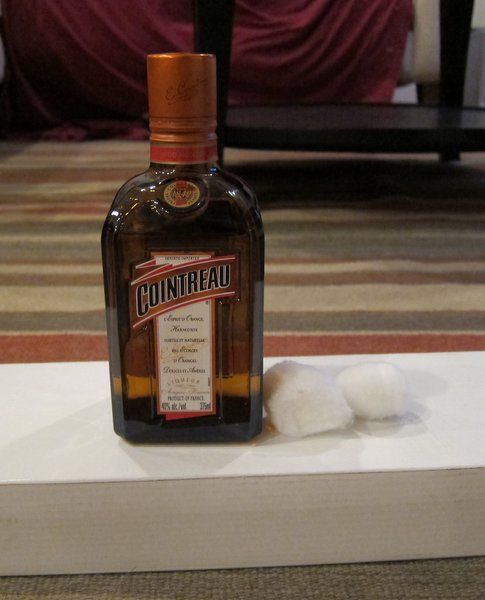
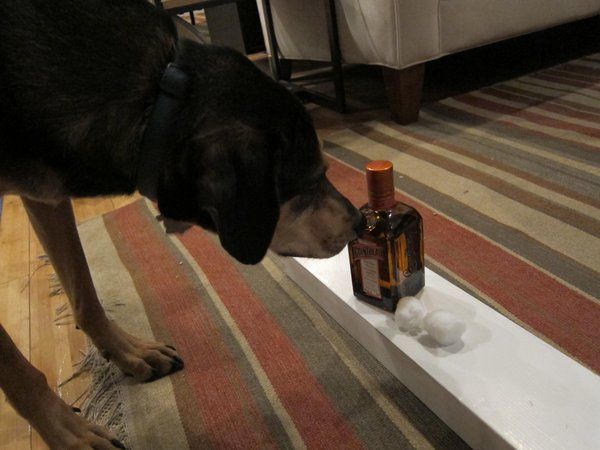
I got it in my head that it would be pretty funny if I could teach Dog Mob to identify different liquors by scent, so for this trick, I dabbed a little bit of the relevant liquors onto a cottonball and then dabbed the cottonball onto the paper labels, figuring that would hold the scent better than the glass bottle. Really, dogs' noses are good enough that I'm sure they'd be able to find it on the bottle too, but I did it this way anyhow.


After waiting a couple of minutes for the alcohol to evaporate (otherwise it acted as a mild aversive, as I discovered when I asked Pongu to pick up the tequila bottle too soon after dabbing it), I invited Dog Mob to sniff the bottles. Any contact to the scented object got a click and treat.


Step 2: Paw Touch/Directed Retrieve - Single Object

Next, I put the scented article on a platform by itself and asked the dog to either retrieve the object (for the lime and tequila bottle) or mark it with a paw touch if it was too big to retrieve (Cointreau bottle, sugar box, salt container). Both dogs already knew these actions, so I didn't have to shape the movements from scratch; it was just a matter of getting them to target the intended objects. So we practiced it a few times, and each correct gesture earned a click and a treat. Once the dog was doing the correct motion with no hesitation, we moved on.

Step 3: Selecting Correct Object

The third step was for the dog to be able to select the correct object from a lineup of dummy objects. For Crookytail, who was new to this sort of thing, I started with just one dummy and one correct object, then slowly worked up to two dummies and one correct object. Pongu is more experienced with object discrimination exercises, so I started him on multiple dummies right away.


At this stage, picking the wrong object gets a NRM and an invitation to re-try, while every correct answer is given a click and treat.

For the salt/sugar "what goes on the rim?" question, I wanted each dog to select a different answer, so I put the other dog's answer in the lineup too and treated it as a dummy (i.e., Crookytail was asked to choose between the sugar box and the salt container, and rewarded only for choosing the sugar box; vice versa for Pongu).

Step 4: Putting It All Together

From there, all that was left was putting the whole thing together.

The final version of the margarita trick is done exclusively with off-camera hand gestures. Other than each dog being released from Stay by name in the last segment, there are no verbal cues, because my attempts to work verbals into the dialogue resulted in both dogs anticipating the cues and doing the exercises as soon as I started talking, instead of waiting until they appeared to be responding to my questions. So instead of giving them verbal cues, I used a very simple system of "stop/move" hand gestures for both dogs. The only cue I'm giving tells them when to move and when to stop; everything else is determined by the context and props.

I also realized that for the last segment, I had to release Crookytail first, because he is so used to holding a Stay while Pongu works that he wouldn't budge once Pongu moved. Unless I specifically asked him to do something, and asked him first, Crooky thought that, as usual, his job was just to keep out of the way. So, again, we adjusted the sequencing a little to achieve the desired effect. (I probably could have gotten it to go the other way eventually, but for a jokey thing like this, why?)

And that's how we did the margarita trick.

Sunday, March 31, 2013

Happy Easter Egg Hunt!

This year, as a combination trick/game, I taught Pongu to hunt Easter eggs.


It's a lot of fun. I can hide the eggs in fairly difficult ways now (under a cloth, raised up on platforms, cardboard boxes, or chair seats, stuffed inside socks, tucked under noise-making obstacles like squeaky snake, etc.) and he enjoys the challenge of sniffing out the eggs and plunking them into the basket. I imagine we'll be playing a lot of this game on rainy days long after Easter's gone, and I'll be looking for even tricksier ways to hide those eggs.

As part of the project (since, as far as I know, this is a trick of my own invention -- I wouldn't be surprised if someone else did it first, but I didn't know about it), I recorded each step of how we learned this game, in case anyone else wanted to do this with their dogs and wasn't sure how to teach it. It really is a lot of fun, and not that hard to train. For Pongu it took about three weeks, but (a) he was starting from zero with regard to retrieving objects; and (b) we were/are training a lot of other new things more intensively at the same time that we were practicing this trick. So if your dog is already familiar with the retrieve concept and/or you don't have anything else on your plate, you're already ahead.

Step 1: Beginning Directed Drop

We didn't start out with Easter eggs. We started with a soft, squishy ball (pretty sure this is one that Dog Mob ripped out of a Kong Wubba and then deflated). Hard plastic Easter eggs are slippery and difficult for a dog to manage without dropping or breaking them open. In the beginning, I wanted Pongu to get comfortable with the novel concept of picking up an object and dropping it into a designated receptacle instead of bringing it to me. To avoid distracting him with other considerations, we used the easiest possible object for him to manage -- this poor, hard-used, deformed squishy ball.


The "basket" is also designed to be as easy as possible. I used the broadest, shallowest, most easily accessible container we had. I covered it with a cloth partly to muffle sound (Pongu is acutely sound sensitive and I was worried the "thunk" of a ball falling into the container would be aversive) and partly so that I could later use the cloth as a visual marker to transfer from this container to an Easter basket. I figured that if he was familiar with targeting the cloth, he might have an easier time carrying the behavior over to a slightly different context.

At this point, Pongu earns a click for carrying the ball in the direction of the basket and dropping it anywhere in its vicinity (defined by the mat), and a jackpot if he actually gets the ball inside the container.

Step 2: Introducing Easter Eggs and Multiple Drops


Once Pongu was reasonably adept with manipulating the ball, and seemed to understand the goal behavior, I switched from the squishy ball to the plastic Easter eggs he'd be using in the final version. This was actually a sub-step in itself, because initially he was not into those eggs.


But he eventually got more comfortable with them (at this point he was still breaking and dropping them a lot, but he'd carry them) and we started practicing with the eggs. I also raised the criteria on the receptacle drop: he had to collect multiple eggs before getting a treat, and I switched the container to a deeper and smaller-mouthed one that was closer to the dimensions of the Easter basket we were going to use.

At this step we weren't really adding any new behaviors, just refining and raising difficulty from the first step.

Step 3: Basket and Basic Find

The next stage was to replace the open-topped container with an Easter basket. Because the basket has a handle across the top, it's much more difficult for the dog to drop an egg inside -- he can't just stick his head directly over the basket and drop it straight in, but has to calculate an angled approach.


I also introduced a very simple "find" component to the game at this stage. Instead of having the eggs lying totally out in the open, they are (just barely) concealed. One is partly under a sock, the other is raised up about ten inches on a platform. They aren't hidden very well, but the concept's introduced: you're gonna have to start looking for these eggs soon, buddy.

Step 4: Introducing Basket Carry

At the end of this trick, I wanted Pongu to bring me the basket full of eggs, so we had to introduce that behavior as well. He got a click and treat first for doing a nose touch to the basket handle, then for mouthing it, and finally for picking it up and moving it even the tiniest fraction of an inch.


I wrapped a white cloth around the basket handle because we were using cheapie $1.99 Chinese-made baskets from the corner drugstore, and god only knows what kinds of toxic dyes they use for those things. I don't want my dog dying of mouth cancer, so I wrapped up the handle -- which had the added benefit of giving him an easier grip on the thing.

Nonetheless, the basket was extremely unwieldy, partly because of its weight distribution and partly because this particular basket has such a long handle that Pongu just couldn't get it high enough off the ground to avoid bumping the bottom. After a couple of sessions I bought a new, smaller basket. It made the egg drop more difficult, but he could carry the thing a little more easily.

Step 5: Putting It All Together

After a couple of weeks, Pongu had all the basic pieces in place: finding the eggs, carrying them to the basket, going back for more eggs, and bringing me the basket at the end of his collection. We spent a few days practicing so that he could build up fluency in each component behavior and become more familiar with the pattern. (Part of the end goal was to have a game that sounded conversational and didn't rely on formal cues -- or, better yet, worked as a single behavior chain on one cue -- so I didn't want to be constantly barking out "Find!" and "Basket!" as he worked.)


At this stage, all the eggs are moderately hidden, we're raising the total number of eggs, and I'm asking him to bring me the basket at the end. It's not 100% to final form, but by this point it was just a matter of practice.

And that's how I taught my dog to hunt Easter eggs.

Friday, March 29, 2013

All Sports Are Good Sports, Right?

"Do More With Your Dog!" is the name of Kyra Sundance's sanctioning organization for the sport of Trick Dog, but it's also a pretty good suggestion for anyone living with a companion dog. The benefits of Trick Dog -- that it "establishes a pattern of learning, teaches skills and focus, is a positive method of training, and promotes a bond between canine and human" -- exist for any good sport taught by positive methods. Plus, most of them have the additional benefit of getting both dog and human up on their feet and exercising for greater strength and flexibility.

It's no secret that I'm a huge proponent of dog sports. Most of our pet dogs don't get enough to do, physically or mentally. It saddens me when I see a dog who's otherwise beautifully cared for -- neatly groomed, well fed, walked regularly on humane equipment, and given a warm, comfortable bed -- but whose owner has neglected the mental aspects of dog ownership because he or she just doesn't have any inkling that it matters. People who would never dream of skipping their dog's heartworm pills or giving him poor-quality food very often don't engage in advanced training because they don't recognize its benefits.

Or, if they do recognize those benefits, they might still write sports off as impossible for their dogs, who are just "regular pet dogs." I can't count the number of times I've been practicing with Pongu in a public area and have had people say "oh, he must be a special dog, my dog would never do that" -- as if Pongu the Insane, a gimpy-legged shelter mutt who was and remains a lifelong behavioral rehab case, was originally "special" in any way that didn't basically mean "godawful crazy."

For the good of our dogs, collectively, I think it's really important that dog sports be emphasized as (a) beneficial; and (b) approachable. The message that "only special dogs can do this, and yours isn't good enough" is toxic.

Luckily, we live in an area where a number of excellent trainers are making efforts to spread the gospel of sports for fun. The crew over at Opportunity Barks, a wonderful school, offers classes in trick training, agility for fun, and occasionally other sports like treibball and Rally. Local trainer Pat Bentz offers regular nosework sessions. And if those students get really hooked, there's a strong network of specialized training clubs ready to take them to the next level -- the competition ring. But even if they don't go that far, both people and dogs benefit by trying the sports.

To that end, the message is always positive, friendly, and welcoming. Newcomers are repeatedly told that the training is "just for fun" -- and it is! Even in the competition ring, these sports should be about fun, always: about building bonds with our dogs and stretching their abilities and marveling at all they're capable of doing so joyously. The emphasis is on trying (and enjoying!) everything until you find the sport that works best for you and your dog.

Which is why I'm so disheartened when I see competitors in one sport badmouthing the others. I feel strongly that as long as the participants enjoy what they're doing and are being trained with kindness and positivity (both dogs and people!), there are no bad sports. None. Agility, freestyle, flyball, treibball, trick dog, Rally -- I think they're all awesome, and while I surely have my favorites, I'm happy to encourage my friends to try every one. That perfect fit's going to be different for each team, after all.

And heaping negativity on Sport A as the "dumbed down" domain of "poorly trained dogs" whose handlers couldn't hack it in Sport B does not make the latter look more attractive by comparison. To the contrary: it sends the message that Sport B is the realm of naysaying sourpusses who can't stand that A has become more popular (in significant part, I should note, because it's genuinely welcoming of mixed breed dogs, disabled dogs, newcomers to the sport, and handlers who want to have fun and talk to their dogs and be able to reward in the ring).

Particularly when we're talking about Rally and traditional obedience, it is genuinely confounding that there should be this persistent bitterness. Rally was originally conceived as a bridge from casual pet training to the competition obedience ring. It hasn't really worked out that way, though, in large part because obedience people seem to be taking every opportunity to push Rally people away. I often hear people tell me that they were drawn to Rally because of its friendly, welcoming, and supportive environment. Guess how many times I've heard that said about AKC obedience? Exactly: zero. (CDSP, a new obedience venue, does have a reputation for being more welcoming, but as I have not yet tried that firsthand I can't vouch for it myself.)

I like competition obedience. I think it's really neat; I admire the precision and the discipline that those dogs display. I am sorely tempted to give it a shot with Pongu when we're ready (which ain't just yet).

But man, it's hard to embrace a sport where people tell you so many times that you and your dog are not welcome, not wanted, not good enough. And if I feel that way, how must someone who's totally new to ring sports feel? Someone who hasn't yet experienced the happiness of a hard-earned high score or seen the joy in a working dog's eyes? It's a big, big turn-off, especially for someone who may still be wondering if their dog is "special" enough to do any sports at all.

And that just hurts everybody.

Tuesday, March 26, 2013

TDCH Pongu the Insane, RL2 (AOE)

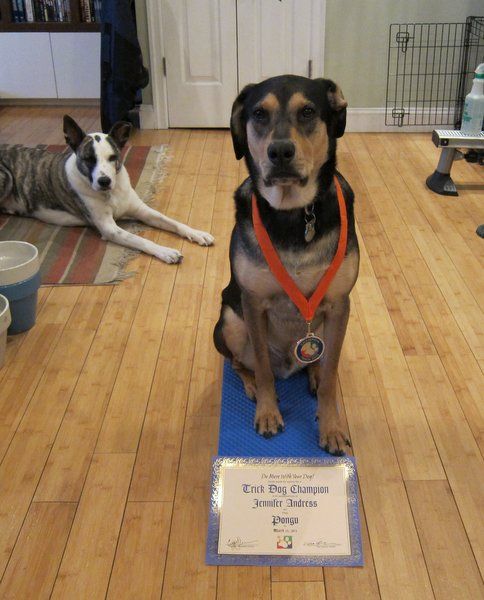
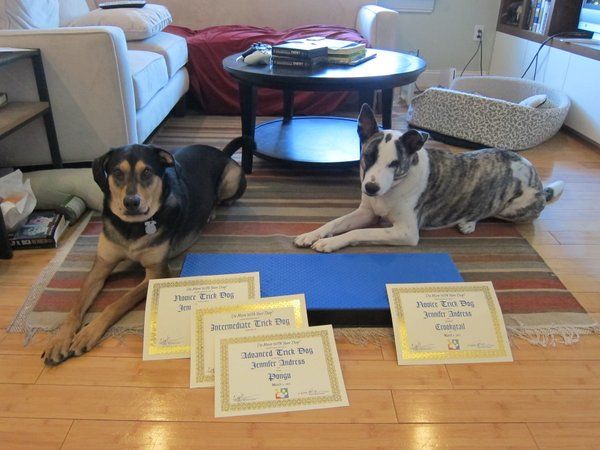
Yesterday Pongu received his Trick Dog title certificate and medal, signifying his first championship in any dog sport.


As I mentioned in my earlier post on the subject, Trick Dog is one of the easier sports to gain titles in. Unlike most dog sports, you don't have to compete in live events, worry about point scores, or gain "legs" under different judges. You can do all the work at home, the criteria are pretty relaxed (it's all pass/fail with effectively unlimited retries), the costs are relatively modest, and just about anybody can serve as a witness. It's a great way to get your feet wet if you like the idea of putting titles on your dog and are interested in dabbling in dog sports, but don't have the time, money, or gung-ho craziness to jump into the more formal venues.

In Pongu's case, we were coming at it from a slightly different angle -- Pongu's already had a fair amount of training in Rally and canine freestyle, along with other odds and ends as various things caught my interest along the way -- so it only took nine days to earn his championship once we decided to do Trick Dog at all. He already had most of the necessary behaviors from doing other sports.

There were still some new challenges for us, though. To qualify for TDCH (Trick Dog Champion), your dog has to demonstrate proficiency in 9 foundational areas of trick work: (1) hind-end coordination, (2) holding/carrying objects, (3) paw touch to directed target, (4) nose touch to directed target, (5) scentwork, (6) distance work, (7) silent signals (working on movement/hand gestures alone, without verbal cues); (8) behavior chains (one cue gets the dog to do multiple separate behaviors); and (9) "expert tricks" (sort of a catch-all provision for your dog to demonstrate tricks that are more difficult to train).

Pongu had no formal retrieve training, as we hadn't gotten to that level in Rally yet and he's not a natural retriever. He also had no scentwork training, since that comes pretty late in the game for competition obedience and we haven't even started that yet. So some of the exercise categories in Trick Dog -- the object hold/carry and scentwork -- were totally foreign, and those required us both to learn new things.

Even so, in nine days, we were good enough to pass muster (again, keeping in mind that the criteria is considerably more relaxed than it might be for some other sports!).


And that concludes Pongu's pursuit of Trick Dog titles, although certainly not his tricks training!

Crookytail, of course, has a lot longer to go. Pongu might have his TDCH, but the Crookydog only has a novice title. He's (barely) halfway to Intermediate now, but it will probably take him years to get all the way to the end, if he ever does.


And he might not, since I'll be dragging Crookytail back into the Rally ring next month, and training Crooky in two disciplines at once is too much for my patience. I don't expect him to do particularly well, but I do want him to do something. His unreliability with strange dogs shows no signs of dissipating, but he did fine in the ringside waiting area at Pongu's last trial, so I guess it's back to the Rally circuit for the poor reluctant Crookydog.

At least until I figure out what else to do with him.

Wednesday, January 9, 2013

Choosing an Approach to Training

The other day, someone asked a question that stuck with me: out of all the different trainers out there in the world, and all the different approaches, how do you choose what works for you?

It's no secret that I'm a staunch adherent of purely positive training. Why and how that happened, though, is not something I've given much conscious thought to in a while.

I'm a perpetual student. There is so much out there that I don't know, and so much that I want to be able to do with my dogs, that I am forever on the hunt for new ideas and resources. But how to decide which ones are credible?

I. Does It Work For the Dogs?

This is the most basic and important test. Do the dogs seem happy, attentive, and successful? Or are they stressed, shut down, and/or hopelessly confused? Putting my own ego and preconceptions aside, as best I can, I look to see whether the trainer's methods are working -- really working -- for the dogs. Because if the dog is not learning, then the training has failed.

Suzanne Clothier has described a happy, understanding dog as having a "light in its eyes," and I think that's a wonderful way of putting it. A dog who understands what is being asked of it, and who is joyous about doing that thing, has a brightness of spirit that I don't see in dogs who have been bullied into performing. The trainers I want to emulate are the ones whose dogs clearly love doing their work. I see that joy in Emily Latham (kikopup)'s dogs; I see it in Suzanne Clothier's, and Denise Fenzi's, and Julie Flanery's. I see it in the demo dogs that my instructors at Y2K9s show. I want my dogs to share that same happiness, so I emulate those trainers'  methods -- which happen, not coincidentally, to be purely positive methods. At the same time, I shy away from punitive methods, because I have seen the thousand-yard zombie stare in the eyes of a dog trained on a shock collar, and I never ever want my dogs to look like that.

As importantly, because we're training for competition, I want dogs who are precise and focused and reliable. A happy but undisciplined dog who can't execute a straight Front, or who runs amok on the course, is no good to me. I'm competitive: I want to win. I want ribbons and titles and championships. I want a canine partner who works with me seamlessly, with an almost telepathic connection on the course.

And again, it's no contest: purely positive methods carry the day. A dog who loves his work, and who above all loves working with his special person, will be laser focused on that work. A dog who's been clicker shaped with precision will have straight Fronts and sharp Heeling and (critically for freestyle) an enormous repertoire of flashy moves that simply cannot be obtained through compulsion. And because clicker training rewards the dog for paying extremely close attention to his handler, it develops that communicative bond to an incredible level.

So purely positive training passes the first test. It works for my dogs. It works for Dog Mob, it works for client dogs, and it's worked for all the Temporary Dogs without exception.

In the very beginning, and only with Pongu, I did briefly attempt force-based training in the form of leash corrections. That definitely did not work. I cringe every time I remember it: this four-month-old fearful puppy getting leash pops from me, the only person in the world he trusted, because he was pulling on lead in a desperate attempt to escape from a big scary world that terrified him. It didn't work, of course. It only damaged his trust in me. I am grateful that I saw the message in his eyes and stopped before any worse damage was done.

II. Does It Work For Me?

The second question is whether I can effectively use the methods being espoused. It's not kikopup or Pat Miller who's going to be training my dog. It's me. No matter how good they are at training their dogs (and they are very good!), if I can't understand what they're telling me to do, or can't carry out the programs clearly and consistently, then again, the training will fail.

Clicker work does require developing some new skills. Timing and observational skills are key to spotting desired behaviors (particularly in the early stages of shaping a new behavior, when the incremental steps will often be quite subtle). There are mechanical skills required in juggling the clicker, treats, target object(s), and/or leash, and often this has to be done while on the move. Eventually, treats have to be faded out if the behavior is to become truly reliable.

At this point, I'm comfortable using a clicker and treats. I know how to manipulate reinforcement rates and read the dog's body language and adjust my approach on the fly to accommodate the specific animal with whom I'm working. But if I did not know those things, and did not have the patience to learn them or apply them properly, then positive training might not work for me.

I've found that this is often the case with people who dismiss operant conditioning: they never learned how to apply the techniques properly and concluded that it was a fault of the training method, not of their implementation.

The flipside of that, of course, is that force-based training will never work for me because I don't know how to apply those techniques effectively. Of course I understand how to apply positive punishment in theory, but I've never done it in practice and I never will, because I know that I can get better results using more humane methods. I have no interest in learning how to ear-pinch a dog into retrieving or training a recall with a shock collar. I don't need to resort to those things to establish a reliable behavior. But for me to say those methods categorically "don't work" would be untrue, because they do work for some dogs and some trainers who are willing to inflict pain and fear, and accept a certain amount of collateral damage, in the name of instilling obedience. I'm not willing to do that, so those techniques don't work for me.

(This is, incidentally, why "balanced" or "crossover" trainers who tout their willingness to "use all tools" drive me batty. At first glance it might seem like a reasonable thing -- who wants to reject potentially useful tools out of hand? -- but then one has to reflect on what tools are being rejected, and why. We generally don't use switches to whip unruly children anymore, and we don't use public stocks to humiliate nagging spouses, and while there are no doubt people who think the world would be a better place if we still employed both of those barbaric "useful tools," I personally would not like to have them as parents or neighbors. Nor, I imagine, do their dogs enjoy having them as owners.)

III. Is It Scientifically Sound? Does It Make Sense?

There is a lot of misinformation circulating in the dog-training world. Metric craptons of it.

One quick filter to get rid of a lot of the garbage is to ask whether the explanations being offered for a particular technique stand up to basic scrutiny. Much of it, especially when it comes to "being the alpha" and dominance mythologies in training, is pseudoscientific hogwash and can safely be discarded.

Much more fails a basic common sense test, such as explanations of how prong collars work by mimicking the mother dog's teeth on her youngster's throat (uh, the pressure on a prong collar is at the front of the throat -- how many mother animals have you seen carrying their offspring around by their windpipes?), or admonitions against soothing fearful dogs because "it'll encourage the behavior" (as Debbie Jacobs is fond of asking, would a loved one patting your back make you eager to rush out and embrace something that scared you witless? Or might it just make you feel marginally safer?).

Sometimes the lack of scientific rigor is harmless. Canine homeopathy is getting to be a thing these days, and it is no more proven than homeopathic remedies are in humans, but as long as it doesn't substitute for appropriate veterinary care, I don't see how it hurts anybody to try. "Can't hurt/might help" is fine. But if there is potential to cause harm, then I don't think there's any excuse for uncritically accepting misinformation. And in general, I have found that positive trainers and writers tend to have more scientifically accurate explanations for their methods.

IV. Is the Source Credible?

I'm more inclined to accept someone as an authority if I know she is respected as such by other knowledgable persons in her field. Publication credits in independent journals or magazines carry weight, as do books published through external houses. The CPDT qualification matters to me -- if nothing else, it shows this person is familiar with the fundamentals of scientifically based training. Strong writing and clearly organized thoughts presented in a professional manner make a good impression too.

Also important is whether this person can do something with their dogs that I want to emulate. Have their dogs won titles that I aspire to get on my own dogs? Can their dogs do cool tricks that I want mine to learn? Have they successfully rehabilitated (not just shut down) difficult behavioral cases? Whatever the goal is, I want to learn from someone who has done it, and who has preferably done it repeatedly in a forum subject to knowledgeable, independent scrutiny.

All the most successful trainers in all the fields of endeavor that interest me espouse positive training methods. I take that as pretty good evidence that this is, in fact, the best way to get those things done.

V. What Are the Consequences of Getting It Wrong?

I will make mistakes. I make mistakes all the time. I drop treats, I mistime clicks, I reward in the wrong position and pull my dogs out of line. Often I misread my dogs' communications or fail to notice things that are distracting them and incorrectly assume they just don't want to pay attention. My handling cues are frequently sloppy and I miss opportunities to reward my dogs for correct behaviors and, all in all, I blunder so often that some days it's a wonder they know how to Sit.

So it is important to me that whatever training techniques I use be forgiving of those mistakes, because I'm going to make them and I'm going to make a lot of them. It's safe to assume that I will blunder every single new technique at least a dozen times while I'm learning how to do it.

If I make a mistake while clicker training, it's not a disaster. Worst case, I confuse my dog for a minute and have to spend another couple of repetitions clarifying that what I wanted was a backwards scoot, not a pop-up into Bow. Or maybe I drop a treat on the Rally course and we get knocked 3 points. It might cost us a placement ribbon (and it has!), but it's really not a big deal.

But if I make a mistake with a choke chain or a shock collar, I could do some real damage to my dog's psyche (and, less likely but possible, his body). I could inadvertently cause him to hate training, or fear approaching strangers, or lose his trust in me. These aren't hypotheticals; I have seen dogs who suffered these outcomes (and, as noted earlier, I almost did it to Pongu). To me, the risk is just not worth it. I don't want that to happen intentionally; I surely don't want it to happen by accident.


So that is pretty much how I landed where I landed, and how I evaluate new sources of information that I stumble across. I want happy dogs who are good at doing what they do, and this seemed like the best way of getting there. Now that I am there (although still with many greater heights to scale!), I look back and am satisfied with the road that I've chosen.
Tuesday, December 4, 2012

Motivation

Our dogs don't always want to do what we want them to do.

It doesn't mean they're being willful or stupid or (shudder) "dominant." It (sometimes -- more on this later) means that whatever you want them to do is not intrinsically fun for them, and whatever you're offering in exchange for the not-intrinsically-fun activity is just not good enough to be worth it. Put simply, they're not sufficiently motivated to play along.

I made this clip while practicing cavaletti with Dog Mob the other day. It's not a particularly good cavaletti clip, but it is a good illustration of a decidedly unmotivated dog.

Crookytail does not like practicing cavaletti. He doesn't especially care for most formal sports exercises, in fact. Like a lot of dogs, he just doesn't see the point. Dog sports involve a lot of really arbitrary and inefficient activities; it's not for nothing that people often say titles demonstrate that your dog loves you enough to do a bunch of really stupid stuff for your sake.

Crookytail believes, quite reasonably, that if the goal is for him to go to the mat, it is faster and more sensible to go around the cavaletti poles than high-step over them. He is a forgiving dog, and I think he feels uncomfortable expressing this too forcefully, but it's pretty clear he thinks I'm nuts for insisting that he take the annoying inefficient route of going over the poles instead of around them.

So, by the time I made this clip, he had just tuned out. The exercise appeared pointless to him and he didn't have enough motivation to do it, so he wasn't about to go through the hassle. (Pongu, on the other hand, is more willing to humor me --  but Pongu has been working with me for longer, so for him, the work itself and the reward of interacting with me is sufficient motivation to run the poles.)


Whenever a dog refuses to do an exercise, I find it helpful to rule out a few possible reasons for the refusal.

(1) Confusion -- does the dog understand the exercise? Perhaps my request is unclear, and the dog just isn't sure what he's supposed to do with all those poles.

In this case I know there's no confusion because Crookytail has been working cavaletti for weeks and knows what the goal of the exercise is. But often this is the first stumbling block, and indicates that I need to go back and break the exercise down into smaller, simpler pieces -- perhaps just one pole on the ground in front of the mat.

(2) Ability -- is the dog capable of the exercise? Perhaps I'm asking for more than the dog is physically able to give. Some dogs will actually strain to the point of injuring themselves in an effort to comply with their humans' requests, so it's vital to keep a close watch on our dogs for signs of injury or illness and never ask for more than they can do.

Here, I know that the height and spacing of the poles makes the exercise difficult but not impossible. The first pole is 8" high, the second one is 1/2" high and deliberately crooked, and the last one is 4" high. The poles are placed at intervals that discourage jumping (which would probably be more fun) and encourage careful high-stepping (much less fun). There's very little physical strain involved here, but the pole setup does require a fair amount of concentration to navigate, and that can be tedious for the dog.

(3) Stress and Distraction -- is the environment one that the dog is able to work within, or is there too much going on for the dog to focus? If the dog is too stressed or distracted, it's not a good teaching environment. It may be a good proofing environment, but if the dog isn't at that level yet or is being asked to learn a novel  behavior, practicing in a high-distraction environment is just setting your partner up for failure.

In this clip, however, we're practicing in our boring old living room where we always practice. Nothing else is competing for his attention, and it's not a new behavior anyway; Crooky is thoroughly familiar with these poles. Stress and distraction are not in play.

So after considering and ruling out those factors, it becomes clear that this is purely a question of motivation. Crookytail is just not interested in playing the game: it's boring to him, and the payoff for sludging through that boredom is not good enough to get him moving.

Fair enough. I have to do a lot of things at my job that I think are boring, and I probably wouldn't do them without a paycheck. It doesn't mean I don't love my boss or coworkers (I do; they're awesome) or that I don't find the work generally rewarding (I do; it's important!)... but I'm honestly not that stoked about filling out proofs of service or formatting cover pages, and the only reason I bother is because I'm getting paid.

Same deal for Crooky. Therefore, as a trainer, there are two things I can do to help my dog succeed: (1) break the exercise down into smaller pieces, so he doesn't have to endure quite as much boredom (make it one or two poles instead of three, and make them straighter and lower instead of presenting him with such a tanglefoot maze); and (2) improve the payoff.

Instead of using the same bland soft treats that he's been getting all day, I might switch to higher-octane stuff: tiny bits of leftover bacon or his favorite cheese. I could give him more effusive praise and neck scratches instead of a murmured "good." If Crooky were more into toys than food, I might give him a ball toss or quick game of Tag or Tug after every run. I could even ask him to do one of his favorite tricks, like Spin, which not only acts as a motivator for the cavaletti poles, but reinforces a behavior he already knows and makes that one more enjoyable too. The more motivators you have, the better and more varied your rewards can be. Getting the same thing every time quickly becomes boring and predictable; most dogs prefer a little surprise now and then.

The subject of building motivation (or "drive," as it's sometimes called) is a much bigger one than this blog post can cover. Entire books -- and very good ones! -- have been written on that topic. But it's important to be able to recognize, and respect, when that's the issue you're facing.

Crookytail's lack of motivation in this clip is not an indication that he's untrainable or doesn't love me or is in any way a Bad Dog. It's just his way of telling me that he is not into this particular game right now, and I'd better make it more fun if I want him to keep playing. And that's fine. I can respect that -- and, just as importantly, I can use it to find a reward that does work for him, and to re-configure the exercise in a way that's more enjoyable for him.

Thursday, April 5, 2012

Winding Down the Burnout Babies

The Burnout Babies are nearing the end of their time here.

Tomorrow they'll head out for another adoption event, this time at PetSmart. Hopefully they'll find their forever families... but even if they don't, they'll be packing up their tiny suitcases and heading elsewhere. I committed to pulling two other puppies before fostering the Burnout Babies; Razz and Cerise came to stay with us as short-termers only because I had a two-week window between Jackie and these guys, and figured that two weeks in foster care was better than nothing. But now the two weeks are up, and the new pups are coming, and that means the Burnout Babies have got to move on, just as they've finally started to settle in.


I spent a lot of time designing new distraction games for these guys. As they recover from mange, they're getting more energetic, which means they need a constant supply of new things to investigate/chew on/destroy to keep themselves occupied. All their meals come stuffed into one toy or another: kibble goes into a Kong wobble pin for dispensing or is hidden in paper balls to be torn up, dog stew is served in frozen "popsicle" blocks, and peanut butter comes in empty paper towel tubes so the puppies can shred the cardboard to earn their prize.


They also get the occasional half-cooked chicken foot, which is small enough to fit into puppy mouths and lasts them a good 15-20 minutes as a chew toy. The Burnout Babies love chicken feet. Given half a chance, Razz will steal Cerise's and hoard both of them in her secret ninja hideout, chewing chicken toes contentedly while her sister cries in the puppy pen.

Training-wise, they have conquered Sit.

Here's Razz doing indoor drills (Sit --> move --> Sit --> move --> Sit) to increase response speed and reinforce the verbal cue. The quicker she follows me and Sits, the quicker she can do it again and earn another treat. Rapid-fire repetitions are one way of increasing speed and reliability in a fairly short time.


She anticipates me once at 0:20, but at this stage that's a pretty good problem to have. Sit is becoming the Burnout Babies' default behavior; they are learning to offer it whenever they want something and don't know what else to do. They're showing signs of (very slightly) improved self-control, and this definitely beats the "jump up and down and yowl at the top of your lungs" behavior they offered before. Not that they've quit yowling, alas.

Outdoor drills this morning:


This is the first time I put the Burnout Babies together and asked them both to Sit. In almost all the previous clips, they are separated: I work with one puppy in the kitchen while the other waits (and usually wails) in the puppy pen. Only at this relatively late stage, when they're being proofed to a bunch of other distractions including sticks, leaves, winds, and car alarms, is it reasonable for me to ask each puppy to focus while the other is in the picture -- and even then, about half the time they got distracted playing with one another instead of listening to me.

When that happened, I would gently separate them again and ask them to focus briefly. One successful repetition and they were clicked, treated, and allowed to play -- so that playing with each other became part of the reward for a successful response. After a few repetitions, their focus improved greatly, but I still wouldn't expect them to get it right the first time at this stage.

I post all these clips of the Burnout Babies practicing Sit not because it's so interesting to watch them put their butts on the ground over and over again (although I suppose it might be of interest to know their current state of training if you're thinking of adopting one of these guys), but to show the progression of teaching and proofing a relatively simple behavior. As basic as Sit is, it took over a week of work before these puppies could reasonably be considered to "know" it... and they still need a good bit of proofing before they'll be reliable in new environments.