Showing posts with label competition obedience. Show all posts

Wednesday, October 29, 2014

WCRL Trial 10/25, TU Post on OTCh-ery

This past Saturday, Pongu had his one and only Rally trial for October.

It was mostly not spectacular. We hadn't been to a trial in over a month, and we've been working almost exclusively on agility stuff rather than Rally exercises this fall, so we were both a little rusty. Plus I was getting over a cold, and Pongu was a little squeaky and worried (not nearly the worst he's ever been, but not the best, either), so we weren't on our A-game going in.

The Oakes trials are some of the biggest ones all year and draw a tough crowd of competitors, and this year's fall trial was no exception. Huge class entries (with lots of new teams, always good to see!), some of the top teams around, very tough competition (but in a good, fun way -- it's always awesome to see your friends do well, and there's never any nastiness in WCRL!).

Accordingly Pongu did not place in the ribbons once during his first five runs. He did poorly a couple of times and kinda-sorta okay-ish a couple of times, but "okay" doesn't get you very far in that crowd. Which is fine; I thought the judging was very fair and we got the scores that we deserved.

And then somehow Pongu calmed down and got his head in the game and just destroyed the last Level 3 run, which was a fairly challenging course (including the Stand With Distraction bonus exercise, historically his worst and weakest one). Perfect score of 210, first place on time (against Edith!! Edith the Ultra-Awesome Border Collie!! That is a rare and precious victory to savor), one of the best runs Pongu's ever done. I sorely wish I'd gotten that one on tape.

Of course if someone had been taping it, he would have totally bombed out, but still.


So that was it for us in WCRL this month. We have a couple of trials in November, in which Pongu might or might not finish his MX2, and a couple in December, and then we're probably finished with Rally until Pongu can start competing in Veterans and/or we fail out of agility so spectacularly that I go crying back to our old familiar stomping grounds.

Also I had another post go up on Team Unruly recently on The Problem of the Force-Free OTCh, which is a piece that I am proud of because our Revered Instructors said they liked it, and yay! sparkles and rainbows!, it is pretty spiffy when people that you admire say that you got something right.

Monday, June 30, 2014

Match... Point?

On Saturday and Sunday, Pongu and I went out to two different obedience matches.

Originally, I had thought we were only entered in one, and I had planned to scratch from that one, because Pongu's nowhere near being ready to do a match in obedience, not even in Beginner Novice. I didn't have a plan for what we'd do in the ring and I didn't have any expectation of even minimal success, so I figured there was no point in going.

But then!, our super awesome instructor talked me into it. Just go into the ring and play, she suggested; don't worry about doing obedience behaviors. (Well, her actual wording may have been something rather more along the lines of "I **FORBID** you to do any obedience behaviors"... and by "more along the lines" I might possibly mean "just exactly that," but hey, let's not nitpick here.)

So off we trundled to a new obedience club that we'd never previously visited, and into the ring we went.

Here's that, in all its four-and-a-half minutes of glory. I don't expect anyone to actually watch it, except maybe me in a few years' time.


I was really happy with this. Yes, Pongu's wobbly, and yes, he gets distracted, and yes, I should have stopped at the three-and-a-half minute mark when he starts fading during that short stretch of heeling. I made several mistakes during this match.

But my dog stayed with me, he mostly stayed engaged, he was willing to play (for a certain value of "play" -- a lot of that is stress jumping as much as it is legitimate engagement). For his first time going into a new venue with zero prep, and being asked to do something that's moderately strange for him (Pongu is not accustomed to just going into a ring and playing with me), that is a good performance for us right now.

So on Sunday we went out to K9Jym to do the same thing again. And this time, even though Pongu was only a little wobblier than he'd been on Saturday, and his engagement wasn't all that much worse, I felt really sad after we left the facility, whereas I'd been full of renewed optimism the day before.

Part of it was that this was a familiar venue to him, and in the past he's done okay there, so I was really expecting him to be a little better, rather than a little worse.

Part of it was that we warmed up outside a ring where a former NOI competitor was doing awesome Utility work with her blazing fast, accurate border collie, which is sort of like trying on swimsuits in the stall next to Kate Upton's. Not really a formula for improved self-esteem.

Whatever the cause, I left feeling pretty lousy, even though the tape doesn't look that bad to watch.


The rest of that day, I moped around obsessing about how we were never going to do competition obedience and what was even the point of training and why was I putting myself or my fearful dog through any of this, bla bla fourth verse same as the first, etc.

And then this morning I saw that the agility intro class I wanted to take in July wasn't filling -- in fact, as of right now, there are only two students enrolled, so if more people don't sign up then the class will likely be canceled -- and thought "welp, so much for switching to a totally new sport, I guess."

And then tonight Pongu and I had a good training session outside.

So I don't know what to think. Currently my plan is that I'm going to take the rest of the year and just play around and train these exercises and try to get Pongu really happy about doing them, and I'm not going to worry about trialing or doing matches or any of the other stuff.

It is strictly going to be about the journey, taking small steps each week, and I refuse to raise my eyes to the prospect of titling down the road.

Let's see how far we can get doing that.

Tuesday, June 3, 2014

An Epiphany to Everest

This morning I was reflecting on some things our obedience instructor had told us yesterday, and I had an epiphany: I think I finally realized why I've been feeling so down about Pongu's and my progress in obedience training.

We've been working on one of Silvia Trkman's tricks DVDs recently, and that is going beautifully even though the behaviors are way crazier than anything asked in the obedience ring. (For context, our current projects are parastanding and the backwards figure 8.) We're nowhere near finished with any of the tricks, but Pongu's progressing quickly and I'm happy with our work and it's just been really fun.


(2on/2off: baby steps! But fun baby steps!)

I haven't felt "fun" about our obedience training in a while. It's not about ring nerves or wanting to get a 200-point perfect picture (it will be about those things later, because I can't help myself, but that's not where we are today); it's just about training and proofing the exercises to a basic level of proficiency in the ring.

And the reason I haven't felt "fun" about that is, I finally realized, because the task is so monumental. When it comes to trick shaping, I know what progress looks like, I know how close we are to the final picture, and I am correspondingly confident that we can get there.

When it comes to obedience, I have no freaking clue. First, I've never done it before. Second, it's a huge topic. There are a lot of exercises, and every single one of them is way more complicated than it seemed when I was a clueless newb going "hur the dog just walks next to me, that is so easy, hurr de durr." On top of that, every piece in the chain has to be proofed to ring-readiness, which is another monumental task, particularly for ol' scaredybutt and me.

It's like I'm trying to climb Mt. Everest and I've gone 10 feet and there's still 10,000 feet ahead, every one of them harder and higher and steeper than the 10 feet I've already gone, and it's like "AAAAAGGGH WHAT AM I EVEN DOING SCREW IT."

In short, I've been trying to do everything at once and it's not a good strategy because it makes me feel like we're not getting anywhere. What I need to do is break things down a lot smaller. Not just for my dog, but (this is the epiphany!) for me.

When you're writing a novel, you don't focus on finishing the entire book. Lots of newbies make that mistake and they feel like they're not getting anywhere and so they give up. You can't do that. What you do is focus on each chapter. Set smaller, concrete benchmarks to measure your progress to the end.

So that's what I'm going to do. That is my new plan for working with Pongu. Every week we are going to set one little bitty benchmark and if we hit that goal, I am going to force my stupid brain to accept that as a success. I am going to find a way to measure and mark what we're doing. Not just recording it in a journal, because I've done that and it doesn't feel like progress to me, but setting target goals in advance and hitting them on the way.

If I can get Pongu to nose a correct scent article outside the house this week, WE WIN. He doesn't have to pick it up. He doesn't have to do the full retrieve chain. It isn't going to be on cue. If he offers the behavior of identifying the correct one in some way -- yeah, that's right, we are going all the way back to OB SB 1 on this -- WE WIN.

So there. That's my epiphany.We will start on that first thing tomorrow!

Wednesday, February 12, 2014

Ceilings and Dreams

What's the ceiling on your dreams?

For all of us, there is a ceiling somewhere. I will never win a Nobel Prize or become President. I'm never going to revolutionize quantum physics or write a song that endures through the ages. If these achievements were ever possible for me (and I doubt they were), they aren't anymore; my life has taken other directions, and those roads are now closed behind me.

I don't think about those dreams anymore. They just aren't part of my world. They certainly aren't among my goals. And so the fact that I will never achieve those things causes me no worry whatsoever, because failing to accomplish an aspiration you don't have is not a failure at all.

Failing to achieve something you do want, on the other hand, can carry a considerable sting. And if that failure comes in the context of a team sport, then... well, then things get very complicated very quickly. Particularly in dog sports.

Which is, of course, why I'm writing this post: because once again I'm recalibrating my aspirations for Pongu, and once again I'm wondering what it is reasonable to dream for this dog.

He is still fearful. He will always be fearful. I know this. My dog -- my crazy little nerdpuppy, my dog that I love more than anything in the world -- has some hard limits on his physical and psychological durability. He can't do what other dogs can, and I don't want to burden him with a freight of disappointments if he can't meet my aspirations.

And yet.

And yet he's come so far, and has achieved so much that I never thought would be possible.

Back in the beginning, when I was just struggling to find ways of helping my fearful puppy cope with the world, I thought Pongu would never set foot in the competition ring. I thought he'd never earn a Rally Q. I thought he'd never earn a Rally title. I thought he'd never do a Novice Stand For Exam, and I thought he'd never do AKC anything.


I was wrong about all those things. So badly wrong, in fact, that I fully anticipate we'll finish Pongu's ARCHMX, and beat the game in World Cynosport, before his fourth birthday. That's in about two months. And after those two months?

Well, we can do AKC Rally for a while. I'll enter trials whenever they're reasonably close and don't conflict with other activities, and I figure we'll get through Pongu's RE this year. Depending on how it goes and how much fun we have in that venue (and on whether I see value in proofing him in the noisier AKC environment), we may start on the RAE.

We can do CDSP obedience, too. Training the Open and Utility exercises will take a while -- probably the rest of this year -- but once we're ready, I don't see any reason Pongu can't succeed in that venue. It's as relaxed and welcoming as competition obedience gets, and since praise is permitted in the ring, I believe my dog can succeed there.

That leaves the great white whale: AKC obedience. The most difficult, the most strictly scored, the most notoriously unwelcoming in certain quarters. The venue where all your scores get posted in perpetuity for other people to Look Upon and Judge. Where at the high levels, you cannot win unless someone else loses. Where there is no praise, and no cookies, and not always that much by way of supportive sport culture for the people, either.

I think of throwing my little dog into that environment and I flinch. And yet. I wonder: is it reasonable to hope for that? Someday? Is it reasonable to dream? Or is that expecting a Nobel Prize out of a little dog who has already given all he's got?

With what I've seen of Pongu's progress in the last year and a half, and what I imagine might be possible with the help of FDSA's instructors, I'm finding myself tempted by those old hopes and wishes again. And I wonder if that's fair to my dog.

I'll have a clearer picture after we've done a few more runs in CDSP, I suspect. Until then... it's all just a dream. And a ceiling untested.

Friday, November 15, 2013

Fear and Failure

While writing that last post, I got to thinking about failure.

I know that I'm going to fail in the ring occasionally. It always sucks to lose, and it sucks exponentially more to lose like we did last weekend. But I know right at the outset that it's something we're going to have to accept, because the nature of trialing with a genetically fearful dog is that you will lose ALL THE TIME.

No matter how much you practice, how good your dog is at home, or how many fun matches and show-and-goes you do, you will fail. Your dog will get scared or stressed and melt down. There's nothing you can do about it but make fun of yourself, give your dog a cookie for trying (because trying counts! Trying counts for a lot!), and go home to practice some more and hopefully do better next time.

Keeping Pongu out of competition until he's "more comfortable" isn't a viable approach (although we've had a couple of instructors who recommended it) because I've learned that the only way this dog gets more comfortable is by being exposed to those environments again and again, and being asked to work in them again and again. He needs that history of success to build his confidence.

So we fail. A lot.

Our road to every achievement we've ever gotten in dog sports has been littered with a huge proportion of NQs and crappy scores in relation to our Qs and good scores. Again: we racked up 22 NQs in Level 3A alone before we got the 3 Qs needed for that title. We've gotten well over 50 total NQs this year. When I say we fail a lot, I mean A LOT.

That's okay (I can say now, after nursing an awful lot of pride bruises over the past 14 months). What matters is not the fact of failure, but how you handle it. Eventually, over the long haul, if you are patient and encouraging and willing to cheer your dog through enough failures, you succeed. Your dog will learn that nothing terrible happens when he freezes up or panics, and that great things happen when he overcomes his fear and works.

And that builds his confidence. He's more willing to keep trying, because he thinks that he can't lose -- he can only win.

For a fearful dog, in my opinion, that is a crucial lesson. It needs to be taught early and often: you will always try, because there is no reason to be afraid of failure.

I don't care (much) if Pongu NQs. I do care, very much, that he goes into the ring and tries. That's what I count as a win. And he knows it, so he's willing to go in there and work to the very best of his ability. Sometimes that gets us a good score and a nice placement, and other times it doesn't -- but because he keeps trying, and keeps being rewarded for trying, the former is true (and true under circumstances that would have been unimaginable a year ago) more often than the latter.

Anyway, the reason I was thinking about this yesterday was because I think one of the reasons I've gravitated so strongly toward force-free training methods is because I have a dog whose success depends on failing X number of times and being given constant encouragement to "fail upward" each time.

Sometimes I wonder what my perspective would be like if I didn't have this near-certainty of failure to look forward to (and back upon). I know that there's no point getting mad at Pongu for being overcome by terror, and I also know that's the only reason he ever screws up, so therefore the only reasonable response to his NQs is to be supportive and encouraging. And since we've been doing this for a while, I can also look back and see that being supportive and encouraging really works for my dog.

I can't punish my dog for being afraid. He's not being disobedient or defiant or "giving me the finger." He's doing the best he can, always. And because the ring is already such a terrifying environment for him, it's incumbent upon me to make the work as enjoyable and inherently rewarding as possible -- which means using lots and lots of R+ training techniques to build up its value in his mind.

I suspect the same is true for an awful lot of dogs whose owners don't see it, though, because their symptoms aren't as severe. When your dog breaks down because he's a shivering, tail-tucked, panicky wreck, everyone can see that he's failing out of fear. But when the symptoms are a little subtler -- maybe just a slightly glassy stare, a distracted loss of eye contact, and a suggestion of a fear grimace that could be mistaken for a "smile" -- then I wonder if the handlers always catch it, or see it for what it is.

And I wonder if they're afraid of failure because they haven't had to deal with it as often, and if their increased attempts to regain "control" reflect that fear.

I'm not afraid of failure anymore. Maybe I'm lucky that we've gone through so much of it this year, early in our shared dog sport career, before Pongu or I had a history of success to worry about losing.

For us, failure is the precursor to success, not the first sign of its loss. It means we're on the way to gaining control, not losing it. And it's nothing at all to fear.

Wednesday, November 13, 2013

On Dropping Out

A couple of weeks ago, I dropped out of the competition obedience class I was so ambivalent about.

In part, I dropped out because the logistics were too hard to finagle. Fighting rush hour traffic across the entire length of Philadelphia meant leaving work at 3 pm in order to make a 5 pm class, and even then I was always a few minutes late, which made the beginning of each session a minor exercise in embarrassment.

The larger reason I dropped out, though, was because after a few sessions it became apparent that the class was not a good fit for what I wanted to do or who I wanted to be.

Here's the thing: When you are a beginning student (as I still mostly am), the world of possibility is wide open. You have no investment in developed skills. You are a blank slate, unformed clay, insert-your-cliche-of-choice; you have complete free choice as to which methods you wish to learn and how good you want to get with them.

It's much harder to walk away from a particular methodology once you've invested a ton of time and money into mastering its skills. If you've had success using those skills, you have to be willing to risk losing that success; you have to un-learn old habits and develop entirely new ones. It's difficult and discouraging and I suspect the monumental nature of the task is one of the reasons that people can get so defensive about whatever their preferred training philosophy might be -- because if they're wrong, then suddenly all those sunk costs look like a really bad investment. And nobody wants to make (or admit they've made) a bad investment.


I used to think that forcible methods were faster to learn/teach, more reliable in producing competition results, or otherwise "better," because why else would people choose to use them for this sport? I took it on faith that this was so. Those were the reasons that people who chose to train this way gave me, and I assumed they knew what they were talking about, since after all they had done it and I had not.

So I wanted to check out the alternatives before going all-in on my original investment. I wanted to see, and try, a different school of thought firsthand.

I'm glad I did. And having done it, I feel reassured that I made the right choice for me and my dogs.

What I saw (and here I'm doing a thing that I hate: jumping right over discussion of concrete specifics to arrive at conclusory labels) was that compulsion-based methods aren't better, don't work faster, don't produce more consistent or precise results, and don't hold up more strongly over the long haul of competition and maintenance. The fallout of using them, on the other hand, was actually greater than I had anticipated, even though I dropped out before the harder "corrections" came into play.

Someday I might be able to analyze and discuss the exact reasons that I came to those conclusions. I don't feel entirely comfortable doing that today; I feel like I need more distance to be able to bring hindsight into full focus. All I can say now is that it wasn't a road I enjoyed walking, and it didn't take long to see that it wasn't leading where I wanted to go. Plus the scenery was pretty discomfiting, for both me and Pongu.

So we decamped for a more pleasant path, and I feel much more confident that we're heading to the right destination.

Sunday, November 10, 2013

CDSP Trial at Bella Vista, 11/9

One thing I often say (probably more often than I should) is that being involved in dog sports is a little bit like being involved in a Lifetime Channel bad relationship: abuse abuse abuse and then a glimmer of good and glorious sweet true love, just enough to keep you going through another round of abuse because you think "this time it'll be different."

Pongu took home a 193 (third place) at yesterday's CDSP trial to finish his CD-C with a string of three okay-but-unexceptional scores in the low 190s. I'm proud that he has his Novice title in obedience now -- a goal that once seemed unimaginable for us -- and I'm looking forward to trialing him in Open next spring.

At the same time I have to admit that I have a lot of mixed emotions about our showing yesterday. It pointed up a number of trouble areas and reminded me that as far as he's come in the past year, Pongu still is a fearful dog and always will be. I will never be able to take for granted that he's bombproof. He isn't. He still falls apart with very little prodding.

And it tantalized me with siren promises of just how good he could be if I keep working at it (and/or if I had a better dog, which is a devil voice that I shall do my utmost to ignore. At least for the next few years).

And it gave us our two worst NQs ever.


So, on to the recap.

Yesterday's trial was held at BVTC, a venue with which Pongu is very familiar and where he's normally pretty relaxed, or anyway as relaxed as crazypants dog ever gets. However, deer season recently started in our area (on the way home we passed several enormous pickup trucks with two or three freshly killed deer apiece strapped onto the back), and there were a lot of people shooting guns on the properties around the training facility. Not hunting, but doing target practice -- and doing so much of it that the percussion of shots was unending and you could actually smell the gunsmoke drifting across the fields.

Pongu did not like that. He was more of a wreck than I've seen him in months: shaking, drooling, wild-eyed, totally unable to focus. It hearkened back to our bad old days starting out in Rally last year. He calmed down somewhat as the day went on, but he was never in good form that entire trial.

Nevertheless, he held it together enough to eke out a Q with a score of 193 on his first run, finishing his CD-C title. We lost points on more anxiety-driven mistakes like Pongu jumping into me (and knocking me back a couple of steps) instead of doing a clean Front after his Recall Over Jump. He also popped up into a Stand when the judge spoke, which hit us for more points. argh.

That was the only Q I was going to get out of him the whole day.

Midway through Pongu's second run, he flipped out and ran wildly around the ring for a solid 20 seconds or so. I have absolutely no idea what set him off, other than general anxiety. It was between exercises so it didn't cost us anything, and I got his focus back after a couple of prompts, but it wasn't a good omen of things to come. (An alternative view, though, is that he was able to calm himself down and become semi-functional once I started asking him to work again, so looked at from that perspective, it's not all bad.)

Right before we set up for the Recall Over Jump, a metal shutter rattled loudly on a window directly behind Pongu. He did not want to have his back to that shutter, and he was super tense holding his Stay on the far side of the jump. So this time when the judge spoke, he broke his Stay and took the jump and that was an NQ.

However, the judge apparently forgot to write this down, because when it came time to read off the scores and pin the class, she had us down for a score of 196, which was also first place and High In Trial. I had to shamefacedly admit that no, actually, we NQ'ed that run, and watch in agony as the big glorious HIT ribbon moved down to the next person who had actually qualified.

argh.

Pongu's third run was even worse. Once again he turned in a performance that had a couple of minor flaws (lagging on the Figure 8 was particularly bad that time around) but was overall pretty good... until he POOPED IN THE RING right before setting up for the Recall Over Jump.

That was a total wtf moment, because Pongu does not have housebreaking issues. At all. Ever. He hasn't had an accident since he was five months old. He has always been flawless in other people's houses and rental cottages and every training or trial facility we've ever visited... and then he just laid a massive stinker right in front of the jump.

I have to think that was another anxiety issue but I honestly don't know. He isn't sick. And he's never been anxious enough to poop himself at a trial before, even though he has done it a couple of times out on the street. So I guess Pongu must have been even more frightened at that trial than he was letting on, and that makes me feel bad that I didn't see it.

(As an added humiliation, I don't know what our final score would have been on that run because he didn't do the Recall Over Jump so that part didn't get scored, but based on the points we lost up till then, I believe it would have been in the neighborhood of 195, maybe better. argh x3.)

Here, for posterity, is the Poop Run:


So... that was that. Pongu finished his Novice obedience title and he gave me humiliations galore. He came infuriatingly close to capturing a HIT on his second (or third, depending on how you're counting) obedience trial ever... and then he didn't, because he was a nervous wreck, but he almost did it even though he was a nervous wreck, so I still don't know how to think about that.

On the way home I stopped at the Valley Forge rest stop and got him some chicken nuggets from Burger King. I feel like overall that day deserved a three-dollar box of chicken nuggets. It wasn't a Barclay Prime filet mignon day. But it was a chicken nuggets day.

That (probably) concludes our competition obedience trialing for 2013. I'm planning to make our debut in Open next spring, and hopefully progress to Utility in the second half of 2014 too.

Sunday, October 27, 2013

Dori Goes Home, Pongu Goes to Work

Busy busy weekend out here in Casa de Dog Mob.

Friday evening, Dori collected her packed bags and went home. I'm so happy for her; I think she'll be happy and well loved, and I hope she makes her new people happy too.


Saturday morning, I got up at 4 am to drive Pongu to the Obedience Training Club of Harrisburg for his very first competition obedience trial.

We entered two runs in CDSP Novice, because I figured Pongu might need a couple of extra attempts in order to earn his CD-C at BVTC in November, and with the help of my beloved Student Driver sticker, I'm totally willing to drive two and a half hours each way for a chance at dog ribbons.

Despite my total willingness to wake up at ungodly hours and drive more ungodly hours to the trial, however, I hadn't really spent much time training the Novice obedience exercises. We'd done the Figure 8 heeling pattern a few times in class, and beyond that I figured Pongu's Rally experience would carry him through Novice. Other than the Stand For Exam (which is still just really a Stand with a pretty hefty distraction), all the exercises are very similar to Rally exercises, so I thought we could just kludge our way through.

My main concern wasn't really so much getting high scores in this trial as just finding out whether Pongu could qualify, anyway. Little Mr. Crazypants's confidence has improved immeasurably beyond where he was a year ago (one year ago, almost to the day, we had just bombed out in our second-ever Rally trial -- the Day of Many NQs -- and I wasn't sure we'd keep going with dog sports at all), but I didn't have a ton of faith that Pongu would be able to tolerate the Stand For Exam, given his reticence about being touched by strangers. And he still refuses the Recall Over Jump occasionally in Rally, particularly when it's an unfamiliar jump, so I wasn't sure how he'd do with that exercise, either.

As it turns out, he did okay. Here's the video from Pongu's first ever attempt at competition obedience:


He earned Qs in both of his runs, scoring 192 and 190 for second- and first-place finishes. Those aren't super awesome scores, to be sure, but it was a small field -- only 4 Novice dogs total, and one of them was in Novice C.


Because Pongu did pretty well on his Saturday runs, I got greedy and entered him for a morning run on Sunday, hoping maybe we could pick up the third Q needed to finish his CD-C title. (What can I say? The venue had nice title ribbons. Dog sport addicts know the power of a nice title ribbon. It overrides any and all rationality we might still possess. It's hypnotic! Next thing you know, you're hitting your alarm off at 4 am and blearily dragging your dog into the freezing cold of a still-dark parking garage.)

Sadly, Pongu NQ'ed his run because he anticipated my cue on the Recall Over Jump and started moving on the judge's cue instead of waiting for me, which is an instant NQ under CDSP rules. In retrospect, I might have seen that one coming; Pongu is used to Rally, where the judge never speaks once you begin the run, and he gets tense enough while holding a Stay on the far side of an obstacle that he's on a hair trigger to move as soon as anyone says anything.

That's the sort of thing that made me wish, looking back, that I'd actually spent some time training for this specific venue. In a way I'm glad we NQ'ed on our last run, because it gives me a reason to prepare more seriously for our next trial. Not that I expect we'll get dramatically better in two weeks -- the downside of scheduling trials close together is that you don't really have much time to fix stuff! -- but hey, we'll do what we can, and we'll see how it goes.

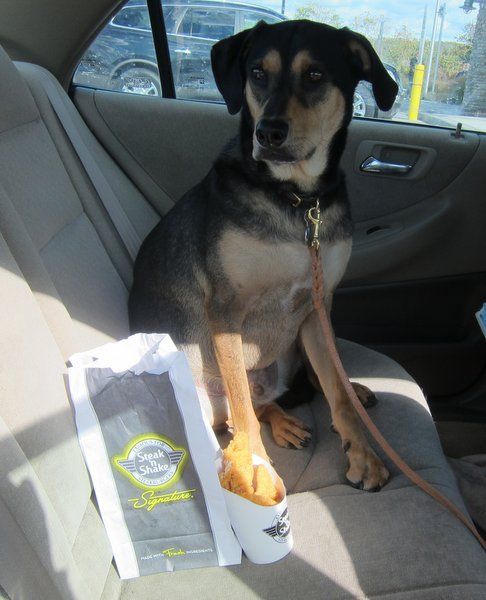
I bought Pongu some consolation chicken tenders from Steak N' Shake on the way home. We sat in the back seat and shared the chicken, listening to The Supremes sing "My World Is Empty Without You" (a song I put at the beginning of our playlist as we left, too).


One thing I noticed at the obedience trial was that some (not all, but some) of the competitors got VERY AGITATED when their dog NQ'ed. It was too bad, because often their dogs were very good dogs who just made one small mistake at the higher levels (which is all it takes), and you could watch the dogs stress about their people's unhappiness.

I didn't care too much about Pongu's NQ. I mean, yeah, sure, it would have been nice to get that hypnotizing title ribbon. But the NQ itself didn't bother me. We already have something like 50 NQs in Rally (I don't even count anymore), so what difference does it make if the number is 52 or 53? Ooh, yeah, crushing.

I'm just thrilled that my insane little pound muppet can do competition obedience at all. That is huge for this dog, and it makes me so excited about where we can go in the future. If Pongu can handle the SFE, and can even do it with strangers in unfamiliar venues, then really there's nothing holding us back from moving full steam ahead in this sport -- no more than holds back any "normal" dog, anyway.

I never dreamed that my fearful dog would be able to do this. And he can. And that's amazing to me. I'm so proud of my little guy.

Tuesday, October 22, 2013

Weekend Updates

Busy busy weekend! We had a bunch of friends in from out of town, so much of the weekend was devoted to non-dog stuff, but I still managed to sneak a few things in here and there.

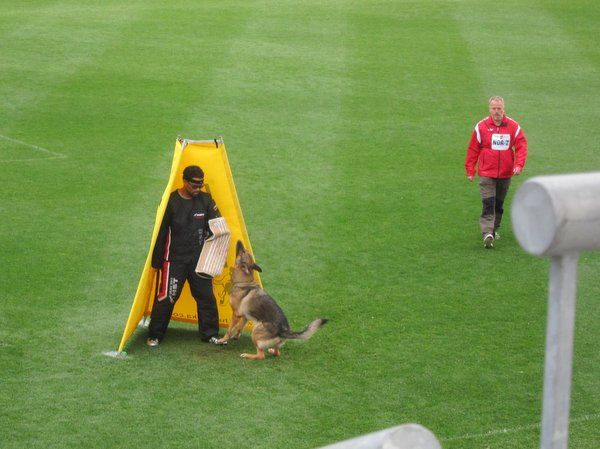
On Saturday I dragged my ultra hungover ass to Chester for the 2013 WUSV world championships. This is an international competition among the best of the best in IPO/Schutzhund, although only German Shepherds may compete in this event. (Belgians, the other major category of IPO dogs, have their own breed championship, and then there's a third major international tournament that is open to all breeds.)

I got to watch a few rounds of the protection and obedience phases. Tracking was at a different field that you had to take a bus to reach, so I missed that one.

It was pretty pretty spiffy. SUPER impressive teams, awesome helpers, tough judges. It was incredible to watch teams trialing at that level -- inspiring and intimidating all at once.


The next morning I went out to do an obedience practice match with Pongu. We did two Novice runs; the ring steward was a little puzzled when I asked to do CDSP instead of AKC, but she improvised quickly and we did our runs with only the minor adjustment of needing to use a high jump instead of a bar for the Recall Over Jump exercise.

Pongu refused the high jump his first time, but (to my considerable surprise) jumped it cleanly on his next two tries, so if it had been a real match we would have earned one imaginary Q and one NQ. His performance on the other exercises was pretty good -- not awesome, but for our first stab at a new sport with crazypants dog, I'll take it. I will be thrilled (and, again, considerably surprised) if he does as well at the actual trial, especially since we're going to be attempting this at a new venue.

After we got back from the practice match, I took the other two dingbats out to the Sunday farmers' market at Headhouse Square.


For the most part, they did quite well. I tethered them to a post across the street from the actual market while I was shopping, because it's not practical for me to try wrangling two dogs while also attempting to purchase assorted sacks of apples and grapes.

To my surprise, though, Dori (as Florence has been renamed, after Hodori, the mascot from the 1988 Seoul Olympics) snarked at a couple of passing dogs while she was tethered to the post. It wasn't anything serious, just a little posturing, but it still came as a bit of a shock to hear a growl from a dog who's otherwise been super sweet and almost completely silent except for "he he he" eagerness panting when she wants cuddles.

As soon as I untied her, she quit behaving that way. I don't know whether it was a territorial thing where she wanted to guard her space, or whether her intent was to frighten off the other dogs while she felt vulnerable being tied to the pole, or whether it was frustration that she couldn't greet them properly... but either way, it was a peculiar, if non-serious, incident.

Once I got her loose, she was fine again, and reacted with her normal sociable interest and pulling toward other dogs with no sign of snarking. Just like before, she was very easy to redirect with "Watch" and hustle-walking past the other dogs, with lots of treats and praise for coming with me. Dori has great focus, and it's been a joy watching how quickly her attention span develops. (Major advantage of starting with a grown dog -- no puppy would have that much concentration in less than a week's work!)


Later that night she also did some alarm barking and growling when my husband came home late and walked in through the downstairs lobby door as I was exiting with the dogs. As soon as she recognized who it was, she melted back into her loose happy tail-wagging self, but it seems that Dori's got a teensy bit of a protective streak when it comes to strangers after dark. And I'm fine with that; I think a lot of people would prefer a dog who barks and growls a little when someone unfamiliar comes into their homes. Better than one that tries to hide under the couch, anyhow! And if it's an undesirable behavior in her final home, it should be one that's pretty easy to fix, at least, since Dori was quick to calm down from her initial state of wariness.

On Monday morning, Dori had her spay stitches pulled. She was fine at the vet. Reasonably calm in the waiting room, tolerant (if unhappy) about being rolled over on her back on the cold tile floor and having her wire sutures pulled out. She weighed in at 42 pounds and is probably still a couple of pounds light, so I'm guessing her healthy weight is around 45.

Once she had her stitches out, Dori was able to play (a little, supervised) with Dog Mob... by which I mean, of course, "Crookytail," since Pongu still wants nothing to do with her.


(Pongu is not just ignoring them in that clip. I put him on a Down-Stay because (a) he needs to proof it anyway; and (b) when I don't actually tell him to stay out of it, Pongu cannot resist running over to yell at the other two and bite them both repeatedly in the face. He ruined all my previous attempts at getting a clip of the other two playing until I finally told him to lie down and stay there.)


That's pretty much it for now. Dori seems to have relaxed enough to potty almost as often as the other dogs. Previously she would hold it for a whole day at a time (once she went over 30 hours without pottying, even though I took her out all the time), but as she relaxes, she's moving toward a more normal schedule.

Her Sit is great and has become a strong default behavior. She's doing well with the Shell Game, too -- she's on Stage 3, which means she's almost finished, and just needs to quit making so many wrong guesses out of impatience before landing on the right one. Dori's fallen into the pretty common trap of thinking that it's easier and faster to just hit all the pots instead of trying to figure out which one is the actual correct pot (although I know she can tell, because occasionally I catch her doing it), so we just need to get the paw touch under better stimulus control and then she'll be done.

Will it happen by Friday? Who knows! But either way, that is the day she's going home.

Sunday, September 22, 2013

IFP and Finding "Success"

Probably the last set of thoughts I want to muddle through on the subject of Imaginary Future Puppy has to do with the nebulous notion of "success" in dog sports. This, I think, is the most selfish and least defensible group of reasons, but it's there and it's a factor, so if I'm being honest then I have to admit that this goes into the calculation too.

At the outset, let's go ahead and admit that the idea of "success" in dog sports is really pretty absurd. It is. It just is. There are maybe 50,000 people in this country who care at all about dog sports, and they don't all care about the same ones. This is a tiny, tiny subculture. Competitive hot-dog eaters have an exponentially bigger audience; at least their events make the local papers when they're in town. Dog sports people are a niche on the level of, I don't know, competitive dollhouse stamp painters.

So on one level it is completely ridiculous to care about "success" in this endeavor beyond doing the best you can to ensure that you and your dog are having fun, because nobody else cares.* Your dog-sport friends will be happy to celebrate your success wherever you set the benchmark for that success -- whether it's winning a championship or just fixing a broken dumbbell retrieve (to cite one not-entirely-hypothetical example), your friends will be thrilled for you either way.

And your dog, who is really the most important party in this entire thing, will (if you're doing this right) be happy about whatever you're happy about. The dogs do not care about titles or ribbons or scorecards. What they care about, generally, is whether you think they did a good job, and possibly whether there will be a celebratory hamburger on the way home.

But, on another level, human nature is what it is, and if there is something to be won -- no matter how trivial it is -- people will vie to win it, sometimes to excessive extremes.**

And if you want to win, which I do, then you need a dog that can win.

It is generally recognized that a great trainer can win with a not-great dog (Exhibit A: Silvia Trkman, pulling greatness out of dog after dog with Issues), and that a lousy trainer will not win regardless of how awesome the dog is. But most of us are somewhere in the vast gray continuum between "great" and "lousy," and even the best handlers don't go out of their way to choose problems (for all her awesomeness, I don't think you're going to see Silvia trying to compete with an elderly, fearful, wheelbarrow-bound English Bulldog anytime soon), because a great trainer with a not-great dog is still going to lose to a great trainer with a great dog. So most of us are trying to choose dogs who have the potential to excel in whatever it is we're trying to do.

I know I am. The conventional wisdom is that it's the human who is usually the limiting factor in any team -- if the dog isn't being brought out to its fullest potential, that's on the human trainer -- but I honestly feel pretty comfortable saying that nope, the limiting factor for us right now is Pongu. He is what he is and I love him times a million, but he is also the partner who spent 40 minutes hiding in another room when I first set up our new bar jump.

The problem I face while trying to choose Imaginary Future Puppy is that, while almost any dog on Earth should be able to do better than Pongu, that "almost" is pretty key. Because I don't actually know how to choose a sound competition prospect. Last time I tried, I wound up with Crookytail, possibly the only dog we've ever had who could somehow manage to be a downgrade from Pongu, so my track record on this front is not exactly awe-inspiring. (Admittedly, we've had foster dogs who were blessed with awesome potential. If I had kept Mab or Sydney instead of Crookytail, my perspective might be a whole lot different today. But, nope, I'm an idiot who kept the big slow dumb one, so here we are.)

So there is an element of Dumbo's feather in play here: I have no faith in my own ability to identify a top competition prospect, therefore I need the talismanic reassurance of a good breeder choosing a good puppy for me. I need the breeder to say "here, this is the one, this is the dog who can do everything you want." Then I will believe it, and I will take this puppy and attempt to do everything with full faith that we can achieve it.

But right now, my ambitions outstrip my experience. And this third dog is absolutely, totally, non-negotiably the last dog who can be in our house until one of the other two dies. I really, really need to get it right, and historically I suck at getting it right, so I'm going to outsource the pressure of choosing to someone who's better positioned to handle it: a knowledgeable and ethical breeder with a proven track record of successfully placing dogs in competition homes.

Ultimately it comes down to "I'm vain and I'm cowardly," but hey, those are factors too.

EDIT: lol I never actually wrote anything in support of my original thesis statement, wow that is sad even by my pitiful standards.

Anyway so that was just going to be the banal observation that "your demands of the dog are dictated by your definition of 'success,'" i.e., Pongu might be considered a raging success by some standards (such as my own, a year ago) but not particularly impressive by others (such as, I dunno, obedience people who love to hate on Rally? Although frankly I'd like to see them do anything with this dog. As the infinitely wise Bart Simpson would say: eat my shorts, Rally haters).

But obviously that is such a super banal point that it hardly deserves to be made, and also as I was in the process of writing it down (originally, not this time) it occurred to me that the fact that there are fewer rescue dogs who reach the pinnacles of whatever sport has probably less to do with the dogs themselves than the risk-aversion of the people handling them.

If you're going to invest thousands of dollars and hours in your dog's competition career (and a significant opportunity cost, since most of us only get to handle a tiny handful of dogs in our lives), most people are going to try to bet on the Complete Package, which is perceived as being the Purebred Performance Puppy partly because if the breeder is doing a good job, that is the complete package, but also because that's what you see all the other successful competitors doing, and it takes a certain bullheaded optimism to break away from the mold. It's sort of like how a lot of people in competition obedience and IPO "proof" on prong collars even if they don't particularly enjoy doing that to their dogs. If that's what all your teachers and role models are doing, and you never see anyone else doing things differently, you will probably do the same rather than risk having to fumble your way down an unknown new path and, in the process, maybe losing.

Basically, it's not that the dogs are themselves any worse, it's that people don't see them as often, and nobody wants to gamble on the less-sure thing. The AKC's Canine Partners rules further operate to push people away in a semi-insidious fashion because they ensure that almost any mutt will be more of a gamble than a purebred: because every dog without papers must be spayed or neutered to compete, it's just about guaranteed that you will not get to see your dog's parents, aunts/uncles, littermates or progeny on the competition field. Every mutt, and most cross-breds, will be a first-generation unknown.

Sucks. But definitely discourages people aiming for top-level competition, even though it has very little to do with the actual merits of the dogs and much more to do with the inability to observe their ancestors and relatives in action.


(* -- Actually, this isn't quite true. There is a small but vocal subset of people who are not your friends and yet may still have something invested in your success or failure: the people who are out fighting the Training Methodology Wars. To a large and happy extent, this war is over in agility and Rally, and [I think] it's dying out in competition obedience, because it has been [mostly] well settled that you can achieve top honors in those sports by a variety of methods, therefore people can just pick whatever fits their own personal values best, stfu, and get on with training their dogs.

However the war is active in full-flame fury in IPO, where it is still vocally believed in many quarters that you cannot title a dog without the use of force [although, predictably, just as happened in every other sport, the goalposts are being reset to "you can't win national competitions" and then to "you can't win international competitions" as people begin overtaking the earlier marks], and it's not entirely dead in competition OB.

To the extent you might possibly care about being a poster child for one of these causes, you have to care about winning whatever the goalpost-of-the-day is. Personally, I'm tired of it and no longer all that interested in getting involved in such annoying and fruitless discussions. But it's Still A Thing, so I note it here.)

(** -- A brutally good short story on this topic is William Gibson's "Dogfight," included in his 1986 collection "Burning Chrome." It has nothing whatsoever to do with dog sports, but I like it as an exploration of the costs that can be incurred by the heedless pursuit of trivial victories. Plus it's just a damn good piece of spec fic writing.)
Friday, September 20, 2013

Pound Puppies and Performance Land

Recently, Team Unruly wrote a long and thoughtful post on "Ten Reasons Why Your Next Sport Dog Should Be A Rescue." It's a good piece; it deserves reading.

It got me to thinking about why my next sport dog won't be a rescue.

I think it's important for shelter and rescue dogs to be welcomed in sport venues -- and their people, too. I remember vividly how much it bummed me out when I got the runlist for the first Rally trial we ever entered and, out of 55 or or so teams, there were three dogs that had obvious one-word pound puppy names and the other 52-ish were all fancy-schmancy craft-beer-sounding purebred names. (Later I discovered that some of those fancy-schmancy names actually belonged to rescue dogs whose owners felt they deserved to be saddled with the same silliness as any pedigreed AKC scion... but that first impression really stuck with me, and so did seeing only two or three other mutts at the show.)

I hold a strong conviction that sports are a good thing for dogs (all dogs! all of the dogs!!), and that sometimes people feel discouraged about entering them with pound puppies, and there is NO REASON this feeling should exist. For all the reasons discussed in that Team Unruly post, rescue and shelter dogs can do very well in many dog sports, and they deserve serious consideration as candidates.

But I'm still not planning to get one, and after reading that post, I felt a little guilty about it and thought I should examine my reasons more closely. I've been in rescue for a while now. I feel strongly that people who want family companions should look to rescues and shelters first, and that just about any kind of dog you could conceivably want is find-able in the shelter system eventually. And, of course, I don't dispute that strong sport candidates are dumped in pounds across the country every day. Many of these dogs, as the TU crew points out, are literally dying for want of homes that can handle their energy and drive.

So, having talked the talk, why am I not walking the walk?

Some good reasons, some not-so-good, some just idiosyncratic to my personal goals and past experiences. Originally I had intended to cover them all in one post, but it got way long even by my blatherful standards, so I'll break the discussion up into a couple of smaller posts and see where we get from there.

Again, this post is not meant to persuade anyone of anything. Nobody needs to be persuaded that purebreds are preferable as sport dogs; they already dominate all the sport venues massively. It's just sort of thinking aloud about why my own thoughts on that front have changed over time.

Thursday, September 5, 2013

Choices and Comfort Zones

Yesterday I enrolled in a competition obedience class that lies a little outside my comfort zone.

The instructor is extremely skilled and extraordinarily accomplished, and it's clear that she is very effective with her chosen methods -- both personally and as a teacher. For this reason, I'm trying to take the class with an open mind, because even if I opt not to use some of those techniques in my own training (and there are several that I can't imagine I'll ever want to use), there should be a lot for me to learn here.

One of the things I've already learned -- and this is something I'd already suspected but which was thrown into sharp relief by some of the exercises in the class I audited -- was that I place a high value on my dogs choosing to work with me, and I do not want my dogs to be coerced into compliance, even if that coercion is done with a relatively light touch. I value a thinking, eager partner who gives me willing cooperation; if that means my dog occasionally says "no," that's fine.

In the classes I watched, the dogs did not have the option of saying no. They didn't really have many options at all. Everything was taught by physical manipulation: attention heeling was taught with the dog's head pulled up by a taut short lead, a Sit-Stay was taught with two fingers hooked into the dog's collar to hold it in place, moving Fronts were taught by (again) hooking fingers into the dog's collar and pulling it along. Handlers reinforced dumbbell holds by clamping their hands around the dogs' mouths. Rarely were the dogs asked to think or given any choices; mostly they were just passive creatures being pulled into position by their handlers.

While almost all the dogs were on prong collars (which in itself makes me uncomfortable), mostly the force employed in training them was relatively light. Not many of the handlers yanked their dogs to the point of causing obvious pain. Nevertheless, it was very clear that the dogs had no choice about participation, and almost all of them exhibited discomfort at times. At the end of the session, many of them fell asleep while their handlers were talking, which to my eye looked like stress exhaustion (and over the course of pushing Pongu up the competition career hill, I have seen plenty of stress exhaustion).

To my surprise, there didn't seem to be much attention paid to motivating the dogs; they were encouraged to jump up on their handlers (which appeared to be genuinely motivating for some, and more of a frenetic stress-relieving movement for others) and were given verbal praise and occasional treats, but the level of primary reinforcement being used was much lower than what I'm used to seeing.

So, overall, the total picture is of something slightly outside my comfort zone. It is by no means a crank-and-yank class (I'd have no use whatsoever for something like that), but it's far from my preferred position on the R+ end of the training spectrum. Watching these dogs and their handlers, I was struck by the total one-sidedness of the working interactions. During their downtime, many handlers were affectionate with their dogs, but when it came time to practice the exercises, it was all one-way dictation, zero listening to the dogs.

And that's not something I want, personally. What I want is a dog who works joyously in competition because the dog wants to be there -- really wants to be there, not Stockholm Syndrome "wants to be there." My choice is to give them choices.

This class may teach me many other things (and I hope it will), but it's not looking likely that it'll teach me how to make obedience a genuinely fun game for my dogs.

And if that environment of stressy and anxious dogs is not only outside my comfort zone, but badly outside Dog Mob's, then we'll drop out. Because that, too, is a choice they get to make.

Wednesday, April 24, 2013

Wishes and What-Ifs

Lately I've been spending a lot of time reading up on the various strains of German Shepherd Dog here in the U.S. Show lines, working lines, import lines, distinctions between various import lines, and so on and so forth down a rabbit hole to infinity. I've even picked out one or two kennels I like, although adding another Permanent Dog is verboten for at least a few more years.

My next competition dog -- the one I frequently refer to as Imaginary Future Schutzhund Dog, even though I've never once in my life been to a Schutzhund competition or even attended a training session in person and have no idea whether I'd actually enjoy the sport -- will very probably be a German Shepherd from European working lines, most likely Czech or East German. They're a little smaller than some of the other types, they don't have the extreme rear end angulation of the show GSDs (which, to my mutt-accustomed eye, looks deformed), and, most importantly, they are bred to have stable temperaments coupled with high intelligence and a powerful desire to work.

That's my perfect dog right there. A smart, steady dog who thrives on learning and working and, eventually, competing.

I don't have that dog right now. It pains me and makes me feel incredibly guilty to admit it, because I love my dogs so much and I know they try their hardest for me, but there's that pernicious, persistent grass-is-greener fantasy lurking in the back of my mind: What if Pongu weren't pathologically fearful? What if his physical structure were sound? What if I could have a dog with his intelligence and devotion and joy in work, but without the extreme neophobia and anxiety and that crippling old injury in his foot?

I've built up Imaginary Future Schutzhund Dog in my mind as a perfect version of Pongu with all his flaws magically erased (also, 20 pounds bigger and totally unfazed by jerks on the street who bother us after dark and/or intentionally try to scare him, because what the hell, this is my imaginary perfect fantasy dog and unlike poor frightened Pongu, he will EAT YOU if you try that. Yes, this addendum is motivated by a group of teenagers who intentionally stomped and charged at my dog to frighten him. Yes, I'm still angry).

Minor rant aside, I know why I've been spending so much time thinking about this lately: because we're about to undertake a new challenge and I am afraid we won't do well.

In a couple of weeks I'll be starting a competition obedience class with Pongu. I don't know what to expect. I have a great fear that he won't be able to do competition obedience, because he is shy and fearful and easily stressed. It's lightyears better than it was, but the exercises in competition obedience are targeted straight at the things that are hardest for him: being approached and touched by strangers, working at a distance from his handler, holding long-duration Stays out of sight.

Even if he can do it, will he enjoy it?

Pongu loves Rally because he's good at it, and the reason he's good at it is because Rally asks for the things he likes doing: staying close to his person, paying rapt attention to everything his person does, occasionally taking easy jumps, and never really having to go near the judge except when his leash goes on or off at the start and finish lines. He can do these things very well and that builds his confidence, which is the whole reason we got started doing it in the first place.

But we're almost done with learning Rally. Pongu has gotten all the Level 3 exercises down to a satisfactory level in familiar environments. There's still a lot of polishing and perfecting to be done, and I expect he'll continue to fall apart and NQ in the competition ring a few times, but the learning is done. He knows the exercises. All that's left is proofing and practice -- and, of course, competing intensely for the next 18 to 20 months until he earns his ARCHMX and gets nationally ranked and beats the game.

Now is the time to start learning something else. I love agility, but we can't really do it because of Pongu's aforementioned crippling physical issues and also the simple lack of space that comes with condo living in the middle of a city (really, if I were sufficiently hardcore about it, we could do agility in small doses on pop-up equipment, and we might yet take a shot at it... but given those limitations, we'd never be serious competitors, so I can't get all that interested in it). Nosework's an option, but I'm inclined to leave that one on the back burner for when Pongu's older and even less athletic than he is now. That leaves obedience, where the obstacles are primarily psychological rather than physical, as the one big obvious candidate.

But I am afraid that perhaps I'm expecting too much, or pushing too far, by trying to get my little fearful rehab mutt into the oh-so-intimidating obedience ring. It's the oldest of the dog sports, its top honor is still considered the Mt. Everest of competition titles by some, and its culture can be pretty nasty in some quarters between the snobbery of some purebred aficionados and the lingering hold that punishment-based training has in places. Dogs are specially bred for this sport, and even with obedience in their blood and the aid of hardcore handlers, they fail by the dozens. And people are pleased about it! As far as I can tell, competition obedience is meant to be unwelcoming.

I honestly don't know if we're up to it, but if we enter, I damn well intend to win. And I don't know if Pongu can win, given his assorted problem areas. I don't know if he can even compete. I worry that pushing him too hard here will cause him to backslide in other areas and perhaps even ruin his enjoyment of Rally, where he's doing so well.

So I spend a lot of time fantasizing about a dog who has no fear. I daydream about the ultraperfect Imaginary Future Schutzhund Dog, who has none of my 'fraidy little pound dog's issues. Because I'm afraid.

It's not a good place to be, but that's where we are right now.

Friday, March 29, 2013

All Sports Are Good Sports, Right?

"Do More With Your Dog!" is the name of Kyra Sundance's sanctioning organization for the sport of Trick Dog, but it's also a pretty good suggestion for anyone living with a companion dog. The benefits of Trick Dog -- that it "establishes a pattern of learning, teaches skills and focus, is a positive method of training, and promotes a bond between canine and human" -- exist for any good sport taught by positive methods. Plus, most of them have the additional benefit of getting both dog and human up on their feet and exercising for greater strength and flexibility.

It's no secret that I'm a huge proponent of dog sports. Most of our pet dogs don't get enough to do, physically or mentally. It saddens me when I see a dog who's otherwise beautifully cared for -- neatly groomed, well fed, walked regularly on humane equipment, and given a warm, comfortable bed -- but whose owner has neglected the mental aspects of dog ownership because he or she just doesn't have any inkling that it matters. People who would never dream of skipping their dog's heartworm pills or giving him poor-quality food very often don't engage in advanced training because they don't recognize its benefits.

Or, if they do recognize those benefits, they might still write sports off as impossible for their dogs, who are just "regular pet dogs." I can't count the number of times I've been practicing with Pongu in a public area and have had people say "oh, he must be a special dog, my dog would never do that" -- as if Pongu the Insane, a gimpy-legged shelter mutt who was and remains a lifelong behavioral rehab case, was originally "special" in any way that didn't basically mean "godawful crazy."

For the good of our dogs, collectively, I think it's really important that dog sports be emphasized as (a) beneficial; and (b) approachable. The message that "only special dogs can do this, and yours isn't good enough" is toxic.

Luckily, we live in an area where a number of excellent trainers are making efforts to spread the gospel of sports for fun. The crew over at Opportunity Barks, a wonderful school, offers classes in trick training, agility for fun, and occasionally other sports like treibball and Rally. Local trainer Pat Bentz offers regular nosework sessions. And if those students get really hooked, there's a strong network of specialized training clubs ready to take them to the next level -- the competition ring. But even if they don't go that far, both people and dogs benefit by trying the sports.

To that end, the message is always positive, friendly, and welcoming. Newcomers are repeatedly told that the training is "just for fun" -- and it is! Even in the competition ring, these sports should be about fun, always: about building bonds with our dogs and stretching their abilities and marveling at all they're capable of doing so joyously. The emphasis is on trying (and enjoying!) everything until you find the sport that works best for you and your dog.

Which is why I'm so disheartened when I see competitors in one sport badmouthing the others. I feel strongly that as long as the participants enjoy what they're doing and are being trained with kindness and positivity (both dogs and people!), there are no bad sports. None. Agility, freestyle, flyball, treibball, trick dog, Rally -- I think they're all awesome, and while I surely have my favorites, I'm happy to encourage my friends to try every one. That perfect fit's going to be different for each team, after all.

And heaping negativity on Sport A as the "dumbed down" domain of "poorly trained dogs" whose handlers couldn't hack it in Sport B does not make the latter look more attractive by comparison. To the contrary: it sends the message that Sport B is the realm of naysaying sourpusses who can't stand that A has become more popular (in significant part, I should note, because it's genuinely welcoming of mixed breed dogs, disabled dogs, newcomers to the sport, and handlers who want to have fun and talk to their dogs and be able to reward in the ring).

Particularly when we're talking about Rally and traditional obedience, it is genuinely confounding that there should be this persistent bitterness. Rally was originally conceived as a bridge from casual pet training to the competition obedience ring. It hasn't really worked out that way, though, in large part because obedience people seem to be taking every opportunity to push Rally people away. I often hear people tell me that they were drawn to Rally because of its friendly, welcoming, and supportive environment. Guess how many times I've heard that said about AKC obedience? Exactly: zero. (CDSP, a new obedience venue, does have a reputation for being more welcoming, but as I have not yet tried that firsthand I can't vouch for it myself.)

I like competition obedience. I think it's really neat; I admire the precision and the discipline that those dogs display. I am sorely tempted to give it a shot with Pongu when we're ready (which ain't just yet).

But man, it's hard to embrace a sport where people tell you so many times that you and your dog are not welcome, not wanted, not good enough. And if I feel that way, how must someone who's totally new to ring sports feel? Someone who hasn't yet experienced the happiness of a hard-earned high score or seen the joy in a working dog's eyes? It's a big, big turn-off, especially for someone who may still be wondering if their dog is "special" enough to do any sports at all.

And that just hurts everybody.