Showing posts with label rainy day games. Show all posts

Sunday, March 31, 2013

Happy Easter Egg Hunt!

This year, as a combination trick/game, I taught Pongu to hunt Easter eggs.


It's a lot of fun. I can hide the eggs in fairly difficult ways now (under a cloth, raised up on platforms, cardboard boxes, or chair seats, stuffed inside socks, tucked under noise-making obstacles like squeaky snake, etc.) and he enjoys the challenge of sniffing out the eggs and plunking them into the basket. I imagine we'll be playing a lot of this game on rainy days long after Easter's gone, and I'll be looking for even tricksier ways to hide those eggs.

As part of the project (since, as far as I know, this is a trick of my own invention -- I wouldn't be surprised if someone else did it first, but I didn't know about it), I recorded each step of how we learned this game, in case anyone else wanted to do this with their dogs and wasn't sure how to teach it. It really is a lot of fun, and not that hard to train. For Pongu it took about three weeks, but (a) he was starting from zero with regard to retrieving objects; and (b) we were/are training a lot of other new things more intensively at the same time that we were practicing this trick. So if your dog is already familiar with the retrieve concept and/or you don't have anything else on your plate, you're already ahead.

Step 1: Beginning Directed Drop

We didn't start out with Easter eggs. We started with a soft, squishy ball (pretty sure this is one that Dog Mob ripped out of a Kong Wubba and then deflated). Hard plastic Easter eggs are slippery and difficult for a dog to manage without dropping or breaking them open. In the beginning, I wanted Pongu to get comfortable with the novel concept of picking up an object and dropping it into a designated receptacle instead of bringing it to me. To avoid distracting him with other considerations, we used the easiest possible object for him to manage -- this poor, hard-used, deformed squishy ball.


The "basket" is also designed to be as easy as possible. I used the broadest, shallowest, most easily accessible container we had. I covered it with a cloth partly to muffle sound (Pongu is acutely sound sensitive and I was worried the "thunk" of a ball falling into the container would be aversive) and partly so that I could later use the cloth as a visual marker to transfer from this container to an Easter basket. I figured that if he was familiar with targeting the cloth, he might have an easier time carrying the behavior over to a slightly different context.

At this point, Pongu earns a click for carrying the ball in the direction of the basket and dropping it anywhere in its vicinity (defined by the mat), and a jackpot if he actually gets the ball inside the container.

Step 2: Introducing Easter Eggs and Multiple Drops


Once Pongu was reasonably adept with manipulating the ball, and seemed to understand the goal behavior, I switched from the squishy ball to the plastic Easter eggs he'd be using in the final version. This was actually a sub-step in itself, because initially he was not into those eggs.


But he eventually got more comfortable with them (at this point he was still breaking and dropping them a lot, but he'd carry them) and we started practicing with the eggs. I also raised the criteria on the receptacle drop: he had to collect multiple eggs before getting a treat, and I switched the container to a deeper and smaller-mouthed one that was closer to the dimensions of the Easter basket we were going to use.

At this step we weren't really adding any new behaviors, just refining and raising difficulty from the first step.

Step 3: Basket and Basic Find

The next stage was to replace the open-topped container with an Easter basket. Because the basket has a handle across the top, it's much more difficult for the dog to drop an egg inside -- he can't just stick his head directly over the basket and drop it straight in, but has to calculate an angled approach.


I also introduced a very simple "find" component to the game at this stage. Instead of having the eggs lying totally out in the open, they are (just barely) concealed. One is partly under a sock, the other is raised up about ten inches on a platform. They aren't hidden very well, but the concept's introduced: you're gonna have to start looking for these eggs soon, buddy.

Step 4: Introducing Basket Carry

At the end of this trick, I wanted Pongu to bring me the basket full of eggs, so we had to introduce that behavior as well. He got a click and treat first for doing a nose touch to the basket handle, then for mouthing it, and finally for picking it up and moving it even the tiniest fraction of an inch.


I wrapped a white cloth around the basket handle because we were using cheapie $1.99 Chinese-made baskets from the corner drugstore, and god only knows what kinds of toxic dyes they use for those things. I don't want my dog dying of mouth cancer, so I wrapped up the handle -- which had the added benefit of giving him an easier grip on the thing.

Nonetheless, the basket was extremely unwieldy, partly because of its weight distribution and partly because this particular basket has such a long handle that Pongu just couldn't get it high enough off the ground to avoid bumping the bottom. After a couple of sessions I bought a new, smaller basket. It made the egg drop more difficult, but he could carry the thing a little more easily.

Step 5: Putting It All Together

After a couple of weeks, Pongu had all the basic pieces in place: finding the eggs, carrying them to the basket, going back for more eggs, and bringing me the basket at the end of his collection. We spent a few days practicing so that he could build up fluency in each component behavior and become more familiar with the pattern. (Part of the end goal was to have a game that sounded conversational and didn't rely on formal cues -- or, better yet, worked as a single behavior chain on one cue -- so I didn't want to be constantly barking out "Find!" and "Basket!" as he worked.)


At this stage, all the eggs are moderately hidden, we're raising the total number of eggs, and I'm asking him to bring me the basket at the end. It's not 100% to final form, but by this point it was just a matter of practice.

And that's how I taught my dog to hunt Easter eggs.

Friday, September 2, 2011

Rainy Day Games: The Paper Ball Game

The Paper Ball Game was originally invented for our hamsters, many many years before we ever thought of getting dogs. It was pretty simple in that incarnation: put Yogie in brown paper bag, crumple bag into a ball, drop bag in hamster cage.

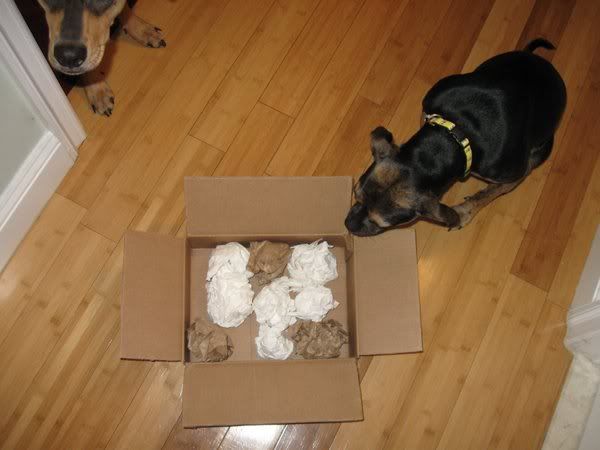
The dog version is basically the same, except that there are a bunch of paper balls and they are piled up together in a container. This allows you to sneak in a little variation, if you're so inclined: put low-value treats in one kind of paper bag and high-value treats in another kind of paper bag, and watch how quickly your dog differentiates between the two when deciding which paper ball he's going to grab first.


Here, the white paper balls contain Wellness Pure Beef jerky treats (each one cut in half so there are actually two smaller treats inside each paper ball, which gives the dogs about 0.05 seconds more entertainment as they sniff out both halves), and the brown paper balls contain scraps of roast chicken from yesterday's dinner.

The dogs wait for the signal to start playing (they're not on a firm "Stay" here, they're just not allowed to take any balls until they get permission):


...and, once released to do so, both immediately go for the brown paper balls. (Then they scurry off with their treasures to opposite ends of the house, which is fine because it prevents them from squabbling.)


Pongu used to be terrified of even approaching the cardboard box, let alone touching a paper ball and risking its terrifying crinkle noise, but he got over that pretty quickly after watching the foster monsters take all his treats the first time. Jealousy's a powerful motivator. Now he loves the game.


Mostly the dogs are pretty polite about unwrapping their treats instead of ripping the bags to shreds, so often you can get multiple uses out of each wrapping. I also use packing paper if it's clean and not too flimsy.

Wednesday, August 24, 2011

Rainy Day Games: The Hallway Kibble Game

With August 2011 being possibly the rainiest month Philadelphia has ever seen, we've had plenty of time to play indoor games lately.

I learned about the Hallway Kibble Game from Leigh Seigfried of Opportunity Barks, who taught it as a method of doggy life enrichment. This game is ridiculously simple -- like, so simple that I didn't even try it for weeks because I thought there was no way dogs could conceivably be entertained by this -- but so far every furball I've tried it on has loved it.

To play this game you need: a handful of dry kibble, a dog (or dogs), and a hallway.

Then you...

(ready? ready??)

...throw the kibble down the hallway, a few pieces at a time, and let the dogs chase it down and eat it.

That is the entire game.


You can feed your dog's entire kibble ration this way. They just don't get tired of it.

Also, while I definitely would NOT recommend playing this game with a dog who had serious food guarding issues, Gremlin exhibited minor food guarding when she first came to us, and I really feel like playing the kibble game helped her get over that. Having a consistent supply of good food that she could eat safely in her crate probably helped a whole lot more, granted, but I think the kibble game helped too.

Playing this game taught her that she didn't have to fight Pongu for the kibble because more would come along seconds later, and if she wasted too much time trying to guard the kibble that had already been thrown, she'd miss out on fresh waves of food. The constant distraction of new food being tossed down the hallway also helped her ignore the presence of another dog nearby, and the fact that kibble is a fairly low-value food made it not really worth getting snappy over. Almost before she realized it, Gremlin was eating right alongside Pongu with no conflict whatsoever.

Obviously you would want to be very careful about playing this game with newly introduced dogs, or those with even slightly serious resource guarding behavior, but I did find it helpful in getting Gremlin desensitized to eating with another dog nearby. So, depending on the dogs you're working with, that may be a side benefit of playing the Hallway Kibble Game.

Saturday, May 21, 2011

Rainy Day Games: Find the Food

What do you do when it's raining and pouring, or 105 degrees out and muggier than a sauna gnome's sweatpants? Can't go for a walk or run. But the dogs still need exercise, and letting them roughhouse indoors is generally not a great idea. So what are some alternatives to the Smashed Furniture Game?

Many dog trainers will attest that mental exercise can be almost as tiring to a dog as physical exercise. (This is why a 20-minute walk in a novel area can exhaust your dog as effectively as a 45-minute walk in a familiar old neighborhood: there are so many new and fascinating smells to process, corners to explore, bits of half-eaten tourist cheesesteaks to furtively grab...) And when you're stuck inside on a rainy day, it's easier to challenge your dog's brain than her legs.

Training is a great rainy day activity. Distraction chews are also handy. And then there are silly little rainy day games like Find the Food.

Find the Food is incredibly simple.

1. Chop stinky food into small pieces.

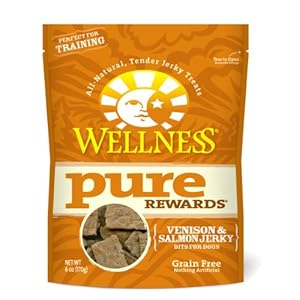
I like to use Wellness Pure Reward jerky treats because they're smelly enough to work well for this game, but dry enough that they don't stain or make a mess. Also, they are easy to chop into small pieces. I quarter each one to make little squares of about half an inch or so.
Healthy, convenient, stinky. What more could you want?
Dry biscuits don't work so well for this game because they don't smell strongly enough (also they are usually too big, so you can only play a few rounds before your dog has eaten all the biscuits he needs for the day). Really high-value treats like turkey hot dogs or chopped chicken are a waste for this game -- save those things for training -- and anyway that stuff is a little too messy to strew casually around your house.

2. Hide stinky food.

I put the dog(s) in another room while I hide the chopped-up treats. You could use a crate or even a tether too. The main thing is just to not let the dog(s) see where you're hiding the food, so they can't cheat. Usually I hide four or five pieces per round -- this is enough to create a pretty good Easter-egg hunt without too much risk that I'll forget where I put the pieces and lose track of any food the dogs don't find. (So far, I've been spared any consequences of my own forgetfulness because Pongu never misses a bit.)


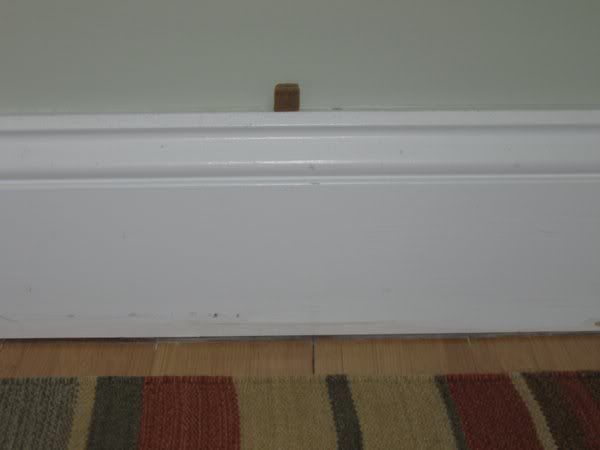
One piece goes on top of a wall moulding...

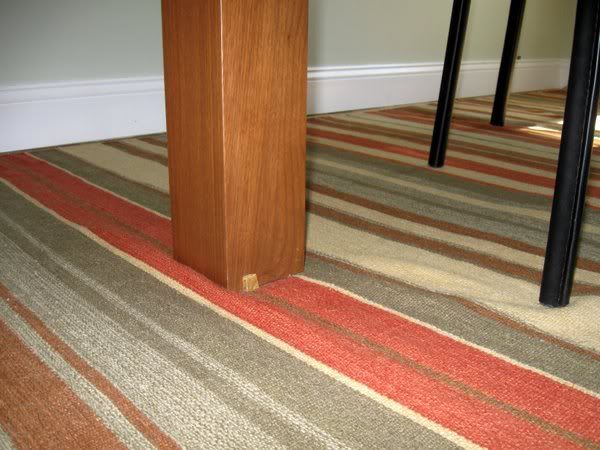
...and another is tucked behind a table leg. (That's not a bug on the wall in the background, it's the first treat!)

When introducing a dog to this game, I will put the food in easy-to-find places that are mostly just on the floor. Gradually I move to slightly harder hiding places: perched on wall mouldings, tucked under the edges of rugs, hidden between a pair of shoes, up on a bookshelf, and so on. As the dog becomes more comfortable with the game, she'll learn to trust her nose even when she can't immediately see the food, and will be more willing to push or manipulate objects to reach the treat.

You can also rub the treat on the floor to make little scent trails to super-hard locations. (I only do this when my husband isn't around. He isn't a fan of me rubbing dog food all over the living room, go figure.)

3. Release the hounds!

And sit back and watch as they sniff out all your hidden prizes.
 
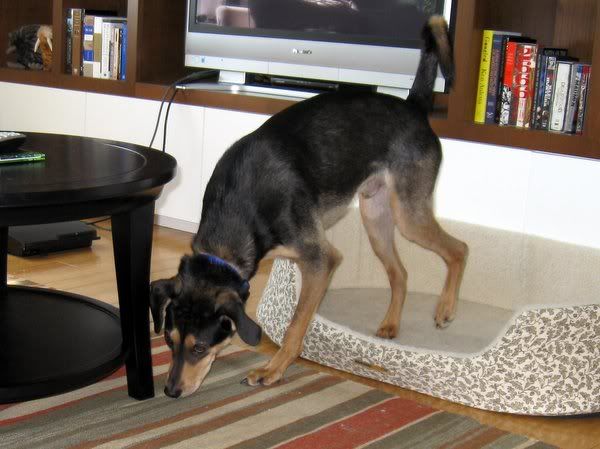
Pongu finds a Clue.
Pongu is good enough at the game now that he usually sniffs out all five treats in two minutes or less. See? Totally part beagle.