Since I have an adorable foster puppy at my disposal for the moment, I made some clips on socializing a new puppy to some of the things that you might expect her to encounter in her future home. These are all very, very basic introductions -- literally the very first steps you might take with a puppy who had no previous acquaintance with any of these ideas. Jackie hasn't even been here for 24 hours, so I figured she'd give a more authentic reaction than my other half-trained mutts.
We spent this afternoon out on the street, camped in an alley about 10 feet removed from the bustle of South Street (which was extra bustling today on account of being a street full of tourist bars on St. Patrick's). Jackie got to meet old people, young people, kids of all ages, people using mobility aids, people so drunk they probably needed mobility aids, people wearing huge green leprechaun hats and necklaces of flashing green Christmas lights, and lots more. I didn't want her to get overwhelmed, so we only stuck around for half an hour and left while she was still having fun, but she probably met over a hundred people in that span. A cute puppy in an "Adopt Me" vest on a crowded street grabs a lot of attention.
After dinner, with the average BAC on the street steadily rising, we retired indoors to do some socialization practice with objects instead of people.
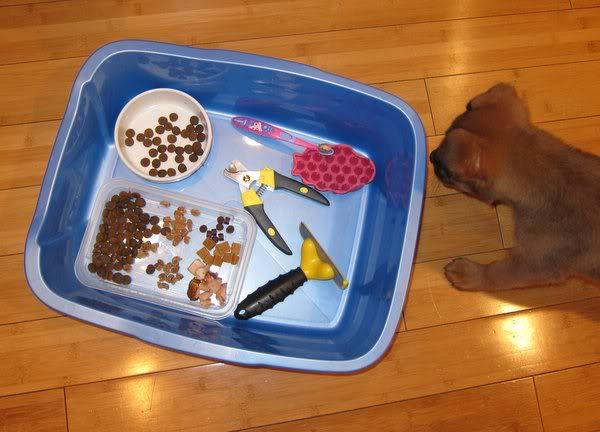
To start, you need a drawer full of props (Kong rubber brush, Furminator metal brush, toothbrush with chicken-flavored doggy toothpaste, nail clipper, bowl of kibble, assortment of tasty treats) and one puppy:
The first exercise we did was just familiarizing Jackie to the grooming tools by giving her the opportunity to investigate them (and, being a puppy, chew on them) at her own pace. I scattered some kibble and treat pieces around the tools to encourage her to sniff at them, but as it turned out those weren't needed.
Once she'd lost interest in them, I moved to the next step: gently brushing her with the Kong rubber brush. The intent isn't to actually brush her (as a fuzzy puppy, she doesn't need a real brushing anyway), but just to familiarize her with the sensation. This is usually the least objectionable part of grooming for most dogs, so I think it's the best place to begin. The rubber Kong brush is less scratchy than the Furminator, so that's the one I used initially.
Next up: the toothbrush.
I put some doggy toothpaste on the brush and let her decide to eat it. While she was chewing, I moved the brush slightly to approximate the way it would move for a real toothbrushing. When the toothpaste was just about gone, but before Jackie lost interest in it, I took the toothbrush away, leaving her wanting more of the "treat." Next time the toothbrush comes out, she's a little more likely to regard it with anticipation.
Lastly we worked a few rounds of Doggie Zen.
The "official" game of Doggie Zen is to hold a treat in a closed hand so that the dog knows you have it but can't get it. The instant that the dog gives up trying to chew the treat out of your hand, you click that moment of acceptance and open your hand so the dog can get the treat.
As simple as this exercise is (and it is very simple, and most dogs grasp it very quickly, such that I've seldom had to play more than one day's worth of strictly defined Doggie Zen before shaping it toward Watch Me, Leave It, Look At That, or any of the other myriad concepts that Doggie Zen leads to), it's important because it introduces impulse control and the idea of "availability" -- that some good things in life may appear to be available but aren't actually available until the handler makes them so.
So while it seriously only takes about five minutes in your life to teach Doggie Zen to most puppies, it's five minutes you might as well spend, because a whole lot of other stuff builds off that simple idea.
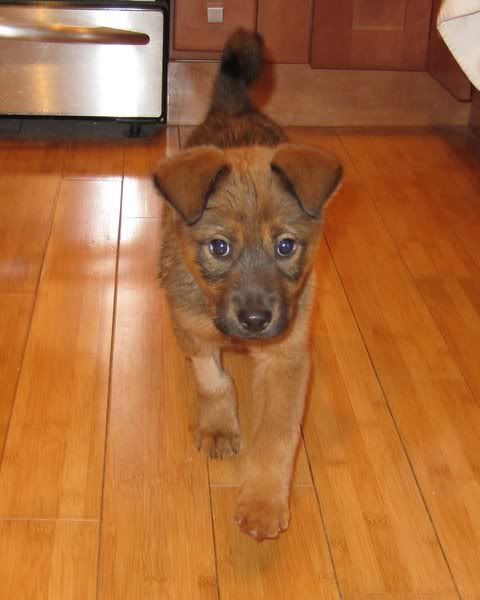
Late last night, a little after 11:30 p.m., Jackie came off the H.O.P.E transport van, crossed a Northeast Philly sidewalk, and toddled on home to stay with us for a while.
Crookytail loved her almost instantly, but Pongu didn't take kindly to the interloper. By the next morning he wasn't trying to kill her anymore, but he's still definitely the Jerk Uncle ("oh my god, don't touch that! No don't touch that one either! Ugh you little hooligan, when are you going home?!") to Crookytail's Cool Uncle ("yeah sure kid, you can play with all the toys").
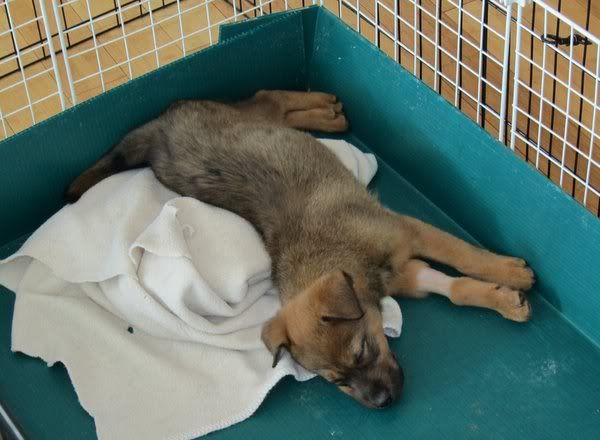
After so much excitement, Jackie went back in the puppy box (aka Biscuit's guinea pig pen) and pooped out...
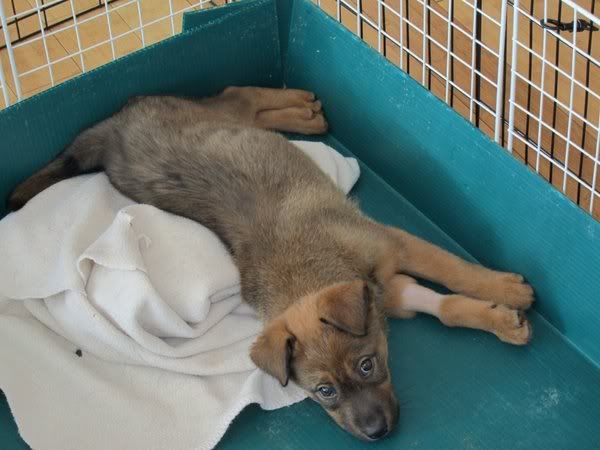
...although not so much that she couldn't wake up when she caught me taking pictures.
And that's where we are for now. I took Jackie out for half an hour this afternoon to socialize her to strangers by having them feed her treats on the street. She did a great job (pretty impressive on St. Patrick's Day with a bunch of noisy, half-drunk strangers coming up right to her face!).
We also started work on a couple of foundational games like Kibble Toss (three goals on this one: (a) priming the marker word "Yes!"; (b) teaching the dog to "learn how to learn" by building an association between cue from person = fun games and treats!!; and (c) laying some foundations for a true recall by repeatedly giving the puppy incentives to turn around, re-orient back to me, and return as quickly as she can).
I don't really expect to have her long enough to make much progress in training, but you never know, so we might as well do what we can in the time that we have.
Let me preface this post by saying: I love dog parks. Love them. A good dog park presents great opportunities for dog-dog socialization, training in a distracting environment, and getting some off-leash exercise in an area that may not have many other options. It's also a nice place to meet other dog people.
Not all dog parks are safe, though, and not all dogs are suited for them. I feel like there is often a great reluctance on the part of some owners to recognize when their dogs are not enjoying the park, or are behaving in troublesome ways, even when recognizing potential problems and intervening appropriately could keep everyone playing together happily. And sometimes other owners are reluctant to speak up because, well, criticizing someone's dog is like criticizing their child: it feels rude and presumptuous.
But children don't have knives for teeth, and their body language is a little easier for most people to read, and generally we know when they need us to intervene well in advance of a fight breaking out. With dogs it's not always so obvious, and the potential damage is a lot worse.
So with that in mind, here are a few clips I recorded at our local dog park over the course of three days (last Thursday, Friday, and Saturday). Ours is a relatively safe park with a supportive, dog-savvy community of regular users -- it's certainly much safer than a couple of other nearby dog parks -- and yet scuffles and more serious fights break out frequently enough that I was able to capture several of them within a total of about three hours' time.
The first step to spotting potential trouble in the making is to familiarize yourself with canine communication. Brenda Aloff's book Canine Body Language and Sarah Kalnajs's DVD set The Language of Dogs are both excellent resources on this topic.
The next step is to observe canine interactions so that you can predict which scenarios are likely to erupt into fights and which can and should be left for the dogs to resolve between themselves. Not every exchange of stares and snarks needs a hovering human to step in; a certain amount of correction should be permitted so that dogs (especially young and under-socialized ones) develop their own understanding of canine etiquette. Knowing when to interrupt and when to leave things be is a skill developed with practice. The more time you spend watching dogs carefully, the quicker you'll be able to spot potential red flags.
Greetings
Entrances and greetings are fraught moments for most dogs in the park. Getting mobbed by a bunch of strange mutts (often strange mutts who are very! excited!! to meet a new dog) right at the gate can be extremely intimidating, and many dogs will react with barks, growls, or exaggerated appeasement signals in an attempt to get space or defuse the tension. Always watch greetings closely, and try to keep your own dogs from overwhelming newcomers at the gate.
The black dog in the middle here is clearly uncomfortable at being mobbed. His posture is stiff, his mouth tightly closed with some tension wrinkles along the muzzle; his tail veers toward a vertical position and makes short sharp wags at a couple of points in the clip. His hackles are raised both on the shoulders and along the rump. He acts to increase social space: at 0:06 he chases one of the sniffing dogs away and at 0:11 he rebuffs their attempts to engage him in play by stiffening up again.
All the other dogs in the park were pretty relaxed and willing to respect this dog's social cues, however, so the tension didn't escalate. About a minute after I stopped filming, he relaxed enough to play.
In this clip, things didn't go so well.
The brown pit at the center of the dog mob in this clip was an intact (un-neutered) young adult male who presented a problem immediately: not only was the guy swimming in his own crazy hormones, but many dogs will harass and/or challenge an intact male (and, indeed, that's why this dog mob formed and swarmed him; these dogs were wandering around all over the park, ignoring each other, before he came in). Because of this, many dog parks specifically prohibit intact males. It's just not worth the risk of fights.
Additionally, this particular dog was tense and visibly wound up even before he came through the gates. He charged into the park with no apparent awareness of any other dogs' personal space, much less respect for their social cues. As soon as I saw him, I knew something was going to happen with this dog, so I got out the camera, and voila: within twenty seconds, something did.
All the other dogs swarming around him are curious, not threatening, but there are a lot of them and this dog isn't handling the stress well. Throughout this clip, his body language expresses a high degree of anxiety and agitation. He's pretty much frozen throughout, except for his upright tail making short, stiff vertical waves. His ears are pinned back in worry. He tongue-flicks at 0:01, 0:07, and 0:12. At the end, after breaking free from the ring, he provokes a fight by chasing another dog in a circle and putting his chin over its back.
My read on that scenario is that an unstable, stressed dog came into the park, was bombarded with more social tension than he could handle, and vented that stress by starting a fight. This dog probably should not have been in the park at all (at least on that particular day), and certainly his owner should have been keeping much closer watch on him. (In fact, the owner did not intervene even after the fight started, nor did he remove his dog or do anything else afterward.)
Excitement Barking
Many dogs bark or growl as part of their play. Many other dogs bark or growl because they feel insecure and are trying to warn other dogs away. The former can be harmless fun but can also prompt some dogs to respond as if the barking or growling were a threat; the latter may indicate that your dog needs to take a breather and, perhaps, return on another day at a less crowded time.
In this clip, the dogs are playing together nicely. Both have loose wiggly body language, bouncy strides, and the larger dog's mouth remains open in a relaxed smile for most of the interaction (this is important because, as the recipient of the barking, that dog's responses determine whether this interaction could become problematic). They pause frequently in mutually respected mini-breaks (0:03, 0:08, 0:19) and resume the game after a play-bow invitation. Halfway through, they reverse roles: the chaser becomes the chased. These are all good signs that both dogs are having a great time.
This clip, too, shows good play with an excitement barker. The black-and-tan dog includes a fair amount of growling with her barks, repeatedly leaps and play bites at the other dog's forequarters and ankles (a more physical play style than that exhibited by the two dogs in the previous clip), and does not reverse roles despite the other dog's invitation to do so at 0:15, but her play partner tolerates this well and is still having fun (loose, bouncy gait, floppy tail wags, relaxed smile, repeatedly re-engaging with play bows). With a less confident or more aggressive dog, this could have turned into a problematic interaction. As is, however, both dogs are having fun.
...and that's a lot of blatheration for today, so I'll pick up with more clips later.
Since I foster failed on Crookytail and he became a permanent member of Team Stupid (which is itself a story for another day), I'm trying to foster small puppies instead of full-size dogs for a while. Puppies can live in the guinea pig pen and will most likely get adopted quickly, so I figured they'd be a less time/space-intensive way of continuing to foster within our condo's limitations.
My first few attempts at getting foster puppies bombed out, though, because these guys have to be little to live comfortably in Biscuit's pen, and there just weren't any small enough that were up for rescue at the time. A couple of weeks went by, and then the Trailer Park Kids landed at the Robeson County Animal Shelter.
These four baby mystery mutts were "found" in a trailer park and taken to the shelter as strays. It's likely that the person who claimed to have found them was, in fact, the owner; quite often people try to duck responsibility for abandoning their own dogs by claiming that they're strays. But regardless, the Trailer Park Kids hit the shelter in early February.
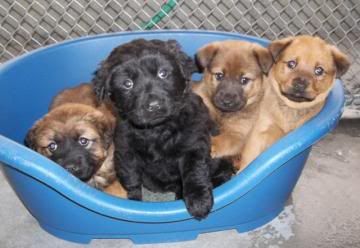
There were two males and two females in the litter. The males are slightly curly-coated and are on the left side of that picture. The females, Jackie and Erin, have slightly shorter, straighter fur and are on the right.
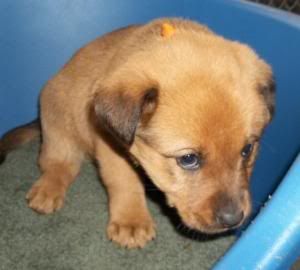
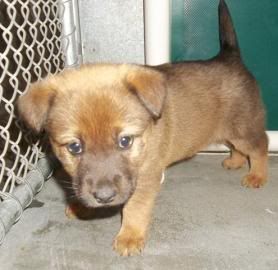
As more and more puppies flooded into the shelter, and it seemed like these plain brown mystery mutts might get overlooked while adopters lined up for the wire-haired terrier pups and eye-catching merle Aussies, I pulled the two girls. Erin and Jackie went to South Robeson Vet Clinic to wait out their 10-day quarantines. A few days later, the boys went home with private adopters.
One week after Jackie and Erin left the shelter, RCAS shut down because of a distemper outbreak. Canine distemper is a constant threat in Robeson County, where a dense population of raccoons acts as a year-round reservoir for the disease. Although distemper is easily prevented by a cheap and readily available vaccine, many people in the county simply can't be bothered to save their dogs' lives for $4.
Dogs are vaccinated against distemper and parvo upon intake at RCAS, but the vaccine needs time to be effective. The outbreak gave them none. Within a week, over 40 animals lost their lives to distemper.
Because distemper is such a nasty disease -- the estimated mortality rate is 90%, and even dogs who survive often have severe, lifelong neurological damage, leading most shelters to euthanize animals immediately upon diagnosis -- and the Trailer Park Kids left the shelter just before the outbreak was announced, they spent an extra week in quarantine as a precaution.
On the last day of that quarantine, Erin collapsed with parvo.
Canine parvovirus is the other major disease that afflicts Southern shelter puppies. Although less of a death sentence than distemper, it's more common, because the virus can live longer outside of its host. Provided the pups receive aggressive and prompt treatment, parvo's estimated fatality rate ranges from 20% to 50%, depending on the age, size, and health of the puppies afflicted. Without treatment, fatality can go as high as 80 to 95%.
It's probable that Erin and Jackie were exposed to parvo before they left RCAS. Both had loose stools and were not in the prime of health when they arrived at the vet clinic, although they were initially diagnosed with coccidia (an extremely common, less deadly bacterial parasite that causes many of the same symptoms as parvo) instead. If that's the case, I fear the worst befell their brothers. None of the local vet clinics reported receiving them (as other puppies came down with parvo at the same time that the Trailer Park Kids did, RCAS rescuers made an effort to tally the cases and measure the extent of the outbreak), and untreated parvo in puppies that small and that young is almost always fatal.
Even with immediate and aggressive treatment, Erin died 12 hours after being diagnosed with parvo. Hers was an aggressive and fast-moving strain, and she and her littermates were small, young, and susceptible.
Erin's death was the first time I have ever lost one of my rescue dogs. It is an unhappy milestone, but one that every rescuer and foster has to confront sooner or later. If you do this long enough, eventually you will lose. Even if you don't go out of your way to take the hard cases (and I definitely don't), eventually you lose.
It happens. But knowing that doesn't make it much easier.
I never even met Erin, but that didn't make it much easier either. You second-guess yourself: what if I'd had the puppies boarded at a different vet clinic? What if I'd had her in foster care? Would that have changed the outcome? Or would it just have exposed other dogs to parvo and made things worse?
There's no way to know, and no way to change what's been done.
And, anyway, the story's not all sad.
Although she didn't show any symptoms other than loose stool (which, as noted, was ambiguously attributable to coccidia and not a sure indicator of parvo), Jackie was put on Tamiflu as a preventative as soon as her sister was diagnosed. This turned out to be a wise precaution, as she came down with full-blown parvo a day after Erin died.
Perhaps because of the Tamiflu, or because she was a little bit stronger, or just through the random whims of fate, Jackie pulled through the disease after three days of touch-and-go doubtfulness. As of this writing, it looks hopeful that she'll make a full recovery and be able to take a transport up to Philadelphia at the end of next week. Two weeks behind schedule, but we'll be grateful to have her at all.
It's been a month since Crookytail arrived, and although I still sometimes have secret qualms about keeping him (mainly when he decides to ignore my shouts of "nooooo" and eat some soggy hamburger bun off the street, or tries to galumph toward an obviously unreceptive dog to say hi, despite my best efforts to haul him back, or is just a drag-ass pain in the butt generally), he's still an exceptionally easy and friendly dog -- such a good family dog that I feel vaguely guilty claiming him as my own foster failure.
But mine he is, and here's where we are training-wise at the end of month one:
He also has "Box" (go into the crate), Front, decent leash manners (apart from the snarfing of ground treasures, pulling toward other dogs, and occasional random balkiness...), and an okay-ish recall (which is actually a very good recall for one month of work, but I am demanding and impatient). So: not bad, but now that he is My Dog instead of a Temporary Dog, I'm always about wanting more more more.
That's doubly true of Pongu-e. We're working on position practice and paw discrimination exercises. I recently got Julie Flanery's T.A.P. DVDs and realized just how weak our foundations were (Pongu didn't even have a proper Stand cue, that's how feeble we were on foundations), so that's what I'm trying to teach and sharpen up now. Got a ways to go...
The T.A.P. program has also been humbling in that it's shown me several mistakes I was making in my training, such as allowing physical cues to overshadow verbal ones. The solution is so simple that I'm embarrassed I didn't figure it out earlier: instead of giving the verbal cue simultaneously with the gesture, give it a second or two before the gesture, so that the dog learns to anticipate the sequence and is soon performing based on the verbal prompt alone. This is literally twice as fast as what I was doing before, and good lord do I feel dumb for not having realized it sooner.
Oh well. Got it now. Here's Pongu learning "Cross Your Paws" by repeated verbal --> gesture prompts. By the last one he's going on the verbal without waiting for the physical, although unfortunately it's hard to see because each successive repetition shifts him slightly to the left so he's partly out of frame by then.
Goals for the next few weeks: sharpen up Pongu's position exercises, get them performed reliably in Heel and Right position (Pongu's pretty good at Heel, not as good at Right, doesn't have the first clue about Behind, so we'll have to start from zero on that one), and start Crookytail learning the same.
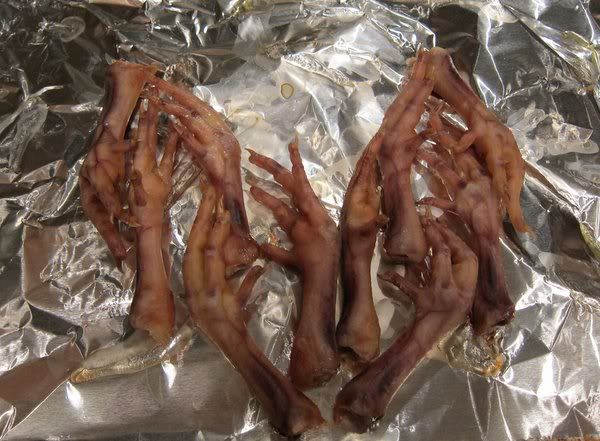
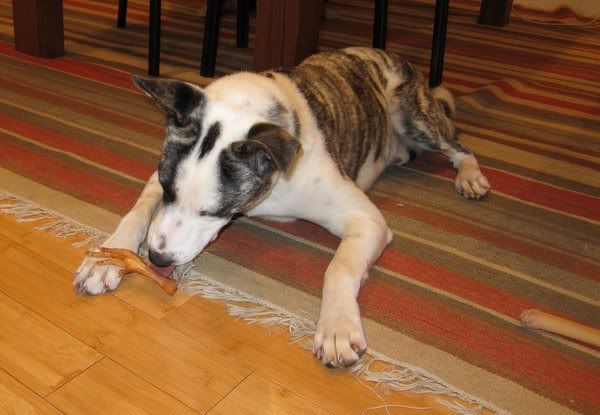
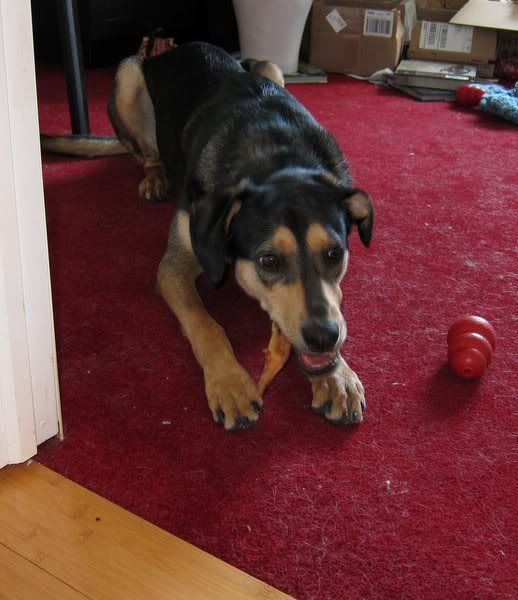
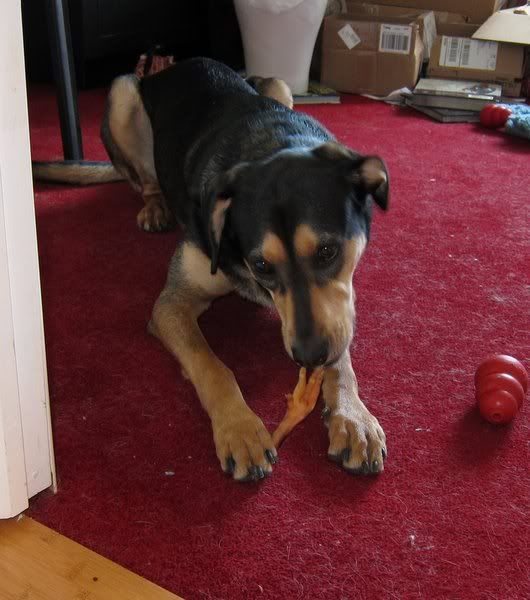
Still don't have much time for blog updates (sorry kids, I know you're devastated) but as a Valentine's treat to my dogs -- who are, of course, my real Valentines; to hell with that other two-legged person-thing who lives in the house -- I bought them a bag of locally raised, vegetarian fed, humanely pastured chicken feet from the Fair Food Farmstand.
(I'm not sure who else buys these chicken feet. I suspect they are like the beef hearts at the Winter Harvest CSA: a novelty item that gets listed because the butchers who supply these markets like to show that they really do use every last bit of the animals, and that occasionally people buy in a rush of misguided optimism, but that no one other than my mutt monsters will ever actually eat. The guy at Winter Harvest was super stoked to see someone else buying beef hearts, and excitedly asked me if I had any good recipes for them. He was disappointed to learn that I just use them for dog food [high taurine! high iron! a fine supplement for your dog's diet!] and then sheepishly confessed that he'd had a beef heart in his spare freezer for about a year without any idea what to DO with the thing. So next time I stop by Winter Harvest he's going to give me that beef heart for free, just so it doesn't go to waste. Score! Although I do feel bad I couldn't help him out any better than that.)
Anyway, so back to chicken feet. I threw them in the oven for a couple of hours at 200 degrees to kill off germs and because Pongu missed the memo re: dogs are supposed to love raw food. He refuses to eat raw meat (with a grudging exception for quail); I have to cook things before he'll touch them. However, chicken feet do have small bones in there and I'm paranoid about splintered bones causing problems, so I kept the cooking to a low-heat minimum and the bones stayed nice and flexible.
A Valentine's heart of nasty scaly lizard feet for my puppies. <3 <3 <3
The dogs LOVED them. So much. Pongu ran around trying to rip extra toes right out of Crookytail's mouth. Mmm, toenails...
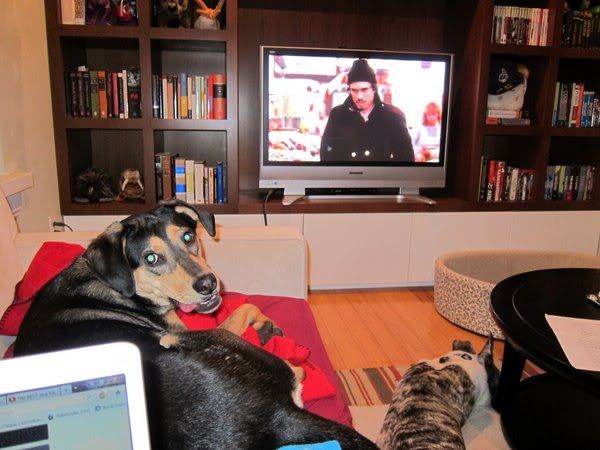
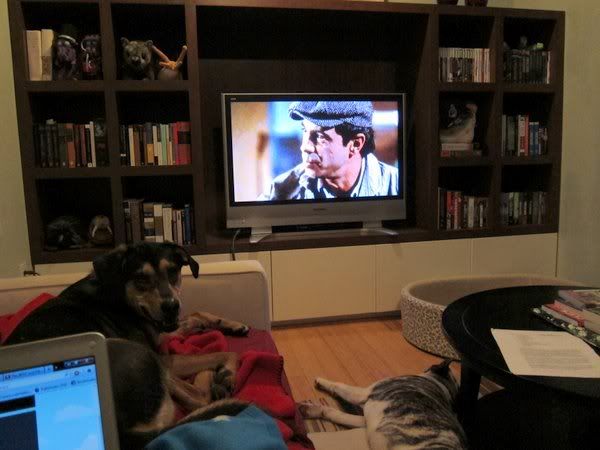
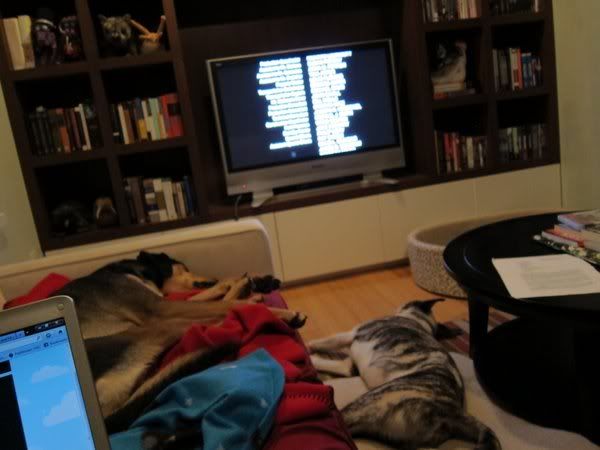
Pretty busy so don't have time to blog much, but here's a quick series of photos of Pongu and Crookytail (not) enjoying the Sylvester Stallone 1986 action epic COBRA, featuring hott '80s hairspray and an axe cult dancing in a warehouse and a whole lotta super tough match-chewing.
Crookytail gave up on this thing almost immediately. Pongu hung on a while longer (I like to think he was marveling at the WTFness of it all as much as I was) but he conked out before the credits too.
Their increasing disillusionment with this movie brings me so much joy.