Showing posts with label nuts and bolts. Show all posts

Tuesday, December 27, 2011

Nuts and Bolts: Chew Toys

Dogs need to chew.

Our foster mutts, being mainly adolescent puppies and young adult dogs, especially need to chew. Kongs are and will always be my #1 favorite dog toy, but they don't satisfy the need to gnaw. So I have spent many months experimenting with chew toys, because that arsenal of rawhides and fake bones is all that keeps our furniture (sorta) safe.

But chew toys are expensive, and not all of them are safe, and some aren't really "chew toys" at all, depending on the vigor and determination with which your mutt destroys things. And so we have this post.

Not Chew Toys: Ropes, tennis balls, soft rubber squeaky toys. All these toys can be great fun for dogs, but you should always supervise a mutt who has them, because they're easily torn apart (yes, even the tennis balls -- I've met dogs at the park who could shuck the green coating off a tennis ball faster than I could peel a banana, and then split the ball inside with one precise chomp, creating not one but three spiffy little choking hazards). Rope toys in particular seem to get shredded into dental floss really quickly in my house... and then whoever did the shredding tries to eat them, potentially resulting in some very expensive vet bills.

Also not chew toys: pig ears and dried jerky treats. They're fine treats (within reason -- pig ears have a lot of calories!), but they just don't last long enough to be worth the name. Tendons are borderline, but I've never had one last longer than a minute and a half so I don't think those are really chew toys either.

Chew Toys: Everything else in this post.

As a blanket statement, given all the concerns about the safety of imported pet foods and treats (which, as of this writing, have recently flared up again with respect to chicken jerky treats from China), I would personally look for toys made in the U.S. or Canada (and, where relevant, from animals raised in the U.S. or Canada) and avoid anything made in China.

Antlers: A relatively recent arrival on the chew toy scene, these are deer and elk antlers sawn into standard lengths. Most of the dogs I've given them to have been intrigued by the antlers but not hugely possessive of them, so I'd consider them medium-value toys on average. I stopped providing antlers after hearing one too many horror stories about dogs cracking teeth on them; they are very hard, and probably ill-advised for a vigorous chewer who likes to really crack down on her teeth. But for a less intense chewer I think they'd be fine. They last a long, long time.

Cheese Chews: Rock-hard plugs of yak milk preserved via traditional methods using salt and lime juice, these are sold as "Himalayan Chews" or "Churpi Chews." The label claims that these are cheeses traditionally eaten by the people of the Himalayas, which leads me to believe these people must have teeth made out of diamonds and kryptonite, because these suckers are hard.
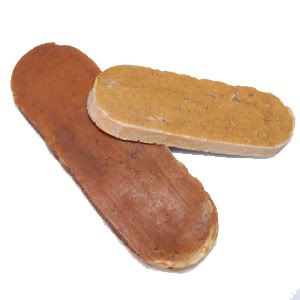
The cheese softens after a little while, allowing the dog to scrape it off and eat it... and make a fair amount of mess, if your mutt's not a super neat eater. Dogs seem to value these more than just about any other chew toy I've tried (although some prefer rawhides) and may quarrel over churpis if they're resource guard-y about food. They don't last quite as long as antlers, but on the other hand I've never heard about them cracking teeth, either.

Hooves: Dried cow hooves (theoretically sometimes other animals' hooves too, I guess, but I've only ever seen cow hooves for sale). I have no experience with these. I heard too many stories about dogs breaking teeth on hard hooves and cutting open their gums on sharp ones and decided it wasn't worth the risk. YMMV but I've honestly never heard anything good about using hooves as chew toys.

Nylon and Polyurethane Bones: Nylabone, Hartz, and other companies make these in a variety of shapes, sizes, and textures. There are varying durability levels so that you can choose a bone tailored to your dog's chewing intensity.

I feel like kind of a bad owner-person because Whole Dog Journal doesn't like these fake plastic bones, but I sure do. Yeah, they're all made of chemicals and synthetic stuff. Yeah, some dogs will reject them because they probably smell and taste artificial, being made entirely of chemicals and synthetic stuff. But none of my mutts has ever turned down a fake bone and they last a long time and they don't break teeth, and generally they're not valuable enough to fight over so I can leave them lying around the house all the time.

So I guess you have to decide for yourself whether you're okay with your dog ingesting tiny scraps of plastic and choose accordingly.

Real Bones: Actual bones should be divided into two groups: baked bones (this includes the clean white sterilized ones) and raw or lightly boiled meaty bones (made at home from raw bones; as far as I know, no one sells boiled bones commercially). These are all bones from large mammals -- pigs, cows, bison and so forth.

Baked bones are too hard for your dog to chew safely, pose some risk of splintering when broken, and, in my opinion, are not safe to give to your dog. Raw or boiled bones are safer but should be further subdivided into marrow bones and knuckle bones. Marrow bones can still be too hard for vigorous chewers and should be taken away once the marrow's gone (although you can then re-stuff them with other fillings and use them like Kongs); knuckle bones can be eaten until they get small enough to pose a choking hazard. Both types last a moderate amount of time, make a pretty big mess (which may be a raw meat mess you don't want in your house), and are valuable enough to spark fights between resource guarders.

Rawhides: Rolled and/or compressed pieces of animal skin (usually cowhide, sometimes pigskin) shaped into knots, braids, circles, and all kinds of crazy designs around major holidays. May be flavored, bleached, or dyed (or painted with titanium oxide to turn them a nice pearly white -- avoid those!).

I look for treats made from thick sheets of undyed, unflavored rawhide. I avoid sticks and gimmicky shapes made from compressed scraps (most of these are dyed and many are artificially flavored, giving me even more incentive to skip them) because you don't know what's in the binders -- companies are not legally required to disclose this information, and given the kinds of crud manufacturers are willing to shove into pet food, I shudder to think what they're using to make the toys. If I can't read the ingredients on the label, I ain't buying it.

And even with all this work, Pongu's still bored with rawhides. He used to love them, but I guess he hit his saturation point months ago; now he has no interest in them whatsoever unless he's taking one away from a foster dog. Oh well. More for them... in the crate.

Wednesday, September 7, 2011

Nuts and Bolts: Give Your Dog A Bone

I like to feed my dogs bones as an occasional treat every couple of weeks. I'm not an advocate of the BARF diet (it's really just not feasible to feed enormous messy chunks of bone and gristle every day when you and your dogs are sharing a 900 sq. ft. condo with no yard), but I do think there are some nutritional and dental benefits to be gleaned from letting a dog chew on a good meaty bone every now and then. Plus, they really like it. REALLY like it. To the point where I supervise them constantly and sometimes separate them by crating one of the mutt monsters before anybody gets a bone, because otherwise I'll have a fight on my hands.

There are, however, a few commonsense precautions to be observed when giving your dog a bone. First, everyone agrees that brittle bones are a no-go. Cooked chicken and turkey bones are the best-known example -- they can splinter when broken, leading to perforated intestines and a severely, even fatally, hurt dog. It doesn't happen every time (or else every dog who got into the Thanksgiving garbage would be in trouble), but it happens often enough that it's just not worth the risk.

Dry roasted beef bones can be dangerous in a different way. These bones, which are often sold in supermarkets as pet treats, are extremely hard and can actually crack or shatter dogs' teeth while they're being chewed on.

Raw bones are generally accepted as safe (other than long beef marrow bones, which are still too hard for most dogs to eat easily even when raw -- I think it's fine to give them to dogs who like to slurp the marrow out in the same way they lick out the filling of a Kong, but if you have a dog who tries to brute-force crack them open with his teeth, it's probably best to skip these). But, and I'll readily admit this might just be my own nutty hang-up, raw bones and gristle are kind of germy and gross and honestly I don't want them being dragged all over my deck. If we had a yard I might feel differently, but we don't.

So I give my dogs lightly cooked bones. I buy beef knuckle bones and occasionally short bones from Whole Foods (and only from Whole Foods or trusted farmer's market vendors, because I've been totally paranoid about mad cow disease since the late '90s and by god I am not feeding my dogs bovine spongiform cannibal cooties), boil them in broth for about 10 to 20 minutes (shorter for marrow bones, longer for knuckle bones), and hand them off to the mutt monsters once they've cooled down. The gristlier the bone, the better; much of the benefit comes from the tough connective tissue and attached gristle, not just the actual bone itself.

MMM KNUCKLE BONES.

Boiling them is pretty safe; if your dog can tolerate raw bones (and not all can -- some dogs are prone to impaction or constipation from eating bones), he can tolerate lightly boiled bones. The cooking method is very moist and doesn't dry the bones out, so there's no more risk of splintering than there would be with raw bones.

Leftover bones go in the freezer, because these things do not keep more than a few days in the fridge. And there usually are leftovers, both because I like to boil them in big batches and save the extras, and because I generally take the bones away after the dogs have been chewing on them for half an hour or so. Otherwise they'd try to eat the whole thing in one sitting, and then they'd probably get constipated. Half an hour's chewing at a time seems good -- long enough for them to get completely satisfied, not long enough to eat themselves sick.

Once the bone's been chewed down to about the size of a hockey puck (i.e., there's some remote risk that the dog might swallow it whole), I throw it away. And that's that for bones.

Tuesday, September 6, 2011

Nuts and Bolts: Dog Stew

I cook for my dogs.

I cook for myself too, obviously, and on rare occasion I even cook for my husband, but people only seem to think you're weird if you cook for your dogs. Pssh to that, I say. Dogs like a good home-cooked meal as much as anyone else.

Of course, what counts as "good" from a dog's perspective may not line up perfectly with our ideas. Most people don't much care for pureed chicken bones in their soup, and it's generally accepted that a little spice improves people-food... but dogs have different notions. Bland and meaty works for them.

Here's the simplified version of my dog stew recipe. The full version takes two to three days to prepare (instead of about 20-30 minutes for this one) and may get you in trouble with your neighbors*, so in the interest of not coming off as completely insane, I'll just post this. I normally serve it mixed half-and-half with a good quality kibble like Acana or Orijen.

DOG STEW

-- 1 can chicken or beef broth or stock (or consomme, or whatever you have on hand -- low sodium is preferable when available, but it's not of huge importance)
-- 3 pounds of ground meat (85% lean beef, chicken, turkey, pork, lamb, or any mixture thereof)
-- 1 and 1/2 cups of finely diced vegetables (equal parts carrots, yellow squash or zucchini, and green beans)
-- generous handful of quick-cooking or rolled oats (probably about 1/3 cup but I've never measured)
-- 6 eggs, whisked together

Cook the meat in the broth over medium to low-medium heat until the meat is thoroughly browned, stirring occasionally to break up big chunks. You want lots of little pieces, like in chili or spaghetti sauce.

Add the rolled oats, cook on low-medium heat about 5 minutes or until the oats are done.

Add the vegetables and cook another few minutes, then add the eggs and stir a few times to break up any big chunks (ideally you want little pieces of egg throughout, kinda like egg drop soup). Remove from heat as soon as the eggs are cooked through and visibly white instead of clear. The vegetables should still be somewhat crisp.

Easy variations: replace some or all of the oats with red lentils, quinoa, or rice (be sure to increase cooking time accordingly!); replace 1/2 pound of the ground meat with an equal amount of diced organ meats (chicken and beef livers are easy to find in most supermarkets); use yellow (or purple!) beans instead of green ones; use different types of summer squash in place of the zucchini or yellow squash. I'm of the opinion that variety in a dog's diet is a good thing, both for improved nutrition and just for the sake of keeping things interesting.

If you don't give your dog bones to chew on regularly, then calcium deficiency may become an issue. You can remedy this by powdering cleaned and dried eggshells in a spice or coffee grinder (or just crushing them with a hammer or rolling pin -- the point is that they have to be reduced to powder, however you do it), then mixing them in with the oats. 3 eggshells is a good amount for one batch of dog stew using the quantities listed above. Then you get calcium and don't annoy your neighbors!

A caution: Not all dogs tolerate all foods equally well. There are dogs who are allergic to some kinds of protein and can, for example, eat chicken but not beef. Some dogs have grain allergies (although these are mostly related to corn and wheat; oats and rice tend to be pretty well tolerated). I once tried adding cottage cheese for the calcium but that didn't work out too well for Gremlin, who turned out to have problems digesting dairy.

The above recipe is pretty safely middle-of-the-road and I've never had problems with it, but that's no guarantee that your dog will automatically have the same experience. Try it with my blessing, but be sensitive to what your dog is telling you: if she doesn't want to eat it, there may be something in that particular combination that doesn't work for her.


(* -- The full dog stew recipe involves boiling down bones until they're soft enough to be pureed in a blender. This takes DAYS. It is also a very fragrant process that caused our neighbors to think that the sewage pipes were leaking inside the building, resulting in confusion and embarrassment for all. I now do my bone-boiling outdoors on the windiest days I can manage, and do not recommend it for anyone else because, while I am completely bonkers, I'd like to think you aren't.

Besides, you can always just give your dog a bone to chew separately.)

Monday, August 22, 2011

Nuts and Bolts: Proofing

"Proofing," in dog training, is the concept of practicing a trained behavior in new and gradually-more-distracting environments until the dog can reliably perform it out in the Real World. It's a critical part of getting a foster pup ready for adoption, because adopters expect that a dog who's advertised as "knowing how to Sit and Stay" will be able to actually do these things out on the street, not just in the quiet of his own living room.

Fortunately, it's very simple to do. It just takes time, patience, and repetitions. A lot of repetitions.

I ended up accidentally recording a demonstration of proofing in action when I started making a series of short Youtube clips to show Gremlin's basic obedience training.

We started with "Sit." By the time I recorded this clip, she had a pretty good Sit inside the house. But when I took out the camera to record it, suddenly Gremlin's response became a lot slower and more unsure -- because having the camera blocking my face was a new, alien element that puzzled her mightily. Behold:


However, even though she was confused by the camera, she still performed the command. Bravo!

When you're proofing something (or somewhere) new, you can't expect the dog to execute a command as perfectly as she did in the old familiar place. Substantial compliance is all you're looking for, initially -- you can always raise criteria as the dog gains confidence. But in the beginning, even a halting performance deserves praise and treats.

So we spent the rest of that session getting used to the camera, and the next day I raised the proofing criteria by moving our practices to the condo hallway: a place that Gremlin was familiar with, having walked through it many times each day, but where she had not previously been asked to do anything.


Again, a little bit of hesitation and confusion (and an awfully lopsided Down that would win no awards in competition, but that's okay, perfect form isn't my goal here). But, again, she does it after a moment's pause.

And then, finally, I moved from the condo hallway to our local dog park -- a very distracting environment filled with freely roaming dogs (including Pongu!), other people, lots of things to smell/chase/bark at/play with -- and asked her for a Stay. And because we had gradually increased the difficulty of the practice sessions, Gremlin was able to maintain discipline even in the face of all those distractions. Could she have done it the first day? No, absolutely not. But by slowly adding to the environmental demands and building up her confidence, Gremlin was able to keep self-control even in the dog park.


What a good dog.

Thursday, June 2, 2011

Nuts and Bolts: Kongs, Glorious Kongs

I love Kongs.

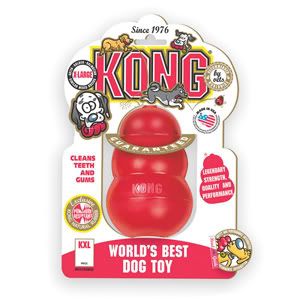
If I ruled the world, every dog would own at least one Kong. The miraculous distraction powers of those tough little rubber beehives may not be literally magical, but they aren't far from it. They serve simultaneously as treats, chew toys, puzzles and bouncing balls, and I have never known a dog who didn't love them (although I've certainly met dogs who needed a little help figuring out what to do with them at first!). Kongs should be showered with glory and hosannas... especially if you're a foster parent.

A Kong is a hollow, bumpy-surfaced toy made of super tough rubber -- the same kind used to make airplane tires, I'm told. The basic concept is simple: stuff food inside and let the dog try to get it out by licking, chewing, and dropping the toy. Simple as it is, however, it can keep a dog entertained for hours.

They're not kidding about the "world's best dog toy."
Because Kongs are so durable, they're probably the best value-for-money to be found in the world of dog toys. Most dogs can't damage a Kong, no matter how hard they chew, and there are extra-tough Kong Extremes for the rare ones who can. You can use a Kong over and over again (the regular ones are dishwasher safe, and it's pretty easy to scrub out any errant food bits with an old toothbrush and some soapy water), and by changing up what you stuff inside, you can keep them constantly new and exciting.

When a dog is first being introduced to Kongs, it's a good idea to use smelly food that's relatively easy to get, and to put it near the mouth of the toy so the dog can reach it immediately. Kibble bits loosely stuck to smears of peanut butter, dog biscuits just barely wedged in there, and other easy-to-get treats are good for beginners.

As the dog becomes more adept with working food out of Kongs, you can start really jamming the food into those things. Two of my favorite techniques are frozen Kongs and jerky Kongs.

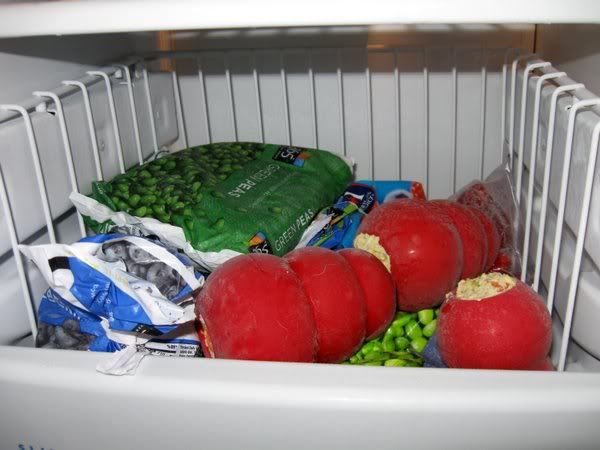
Frozen Kongs are awesome. Stuff a Kong with a mixture of wet food (I use homemade "dog stew," but canned food is fine too) and kibble, stick it in the freezer overnight, and in the morning you will have one of the finest dog toys known to humankind. It takes Pongu about 20 minutes to empty a medium Kong filled with frozen dog food and up to 30 minutes to empty a large one. Rawhide chews only last half as long. Pig ears are gone in a paltry three or four minutes, and with less nutrition and more calories to boot. The clear winner: frozen Kongs.

Our freezer pretty much always looks like this.

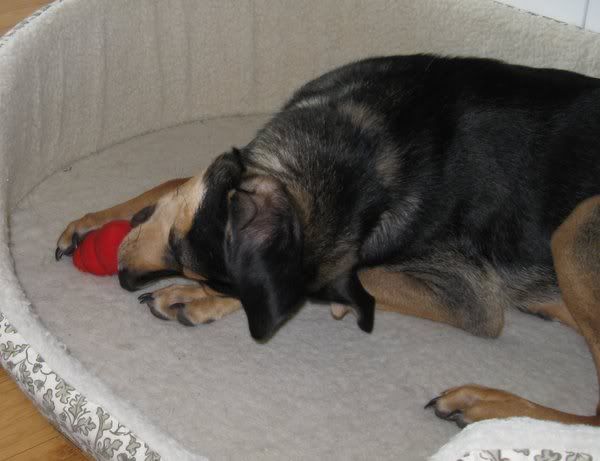
I love frozen Kongs so much that I feed foster dogs almost all their meals from frozen Kongs in crates. This prevents squabbling over food (since the foster's in a crate, Pongu can't steal its dinner) and helps the foster dog learn to think of its crate as a place where it gets delicious meals served in spiffy toys. Also, because the frozen Kong keeps the dog totally absorbed for a solid half hour, I can sneak away to take a bath or get dressed for work without worrying that the mutt puppies will get into trouble while I'm not looking.


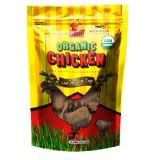
Only slightly less awesome is the jerky Kong, a fine alternative to use when you don't have six hours to wait for a freshly packed Kong to freeze or just don't think your dog needs that much extra food. I like to use Plato Wise Treats jerky strips, which are conveniently cut into just the right size and shape to wedge into a medium Kong (some of them are a little too thin to use alone, but if you stuff two of those in together, you've got a well-packed Kong).

Jerky Kongs, in my experience, last longer than peanut butter Kongs (unless they're frozen) or biscuit-stuffed Kongs. This is because as the dog chews and licks at the jerky stuffed inside the Kong, the dried meat absorbs moisture and swells, thereby becoming even more tightly wedged inside the toy. The dog can taste the meat, which encourages him to keep working, but it usually takes a good long time before he can actually wiggle the jerky out.

"...almost got it... almost got it..."
You can stuff just about anything you want into a Kong: cream cheese, peanut butter, kibble soaked in chicken broth, dog biscuits. If it's sticky enough to adhere to the sides or hard enough to be wedged inside and put up some resistance to tugging, it'll work. And your dog will thank you... or, like Pongu, drop his empty Kong meaningfully on your feet every morning.

Monday, May 16, 2011

Nuts and Bolts: Crates

Let's talk about crates.

While crates are extremely useful even when you're only dealing with your own dog, many people get by just fine without them. I did. Pongu whined and scratched and was so noisily pitiful whenever I put him in his crate that after the third day I just let him sleep on a towel next to my air mattress. (We were poor and furniture-free in those days, which was one of the reasons I was so cavalier about not crating him: even if he had been inclined to destroy my stuff, I didn't own anything he could chew.) The primary crate I use for foster dogs was a donation from a couple at my local dog park, who never used it with their dog for similar reasons.

If you only have one dog, and you can keep an eye on your dog all the time until you're sure he can be trusted, and your dog isn't terribly prone to chewing on furniture or making messes in the house, you can get by without a crate.

If you're fostering, a crate is an absolute lifesaver.

Most dogs in rescue networks have big question marks in their backgrounds. Many have never known a stable home -- or, for that matter, any kind of home at all. Some dogs have spent their entire lives on a chain outdoors or in a cramped puppy mill cage; to them, everything about living inside is new and confusing. They often aren't housetrained. They might not know the difference between a dog toy and a $300 pair of shoes... or an electrical cord for a plugged-in appliance. And, because most of these dogs are coming out of crowded, understaffed shelter environments (where stress and anxiety may create problems that the dog didn't have before going in), no one can tell you ahead of time if the dog knows these things or not. Crate training can save a lot of damage to your home, your patience, and the dog's confidence in the early days.

If you're dealing with a multi-dog household, a crate is even more important. It gives the foster dog a safe place that is immediately "hers" in another dog's territory. It allows you to separate the dogs for feeding, and to keep them separate while you're away from home. (No matter how good the dogs are together while you're around, it's unwise to leave them unsupervised until you can completely trust both or all of them -- and with an ever-changing foster rotation, that day may never come.) If they play together every waking moment, the crate may be the only way to grab a moment's peace and quiet for yourself.

Finally, as a foster parent, your ultimate goal is to help the dog get adopted into a suitable, loving forever home. Everything you can do to make the dog more "adoptable" helps, and crate training gives the dog one more point in its favor. And if the dog can't tolerate being crated, no matter what you do, then at least you know that and can match it to adoptive families accordingly.

Crates come in two main types: wire-sided collapsible ones and plastic-sided airline-approved crates. My personal preference is for the wire-sided type, which is easier to clean and easier to see into (so you can tell at a glance if your foster dog's getting into trouble), but either kind works. There are also fabric-walled crates, wooden crates, and crates that look like artistic sculptures, if you're not into wire or plastic.

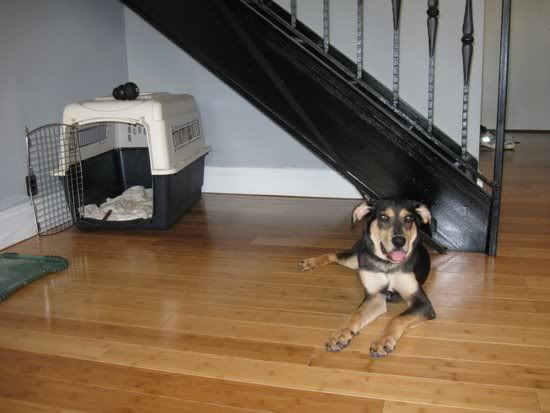
Whatever kind you choose, the crate should be large enough for the dog to stand up, turn around, and lie down comfortably, but not big enough to tempt the dog to potty in one corner and sleep in another. Fill up some of the empty space with boxes or block it off if the crate is too large. Put in an old blanket or towel as bedding. If possible, the crate should be in a quiet spot in a frequently-used room (we use a corner of the living room that's under a flight of stairs), so it feels safe but doesn't feel like banishment to Siberia.

Our crate is under the stairs in the living room: a quiet corner, but close to the family.
Many dogs will go into the crate immediately, seeking it out as a den or safe place. If the dog needs a little more encouragement, scatter a few bits of kibble or dry biscuits in the back (so the dog has to go all the way into the crate to get them). Don't close the door immediately. Let the dog sniff around and explore it, and make it clear that he can go in and out as he wishes. Once that seems comfortable, you can close the door for a few seconds, then a few minutes, and so on.

Always feed the foster dog in its crate. This both helps the dog to associate good things with its "den" and serves the functional purpose of keeping dogs separate so they don't squabble over dinner. Similarly, when you hand out long-lasting treats like rawhides or stuffed Kongs, always give the foster dog its treats in the crate.

Don't keep a dog crated too long. A few minutes here and there over the course of the first days, plus mealtimes and bedtimes, is plenty. You can gradually increase the duration, but a dog shouldn't be crated for more than three or four hours at a time (consider a midday dog walker if you have to be away longer for work), and if possible, tire the dog out with a good bout of exercise before and after such long spells in the crate.

NEVER use the crate as punishment or for a "time out." Even if you're frustrated beyond all human endurance and need to get every four-legged furball in the house out of your sight before you strangle every last one of them a la Homer Simpson with Bart, NEVER send the dog to its crate in anger. Put on a smile, hand out the rawhides, send everyone to their assigned places with singsong delight... and then go punch a hole in the wall and/or pour yourself a drink. But never, ever do anything to make the dog think of its crate as a bad place instead of a safe warm den filled with treats and snuggle blankets and happiness.

And voila!, you have mastered crates, the #1 tool for fostering dogs without losing your mind.

Saturday, May 14, 2011

Nuts and Bolts: Equipment

One of the things I'd like to do with this blog is note some of the things I've learned in the hopes that they might be useful to other doggy foster parents down the road. There's rarely One True Way to do anything in the world of dog training, but there are frequently practices that work most of the time for most of the dogs you'll encounter, and I think the same approach is reasonable when it comes to fostering.

In that spirit, here's a list of equipment that is generally a good idea to have on hand when you're getting ready to bring a new foster dog into your home. Most of these things are useful even when you just have one dog and it's your dog. They are damn near indispensable if you're trying to integrate a temporary second (or third, or fourth, or you-must-be-crazy) dog who may not have had the benefit of consistent training, or even know how to live with people inside a house. So here's my list of things that help maintain your sanity (and furniture) as you strive to get everyone acquainted and teach the foster dog what he or she needs to learn to become a well-behaved, "adoptable" family pet.

Necessities:
-- Crate
-- Bedding for the crate (I like to use old towels because they're absorbent, durable, and easy to wash, plus we got a bunch of really nice towels as wedding presents that turned out to be the wrong color for the house. But they're perfect for dog care!)
-- Collar with temporary ID tags (I use Pongu's old tags -- the name's wrong, but the number and address are right, and those are the important bits)
-- Leash
-- Food and water dishes (the foster should at least have its own food dish, if not its own water bowl)
-- Poo bags

Not Necessities, But Definitely Handy:
-- Kongs (two big Kongs for mealtimes, two medium Kongs for distractions)
-- Squirt bottle filled with water (for breaking up squabbles, discouraging barking, etc.)

-- Bitter Apple or similar chew deterrent
-- Rolls upon rolls of paper towels (...actually, maybe this should be a "necessity")
-- Nature's Miracle or similar enzymatic odor neutralizer
-- Your favorite multipurpose furniture/surface cleaner, and lots of it
-- A good assortment of dog toys and "distraction chews" (rawhides, pig ears, etc.)
-- Wet food (for packing into Kongs and freezing; I use home-cooked "dog stew," but canned dog food is fine too, the point is just to have something with a high moisture content that'll freeze solid)
-- Heartworm preventative
-- Frontline (flea/tick preventative)
-- EasyWalk or similar body harness
-- Training treats (Wellness makes a good line of these, also I use cut-up turkey hot dogs)
-- Clicker
-- Dry dog biscuits
-- Adult beverages. Not for the dog, for you. I'm partial to rum, myself.