Wednesday, October 2, 2013

Back in Nantucket

Because, you know, why not.

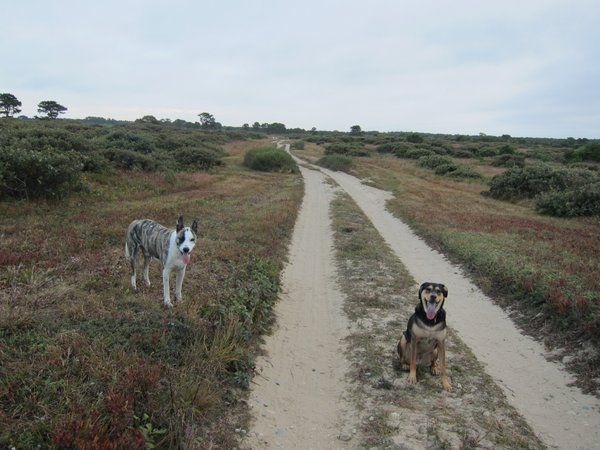
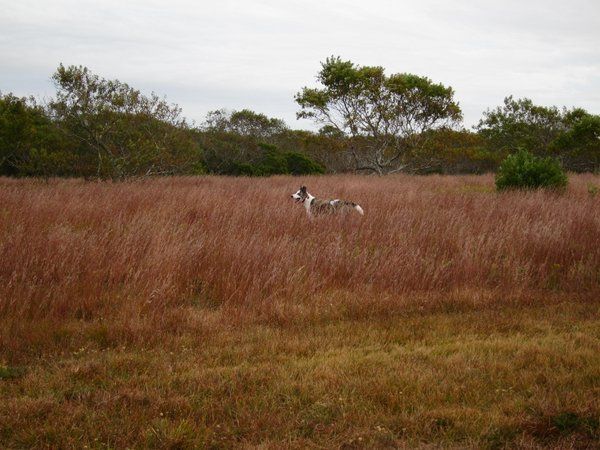
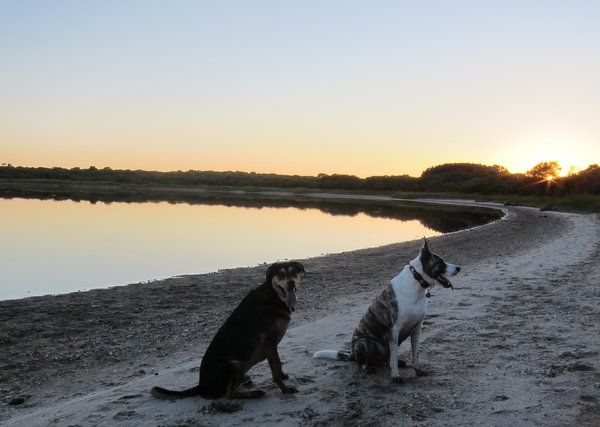
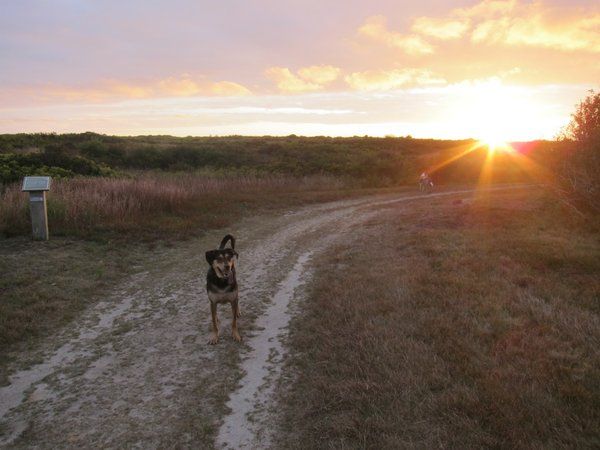
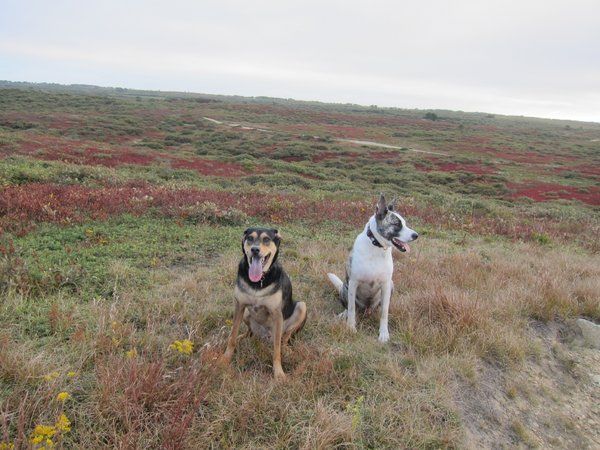
I wanted to see the island in the fall -- everyone says the Middle Moors are particularly beautiful when the foliage starts changing, and indeed, it is so. Would that I had a better camera (and the skill to use it) so that I could more adequately capture the color shifts between pink grass, red blueberry bushes, yellow-leaved grapevines, wildflowers in every hue, and sturdy greenery.


Tuesday, October 1, 2013

All Roads Lead to...

...where, exactly?

Recently I started a new training class -- the same one that I talked about in a previous post -- and while I'm still of mixed emotions here (so far it's not that bad, although I will admit to feeling a pang of alarm when the instructor said that we'd only be using clickers for about a month because she didn't see any value to them after that... oof), I'm trying to do the exercises with an open mind, at least for as long as I can.

We are, as I'd expected, spending a lot of time pushing and prodding dogs into place. So far Pongu is tolerating it pretty well; he's clearly puzzled by the whole endeavor, but he trusts me and is doing his level best to cooperate with what he understands the exercises to be.

Currently we're working on position changes: Sit, Stand, Down. The emphasis is on moving the dog (not allowing the dog to move itself) in such a way that all the position changes leave the dog perfectly in Heel position. Tuck Sit, fold-back Down, kick-back Stand.


This is important because, as demonstrated in this clip I made a really long time ago with Crookytail, the other versions of these movements will pull a dog out of Heel position very quickly. This is a Bad Thing in competition obedience, at least if you care about getting high scores.

There are a number of ways to teach these movements to achieve the same goal, though. With Pongu, I originally taught them using a platform and foot target:


Doing it this way can be slower up front. You have to teach the dog to balance on the platform and keep his front feet on the target. Then you have to teach him to move through the desired position changes while maintaining his footing on the platform and target.

If you do it with the push-and-pull method, there's no delay to get those extra foundations in place; the Sit-Stand-Down sequence is the foundation.

So at the outset it might look like doing it the "hands off" way with the platforms and foot targets is the roundabout inefficient way of doing things. Assuming that you're being careful about not actually hurting or worrying your dog with the physical manipulation method, why not use the faster technique?

Three reasons spring to mind:

First, while the platforms are slower up front, I am inclined to think that they save time in the long run, because you can use those same foundations for pivot work and balance/core conditioning exercises and tons upon tons of tricks. Some of those extras will help you in the competition obedience ring and some might not, but we don't (I hope) just have dogs so we can teach them only the Novice-through-Utility exercises and then nothing else ever for the rest of their lives. A dog who has learned to think creatively, and not just let himself be passively guided into positions, is much more fun for me to train over the long haul.

Second, because I think the dog internalizes and retains these lessons better when it's making its own decisions and coming to its own understanding of what is wanted. It's the same argument that applies to free-shaped behaviors vs. lured ones: yes, it might take a little longer to install early on, but the dog really understands what is wanted, and so retention is much stronger (not a small consideration when you're planning to ask for these behaviors amid the stress of a trial environment). I don't actually know whether this one is true, but I'll be watching to see whether my guess is right.

And third, because as I observed during that first introductory class, a lot of people aren't that careful about respecting their dogs' comfort levels. They may want to be, but in the hurry of a crowded, fast-paced class, a lot of novice handlers with novice dogs get flustered and frustrated (I know I did, before I learned to accept that sometimes we're just going to be behind the rest of the class and that's okay). Unable to guide their dogs gently into position, and seeing everyone else doing "better," they resort to ever-greater measures of force to bend their dogs into compliance.

It makes me uncomfortable to watch somebody handling a four-month-old puppy like an Ikea table that isn't coming together right. I know I get mad enough to just bang things either together or into pieces, and by the time I reach that level of frustration, I don't even care which it is anymore (one of several reasons why assemble-it-yourself furniture is a no-go in this household). But I'm not doing that with a puppy. Not when the failure is my fault, not his. Not over a silly game that we're supposed to be playing together for fun.

Ultimately, it should be possible for someone to get the same behavior by either method. I think that the methods used in this class are probably easier for a novice in some ways. But at the same time, I think they are harder on (not necessarily for, but on) the dogs, and that's not a tradeoff I'm willing to make.

All roads may lead to Rome, but some charge tolls that I'm not paying.

Monday, September 23, 2013

Teaching Tug

...is a thing I'm not especially good at.

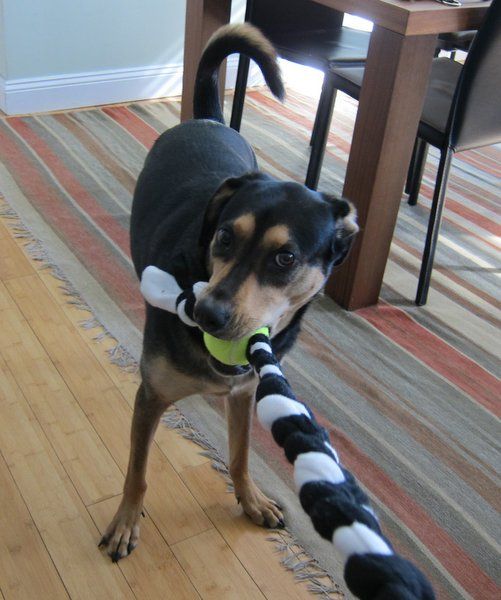
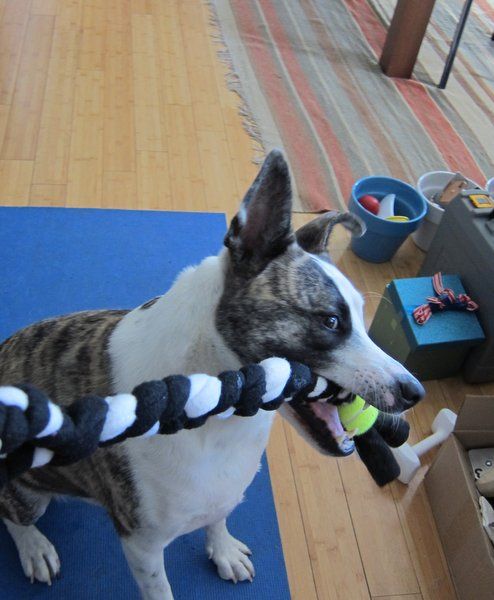
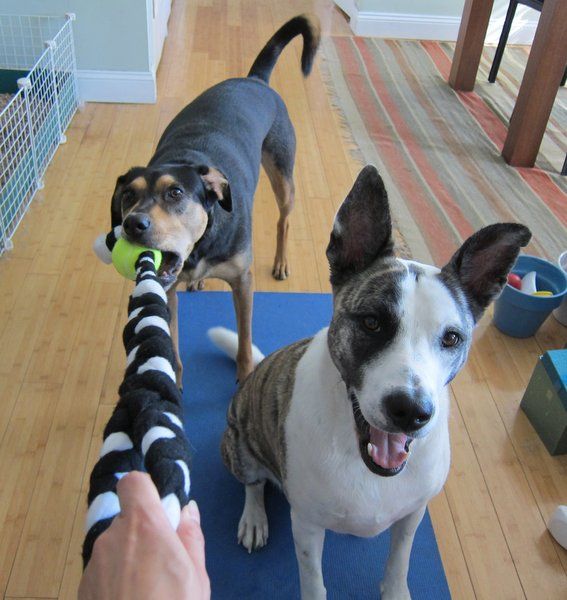
I rented the Michael Ellis DVD on how to play Tug with your dog. Hopefully I'll be able to get started watching that tonight and it will help. In the meantime, documentation of my own sad efforts:


^ most accurate summation of how our sessions usually go.

Sunday, September 22, 2013

IFP and Finding "Success"

Probably the last set of thoughts I want to muddle through on the subject of Imaginary Future Puppy has to do with the nebulous notion of "success" in dog sports. This, I think, is the most selfish and least defensible group of reasons, but it's there and it's a factor, so if I'm being honest then I have to admit that this goes into the calculation too.

At the outset, let's go ahead and admit that the idea of "success" in dog sports is really pretty absurd. It is. It just is. There are maybe 50,000 people in this country who care at all about dog sports, and they don't all care about the same ones. This is a tiny, tiny subculture. Competitive hot-dog eaters have an exponentially bigger audience; at least their events make the local papers when they're in town. Dog sports people are a niche on the level of, I don't know, competitive dollhouse stamp painters.

So on one level it is completely ridiculous to care about "success" in this endeavor beyond doing the best you can to ensure that you and your dog are having fun, because nobody else cares.* Your dog-sport friends will be happy to celebrate your success wherever you set the benchmark for that success -- whether it's winning a championship or just fixing a broken dumbbell retrieve (to cite one not-entirely-hypothetical example), your friends will be thrilled for you either way.

And your dog, who is really the most important party in this entire thing, will (if you're doing this right) be happy about whatever you're happy about. The dogs do not care about titles or ribbons or scorecards. What they care about, generally, is whether you think they did a good job, and possibly whether there will be a celebratory hamburger on the way home.

But, on another level, human nature is what it is, and if there is something to be won -- no matter how trivial it is -- people will vie to win it, sometimes to excessive extremes.**

And if you want to win, which I do, then you need a dog that can win.

It is generally recognized that a great trainer can win with a not-great dog (Exhibit A: Silvia Trkman, pulling greatness out of dog after dog with Issues), and that a lousy trainer will not win regardless of how awesome the dog is. But most of us are somewhere in the vast gray continuum between "great" and "lousy," and even the best handlers don't go out of their way to choose problems (for all her awesomeness, I don't think you're going to see Silvia trying to compete with an elderly, fearful, wheelbarrow-bound English Bulldog anytime soon), because a great trainer with a not-great dog is still going to lose to a great trainer with a great dog. So most of us are trying to choose dogs who have the potential to excel in whatever it is we're trying to do.

I know I am. The conventional wisdom is that it's the human who is usually the limiting factor in any team -- if the dog isn't being brought out to its fullest potential, that's on the human trainer -- but I honestly feel pretty comfortable saying that nope, the limiting factor for us right now is Pongu. He is what he is and I love him times a million, but he is also the partner who spent 40 minutes hiding in another room when I first set up our new bar jump.

The problem I face while trying to choose Imaginary Future Puppy is that, while almost any dog on Earth should be able to do better than Pongu, that "almost" is pretty key. Because I don't actually know how to choose a sound competition prospect. Last time I tried, I wound up with Crookytail, possibly the only dog we've ever had who could somehow manage to be a downgrade from Pongu, so my track record on this front is not exactly awe-inspiring. (Admittedly, we've had foster dogs who were blessed with awesome potential. If I had kept Mab or Sydney instead of Crookytail, my perspective might be a whole lot different today. But, nope, I'm an idiot who kept the big slow dumb one, so here we are.)

So there is an element of Dumbo's feather in play here: I have no faith in my own ability to identify a top competition prospect, therefore I need the talismanic reassurance of a good breeder choosing a good puppy for me. I need the breeder to say "here, this is the one, this is the dog who can do everything you want." Then I will believe it, and I will take this puppy and attempt to do everything with full faith that we can achieve it.

But right now, my ambitions outstrip my experience. And this third dog is absolutely, totally, non-negotiably the last dog who can be in our house until one of the other two dies. I really, really need to get it right, and historically I suck at getting it right, so I'm going to outsource the pressure of choosing to someone who's better positioned to handle it: a knowledgeable and ethical breeder with a proven track record of successfully placing dogs in competition homes.

Ultimately it comes down to "I'm vain and I'm cowardly," but hey, those are factors too.

EDIT: lol I never actually wrote anything in support of my original thesis statement, wow that is sad even by my pitiful standards.

Anyway so that was just going to be the banal observation that "your demands of the dog are dictated by your definition of 'success,'" i.e., Pongu might be considered a raging success by some standards (such as my own, a year ago) but not particularly impressive by others (such as, I dunno, obedience people who love to hate on Rally? Although frankly I'd like to see them do anything with this dog. As the infinitely wise Bart Simpson would say: eat my shorts, Rally haters).

But obviously that is such a super banal point that it hardly deserves to be made, and also as I was in the process of writing it down (originally, not this time) it occurred to me that the fact that there are fewer rescue dogs who reach the pinnacles of whatever sport has probably less to do with the dogs themselves than the risk-aversion of the people handling them.

If you're going to invest thousands of dollars and hours in your dog's competition career (and a significant opportunity cost, since most of us only get to handle a tiny handful of dogs in our lives), most people are going to try to bet on the Complete Package, which is perceived as being the Purebred Performance Puppy partly because if the breeder is doing a good job, that is the complete package, but also because that's what you see all the other successful competitors doing, and it takes a certain bullheaded optimism to break away from the mold. It's sort of like how a lot of people in competition obedience and IPO "proof" on prong collars even if they don't particularly enjoy doing that to their dogs. If that's what all your teachers and role models are doing, and you never see anyone else doing things differently, you will probably do the same rather than risk having to fumble your way down an unknown new path and, in the process, maybe losing.

Basically, it's not that the dogs are themselves any worse, it's that people don't see them as often, and nobody wants to gamble on the less-sure thing. The AKC's Canine Partners rules further operate to push people away in a semi-insidious fashion because they ensure that almost any mutt will be more of a gamble than a purebred: because every dog without papers must be spayed or neutered to compete, it's just about guaranteed that you will not get to see your dog's parents, aunts/uncles, littermates or progeny on the competition field. Every mutt, and most cross-breds, will be a first-generation unknown.

Sucks. But definitely discourages people aiming for top-level competition, even though it has very little to do with the actual merits of the dogs and much more to do with the inability to observe their ancestors and relatives in action.


(* -- Actually, this isn't quite true. There is a small but vocal subset of people who are not your friends and yet may still have something invested in your success or failure: the people who are out fighting the Training Methodology Wars. To a large and happy extent, this war is over in agility and Rally, and [I think] it's dying out in competition obedience, because it has been [mostly] well settled that you can achieve top honors in those sports by a variety of methods, therefore people can just pick whatever fits their own personal values best, stfu, and get on with training their dogs.

However the war is active in full-flame fury in IPO, where it is still vocally believed in many quarters that you cannot title a dog without the use of force [although, predictably, just as happened in every other sport, the goalposts are being reset to "you can't win national competitions" and then to "you can't win international competitions" as people begin overtaking the earlier marks], and it's not entirely dead in competition OB.

To the extent you might possibly care about being a poster child for one of these causes, you have to care about winning whatever the goalpost-of-the-day is. Personally, I'm tired of it and no longer all that interested in getting involved in such annoying and fruitless discussions. But it's Still A Thing, so I note it here.)

(** -- A brutally good short story on this topic is William Gibson's "Dogfight," included in his 1986 collection "Burning Chrome." It has nothing whatsoever to do with dog sports, but I like it as an exploration of the costs that can be incurred by the heedless pursuit of trivial victories. Plus it's just a damn good piece of spec fic writing.)
Saturday, September 21, 2013

Thoughts on IFP and the Role of Performance Homes

More ruminations on sport dogs and pound puppies and Fancy Performance Puppies...

There are, broadly speaking, two ways to approach dog sports: (1) You choose the dog first, and you get into sports based on what the dog enjoys and does well; or (2) You choose the sport first, and you pick a dog who's likely to be successful in that sport. I don't think either version is necessarily better or worse, just different. Many homes cycle back and forth between the two.

Category #2 is further complicated by how you choose to define "successful," but I'll get more into that later.

For the entirety of Dog Mob's sport career (which is a whole, what, one year and some change? Not exactly lifelong veterans here...), I've been in Category #1.

I got Pongu as a clueless newbie with no real aspirations beyond "adopt a pound dog and give him a nice home." I didn't even know what dog sports were. Then my puppy turned out to be insane and I got into sports because I read in a bunch of dog books that sports were a good thing to do for building up your fearful dog's confidence, and now, several years later, we're firmly ensconced in Crazy Dog Person Land because that's how we do things around here.

Crookytail was kind of an in-between case in the sense that I picked him out of the shelter because I had a vague notion that he might work out as a sport prospect, but HAA that didn't happen. He's still here, though, despite his complete inability to do anything beyond muddle through novice titles with crappy scores. And when I chose him I didn't have any clear idea of which sports I might want to do with him, and honestly the real reasons he stayed were founded on his sweet personality and my reluctance to go through another foster parting as rough as Stella's had been, not any actual demonstrated sport potential, so I classify Crooky as Category #1 too.

Imaginary Future Puppy will be in Category #2. I've been around a little bit longer, I've developed my skills a little bit more, and I now have a very concrete list of goals that, at least in IPO, are unlikely to be met by a pound puppy.

This is a fairly common trajectory in dog sports, in its broad outlines if not its specifics. A lot of people start out doing sports just for fun with the family dog, and while a lot of people stay there, a significant chunk of them get bitten by the bug and start looking a more competitive dog the next time around. Probably the best-known example is agility people switching from other breeds to Border Collies, but it happens in all the sports, and the extent to which it happens is directly correlated to the competitiveness of the venue. People pick dogs that they think will win, and how you define "success" has a major influence on the dog you choose. But that, again, is a subject for another post.

What I want to get into this time around is the role of performance homes in dogdom.

There are not that many performance homes in the country. There just aren't. HSUS estimates that there are about 78 million owned dogs in the U.S., and the most persuasive estimate I've seen is that there are about 50,000 homes actively participating in all dog sports across the country. (This is murky and hard to guess, because there are a ton of different registering organizations, a lot of overlap in registrations -- a person is likely to be registered in, say, CPE agility, AKC agility, CDSP obedience, and U-FLI flyball all at the same time, but it's still just one home -- and difficulties in definitions; does a person who has taken two agility classes with their dog, but never competed in a trial, count as a "sport home"?)

If you are in that tiny fraction of performance homes, then where you choose to get your dog can have repercussions that extend beyond your own home and your own dog. It doesn't have to. But it can.

If you choose to adopt a shelter or rescue dog, you may become an Inspiring Example of how pound puppies can succeed in performance arenas, debunking the myth that only purebreds can win fancy titles and ribbons. Just by doing your own thing with your own dog, you may encourage other owners of pound puppies to give sports a try. You may be cited by the shelter or rescue organization as encouragement for other people to adopt dogs from that group, because look, its dogs are awesome!! And you may help other pet owners find a way to deal with their newly adopted pound puppy's unexpectedly high energy and athleticism. All good things.

If you choose to purchase a responsibly bred performance purebred, however, it also has the potential to do good things.

It's no secret that I am not the world's biggest fan of the conformation ring or what it's done to dogs. The first breed I seriously looked into getting was the German Shepherd, and there is nothing quite like the modern American GSD to give you a bleak view of the value of the conformation ring. If there is any actual benefit to breeding dogs for conformation showing instead of functional structure, working instinct, and intelligence, it has entirely escaped me. I've seen way too many pedigrees where all the dogs had Ch. prefixes but not so much as a CGC on the other end, and frankly that is depressing.

However, conformation breeders HUGELY outweigh performance and dual-purpose show/performance breeders in this country, and one of the big reasons for that is the lack of good working homes to take those puppies. Conformation breeders can sell all their non-show prospects to pet homes. Working breeders, depending on the breed and the specific litter, often cannot. A serious field-bred Lab or working Belgian would be a complete disaster in the average two-kids-and-white-picket-fence suburban pet home.

This difference in demand is why a pet-quality German Shepherd puppy from top show lines often costs $2500-3500, while a performance-quality German Shepherd puppy from top working lines can be had for $1500 or less. But it's that working line, in my opinion, that really deserves to be preserved as what that breed is supposed to be. And it is largely up to performance homes to support the breeders who are striving to do that.

In smaller breeds, like the Belgian Tervuren, performance homes are even more critical. These are the homes that are able and willing to train and title their dogs to high levels, and thereby prove the merits of potential breeding prospects for the preservation of the breed. The working Belgian Tervuren population in the U.S. is tiny -- fewer than 100 such dogs are born each year, and there's a lot of overlap in their pedigrees. Expanding the gene pool with proven, breedable working dogs is key to keeping that breed healthy.

It's possible to obtain an excellent sport prospect from either of these sources, of course. And whether you choose to adopt a performance pup from a shelter or rescue or buy one from an ethical breeder whose vision you support, there is no wrong answer. But either choice has the potential to shape the bigger world of dogdom in slightly different ways.

Friday, September 20, 2013

Thoughts on IPO and IFP

The first and most obvious chunk of reasons that Imaginary Future Puppy probably won't be Imaginary Future Pound Puppy relate to some of my chosen sports.

I'm hoping to get into IPO/Schutzhund with the next dog. I'm a total novice to this world -- I've never trained in it and I've certainly never titled a dog in it -- so much of this is from the perspective of a newbie fumbling through a fog of ignorance.

Even allowing for that, though, I think it's particularly difficult to find a solid sport prospect in the shelter system if the sport in question demands specialized traits and instincts in the dog. If you really, really want to compete in retriever field trials or high-level herding, it helps a ton to choose a dog from a specific lineage bred for that job. At that point, you're not just looking for "a Labrador Retriever" or "a Border Collie," but for specific pedigrees and ancestors in the line.

The same is true in protection sports. Not every German Shepherd or Belgian Malinois will succeed. Your odds are considerably better if you select a dog from a lineage bred specifically to work in that area.

Additionally, for obvious reasons, most shelters are not real eager to adopt out dogs who show signs of being willing to bite people (even in play, which is the foundation of most IPO training -- the dog is taught that the "bite" is just a great game of tug), and the ones who do have that potential are likely to come with a host of other issues that I'm not necessarily equipped to deal with.

Many of those "issues" might be no more than typical high-energy adolescent rambunctiousness, but the fact remains that I do not, personally, want to deal with an untrained adolescent working-line German Shepherd or Malinois at this point in my life. This'll be my first working-line dog of a "serious" breed, and I really think I'll be best served by raising the pup from, well, a pup. Starting with the 80-pound version instead of the 8-pound version is probably more than I can handle.

One of the big pieces of conventional wisdom that IPO people like to emphasize is to be very careful about getting more dog than you can handle, especially your first time out... and while I'm sure there's a certain amount of scare-the-noob hyperbole in that, there's probably a fair amount of truth, too. Particularly in our situation (tiny condo, no yard, neighbors on all sides, two other big resident dogs who were here first), throwing a full- or mostly-grown male working dog into the mix seems like a Bad Idea.

Another factor that's more or less specific to IPO Land is that some clubs and training directors are very resistant to allowing "off breeds," let alone shelter mutts. From what (little) I've seen of the IPO world, it's not too welcoming to unusual breeds and unorthodox teams. Some clubs won't accept anything but German Shepherds, and some won't accept anything but Malinois. Even breeds like Dobermans, Rottweilers, and Bouviers are often disparaged as unable to do the work. The belief is that even if these dogs can participate in low levels of the sport (and, honestly, many can't), they'll never be "good" at it, so therefore they aren't worth the club's time or the wear and tear on the helper/decoy.

This isn't a universal sentiment by any measure (there are also plenty of people really excited to see "off breeds" succeed on the field!) but it's common enough to be a factor. Breaking into a new sport as a total newbie is hard enough as it is, and breaking into this particular sport as a force-free handler is even harder. There's only so much uphill pushing I can take. So when it comes to this particular issue, I'm out to make my life as easy as possible.

So all this leads to the question: If I didn't want to do IPO, and all my other goals were the same, would I be open to considering a pound puppy?

I might. All my other reasons weigh a lot less strongly. Which is funny, because I'm not even sure I will do IPO -- I might just try it briefly and drop out after two weeks -- but I want to keep the door open. Even if that means closing it to pound dogs.

Pound Puppies and Performance Land

Recently, Team Unruly wrote a long and thoughtful post on "Ten Reasons Why Your Next Sport Dog Should Be A Rescue." It's a good piece; it deserves reading.

It got me to thinking about why my next sport dog won't be a rescue.

I think it's important for shelter and rescue dogs to be welcomed in sport venues -- and their people, too. I remember vividly how much it bummed me out when I got the runlist for the first Rally trial we ever entered and, out of 55 or or so teams, there were three dogs that had obvious one-word pound puppy names and the other 52-ish were all fancy-schmancy craft-beer-sounding purebred names. (Later I discovered that some of those fancy-schmancy names actually belonged to rescue dogs whose owners felt they deserved to be saddled with the same silliness as any pedigreed AKC scion... but that first impression really stuck with me, and so did seeing only two or three other mutts at the show.)

I hold a strong conviction that sports are a good thing for dogs (all dogs! all of the dogs!!), and that sometimes people feel discouraged about entering them with pound puppies, and there is NO REASON this feeling should exist. For all the reasons discussed in that Team Unruly post, rescue and shelter dogs can do very well in many dog sports, and they deserve serious consideration as candidates.

But I'm still not planning to get one, and after reading that post, I felt a little guilty about it and thought I should examine my reasons more closely. I've been in rescue for a while now. I feel strongly that people who want family companions should look to rescues and shelters first, and that just about any kind of dog you could conceivably want is find-able in the shelter system eventually. And, of course, I don't dispute that strong sport candidates are dumped in pounds across the country every day. Many of these dogs, as the TU crew points out, are literally dying for want of homes that can handle their energy and drive.

So, having talked the talk, why am I not walking the walk?

Some good reasons, some not-so-good, some just idiosyncratic to my personal goals and past experiences. Originally I had intended to cover them all in one post, but it got way long even by my blatherful standards, so I'll break the discussion up into a couple of smaller posts and see where we get from there.

Again, this post is not meant to persuade anyone of anything. Nobody needs to be persuaded that purebreds are preferable as sport dogs; they already dominate all the sport venues massively. It's just sort of thinking aloud about why my own thoughts on that front have changed over time.