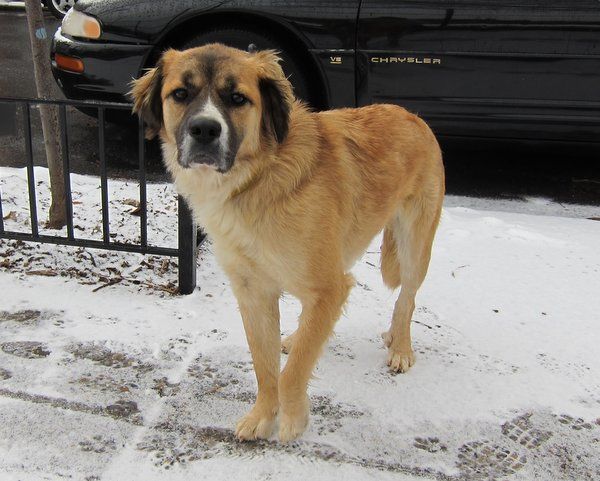
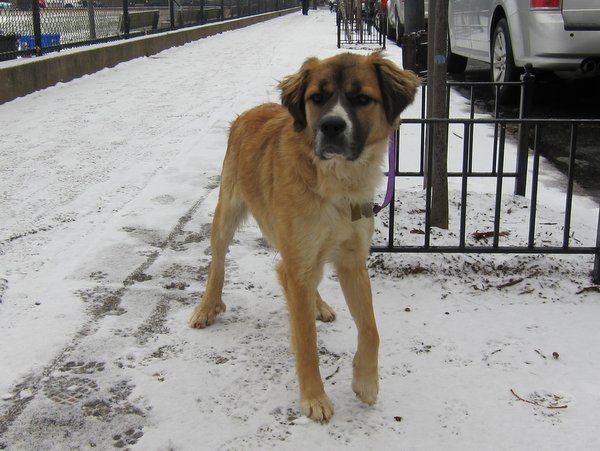
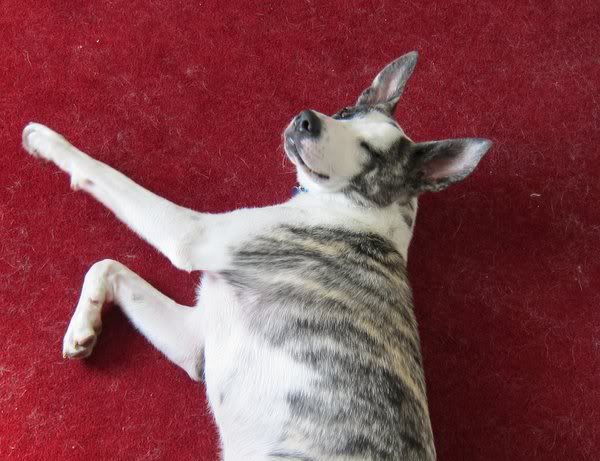
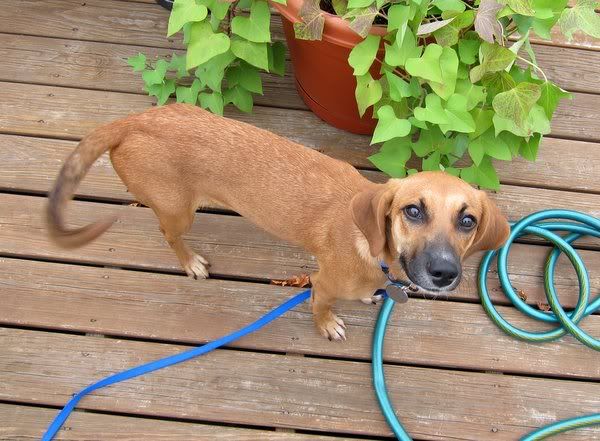
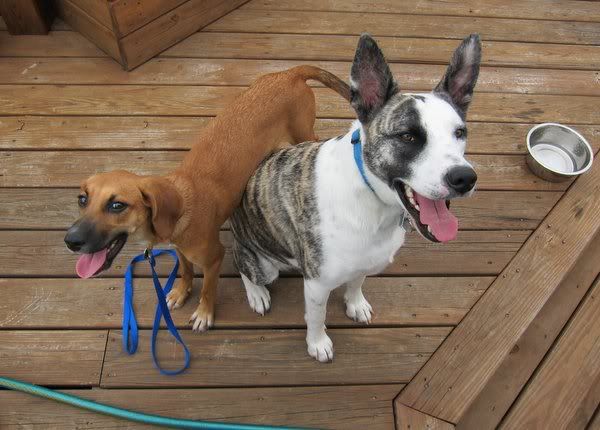
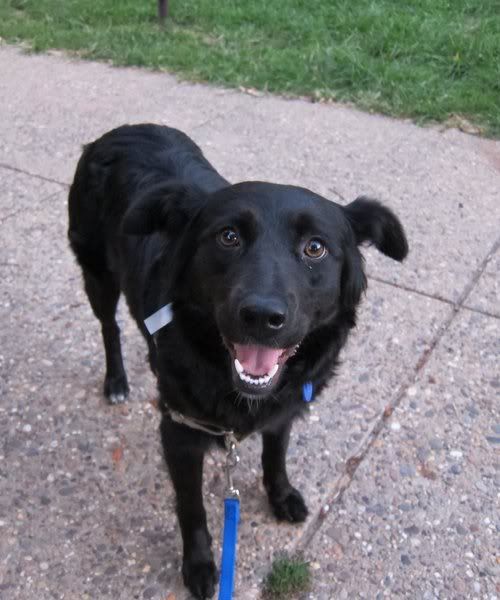
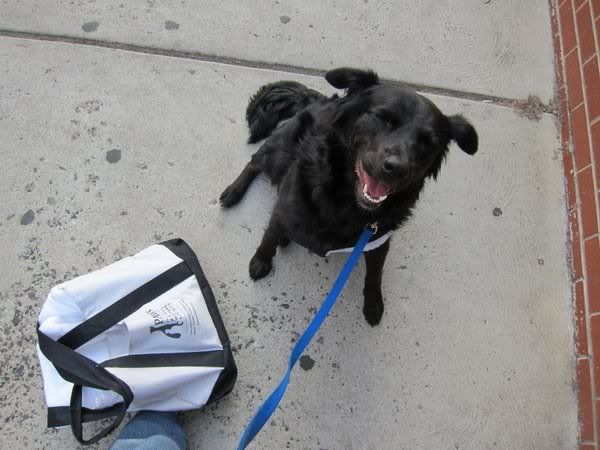
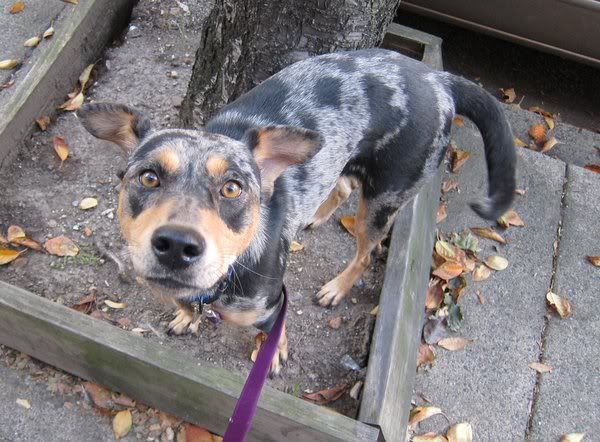
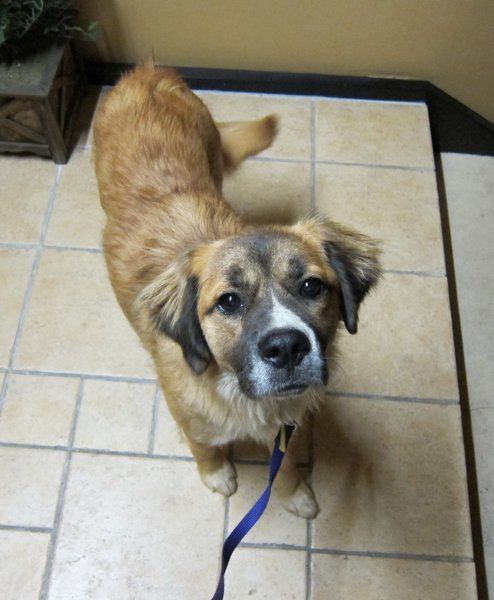
Late last night we got our first foster dog of 2013: a young, friendly golden retriever/St. Bernard mix named Penny Lane.
Penny Lane hails from Wilson, North Carolina. Every year, Wags sends a caravan of volunteers down to North Carolina to pull a huge haul of adoptable dogs from the high-kill shelters in that area. This year's pull included about 85 dogs, of which Penny Lane was just one.
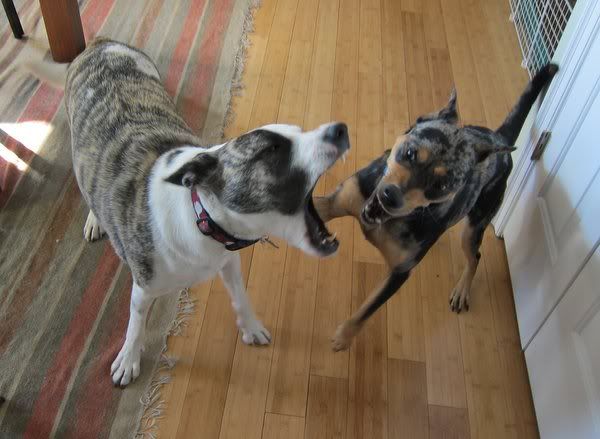
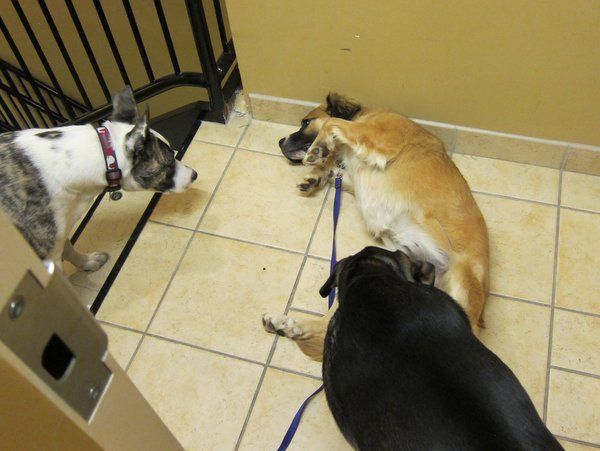
The dogs were actually supposed to arrive in the Philadelphia area around 6 pm, but the transport van for the big dogs broke down in Virginia and was delayed for several hours there, so Penny Lane didn't get here until shortly before midnight. She did arrive safely, though, and was promptly greeted at the door by a hostile growly Pongu and a friendly but slightly perplexed Crookytail.
Being a polite girl, Penny immediately peed on the doorstep to introduce herself and rolled over to show she meant no harm.
Then she came inside to take up residence as the current Temporary Dog.
It was so late when Penny Lane got in that I didn't have time to wash her or really get to know her at all before tucking her into her crate with a couple of frozen Kongs for the night.
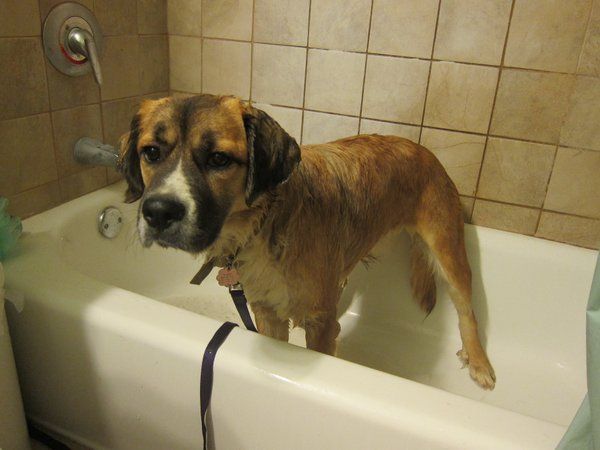
This morning she got a bath -- which she badly needed, as she was so stinky and filthy that the bathwater turned a disgusting foamy yellowy-brown as soon as I rinsed off her shampoo -- and I noticed that she's got double dewclaws on both hind legs, which cements that she is indeed a St. Bernard mix. It's an uncommon breed to find in rescue, but that double dewclaw is distinctive to St. Bernards (and Briards and a couple of other breeds that are even less likely to be in the mix), and Penny does have a very St. Bernard look to her.
I don't know how old Penny Lane is supposed to be. Because of the problems with the transport van breaking down in Virginia, I don't have her medical records yet. She doesn't look like she has fully grown into her body yet, though, so I would guess that she's an older adolescent -- maybe 10 to 12 months old. She's also pretty underweight right now; while she clocked in at 45 pounds at the shelter, her healthy weight is probably closer to 55-60 pounds, and if she's still got some growing to do, she might end up bigger.
In her first day here, Penny Lane has shown herself to be an outgoing, curious, and gentle dog. She wants to say hi to every person she passes on the sidewalk, especially kids -- which is actually not such a great trait, since not everybody wants to say hi back to a strange dog (particularly not a large-ish one!) and the streets were super slippery this morning -- but at least speaks well of her people-oriented nature. She likes to investigate what interesting things might be on tabletops or windowsills, and she tried to get into the garbage once, although after I scolded her, she did not try it again.
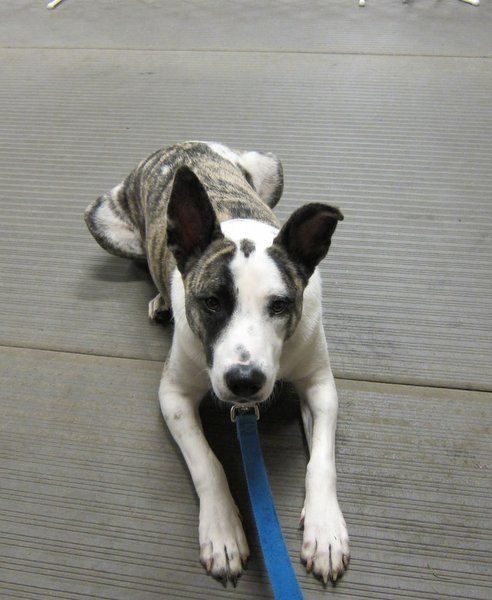
As far as I can tell, Penny Lane has had no formal training at all. She doesn't know how to Sit (or any other formal cue that I've tried) and while she's not bad on leash, she's also obviously never been asked to walk politely with a person. She always seems sort of surprised when I offer her a treat for being good, as if that's just not a connection anyone ever asked her to make before.
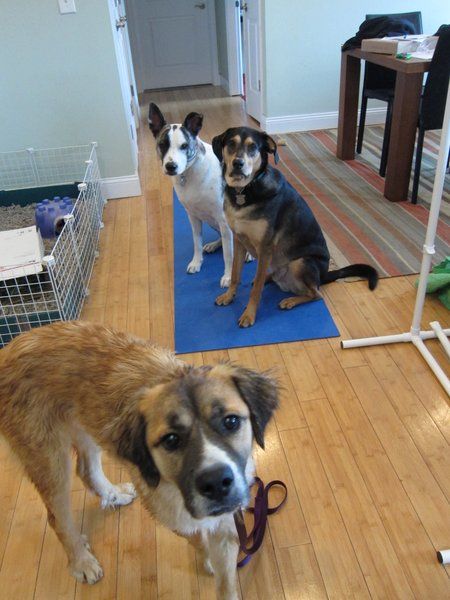
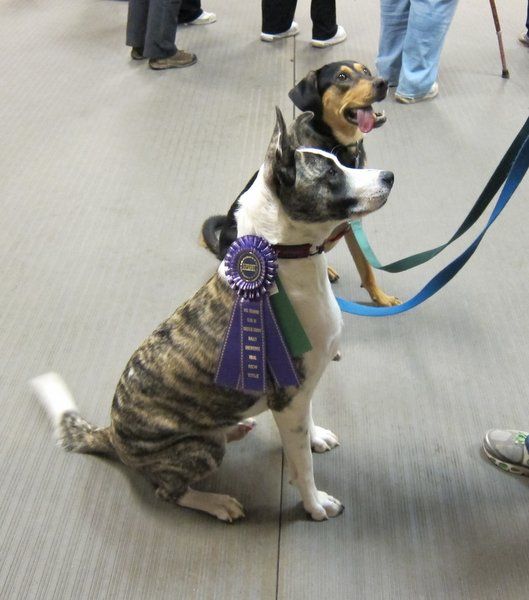
(Dog Mob can Sit-Stay in a nice neat line. Penny Lane, not so much.)
Despite her lack of formal education, however, Penny is a good and sweet dog with an inherently gentle nature. She is deferential to Dog Mob and tolerant of Pongu being a massive dick at her constantly. Her social skills and canine communicative sophistication are well developed; she's clearly spent a lot of time around other dogs and is very capable of conducting herself appropriately around them. She is not pushy or guardy around Dog Mob at all, at least not on the first day. She's also not especially playful, but that's normal -- if she's still not engaging with Crookytail after another couple of days, then I'll be concerned. Right now, it's normal for the new kid to feel overwhelmed.
While mildly curious about the guinea pigs, she doesn't seem to be especially fixated on them and ignored them after about 5-10 seconds of not-very-interested sniffing, so I feel safe saying that Penny Lane would do fine living with a reasonably dog-savvy cat.
Thus far she's mostly been quiet except for some grumbling and whining when I put her in the crate. She has calmed down after the first couple of minutes, and gives up pretty quickly if she can't actually see or hear anybody moving around in the same room (so I built up a visual barricade around the crate to help everybody sleep at night), so that hasn't really been troublesome. No barking thus far.
I can't tell yet if she's housebroken. I am assuming that the answer is "no," and am treating her accordingly, but it does seem like Penny Lane has previous experience with living inside a house (she navigates stairs easily and isn't afraid of opaque doors, although she did walk facefirst into the glass door downstairs this morning, so I guess she hasn't seen that before...), so it's conceivable that she might be.
And that's about it for her first day. Penny Lane is currently being treated for a minor non-contagious skin infection (she takes two pills in her breakfast for that) and seems to have a slight limp; she favors her left front foot noticeably when she walks, although it doesn't appear to cause her any pain and she'll let me handle the foot/leg without protest. It's visible in some of her pictures: she holds that foot more gingerly than the other. I'm not sure what that's about. If she's young enough, it could be a growth plate issue; that's not uncommon in large/giant breed pups. Or it could be an old injury. Or something else.
Whatever it is, it doesn't seem to be hurting her, but I probably wouldn't recommend her for a hardcore agility career right now.
Monday, January 28, 2013
Wednesday, January 9, 2013
Choosing an Approach to Training
The other day, someone asked a question that stuck with me: out of all the different trainers out there in the world, and all the different approaches, how do you choose what works for you?
It's no secret that I'm a staunch adherent of purely positive training. Why and how that happened, though, is not something I've given much conscious thought to in a while.
I'm a perpetual student. There is so much out there that I don't know, and so much that I want to be able to do with my dogs, that I am forever on the hunt for new ideas and resources. But how to decide which ones are credible?
I. Does It Work For the Dogs?
This is the most basic and important test. Do the dogs seem happy, attentive, and successful? Or are they stressed, shut down, and/or hopelessly confused? Putting my own ego and preconceptions aside, as best I can, I look to see whether the trainer's methods are working -- really working -- for the dogs. Because if the dog is not learning, then the training has failed.
Suzanne Clothier has described a happy, understanding dog as having a "light in its eyes," and I think that's a wonderful way of putting it. A dog who understands what is being asked of it, and who is joyous about doing that thing, has a brightness of spirit that I don't see in dogs who have been bullied into performing. The trainers I want to emulate are the ones whose dogs clearly love doing their work. I see that joy in Emily Latham (kikopup)'s dogs; I see it in Suzanne Clothier's, and Denise Fenzi's, and Julie Flanery's. I see it in the demo dogs that my instructors at Y2K9s show. I want my dogs to share that same happiness, so I emulate those trainers' methods -- which happen, not coincidentally, to be purely positive methods. At the same time, I shy away from punitive methods, because I have seen the thousand-yard zombie stare in the eyes of a dog trained on a shock collar, and I never ever want my dogs to look like that.
As importantly, because we're training for competition, I want dogs who are precise and focused and reliable. A happy but undisciplined dog who can't execute a straight Front, or who runs amok on the course, is no good to me. I'm competitive: I want to win. I want ribbons and titles and championships. I want a canine partner who works with me seamlessly, with an almost telepathic connection on the course.
And again, it's no contest: purely positive methods carry the day. A dog who loves his work, and who above all loves working with his special person, will be laser focused on that work. A dog who's been clicker shaped with precision will have straight Fronts and sharp Heeling and (critically for freestyle) an enormous repertoire of flashy moves that simply cannot be obtained through compulsion. And because clicker training rewards the dog for paying extremely close attention to his handler, it develops that communicative bond to an incredible level.
So purely positive training passes the first test. It works for my dogs. It works for Dog Mob, it works for client dogs, and it's worked for all the Temporary Dogs without exception.
In the very beginning, and only with Pongu, I did briefly attempt force-based training in the form of leash corrections. That definitely did not work. I cringe every time I remember it: this four-month-old fearful puppy getting leash pops from me, the only person in the world he trusted, because he was pulling on lead in a desperate attempt to escape from a big scary world that terrified him. It didn't work, of course. It only damaged his trust in me. I am grateful that I saw the message in his eyes and stopped before any worse damage was done.
II. Does It Work For Me?
The second question is whether I can effectively use the methods being espoused. It's not kikopup or Pat Miller who's going to be training my dog. It's me. No matter how good they are at training their dogs (and they are very good!), if I can't understand what they're telling me to do, or can't carry out the programs clearly and consistently, then again, the training will fail.
Clicker work does require developing some new skills. Timing and observational skills are key to spotting desired behaviors (particularly in the early stages of shaping a new behavior, when the incremental steps will often be quite subtle). There are mechanical skills required in juggling the clicker, treats, target object(s), and/or leash, and often this has to be done while on the move. Eventually, treats have to be faded out if the behavior is to become truly reliable.
At this point, I'm comfortable using a clicker and treats. I know how to manipulate reinforcement rates and read the dog's body language and adjust my approach on the fly to accommodate the specific animal with whom I'm working. But if I did not know those things, and did not have the patience to learn them or apply them properly, then positive training might not work for me.
I've found that this is often the case with people who dismiss operant conditioning: they never learned how to apply the techniques properly and concluded that it was a fault of the training method, not of their implementation.
The flipside of that, of course, is that force-based training will never work for me because I don't know how to apply those techniques effectively. Of course I understand how to apply positive punishment in theory, but I've never done it in practice and I never will, because I know that I can get better results using more humane methods. I have no interest in learning how to ear-pinch a dog into retrieving or training a recall with a shock collar. I don't need to resort to those things to establish a reliable behavior. But for me to say those methods categorically "don't work" would be untrue, because they do work for some dogs and some trainers who are willing to inflict pain and fear, and accept a certain amount of collateral damage, in the name of instilling obedience. I'm not willing to do that, so those techniques don't work for me.
(This is, incidentally, why "balanced" or "crossover" trainers who tout their willingness to "use all tools" drive me batty. At first glance it might seem like a reasonable thing -- who wants to reject potentially useful tools out of hand? -- but then one has to reflect on what tools are being rejected, and why. We generally don't use switches to whip unruly children anymore, and we don't use public stocks to humiliate nagging spouses, and while there are no doubt people who think the world would be a better place if we still employed both of those barbaric "useful tools," I personally would not like to have them as parents or neighbors. Nor, I imagine, do their dogs enjoy having them as owners.)
III. Is It Scientifically Sound? Does It Make Sense?
There is a lot of misinformation circulating in the dog-training world. Metric craptons of it.
One quick filter to get rid of a lot of the garbage is to ask whether the explanations being offered for a particular technique stand up to basic scrutiny. Much of it, especially when it comes to "being the alpha" and dominance mythologies in training, is pseudoscientific hogwash and can safely be discarded.
Much more fails a basic common sense test, such as explanations of how prong collars work by mimicking the mother dog's teeth on her youngster's throat (uh, the pressure on a prong collar is at the front of the throat -- how many mother animals have you seen carrying their offspring around by their windpipes?), or admonitions against soothing fearful dogs because "it'll encourage the behavior" (as Debbie Jacobs is fond of asking, would a loved one patting your back make you eager to rush out and embrace something that scared you witless? Or might it just make you feel marginally safer?).
Sometimes the lack of scientific rigor is harmless. Canine homeopathy is getting to be a thing these days, and it is no more proven than homeopathic remedies are in humans, but as long as it doesn't substitute for appropriate veterinary care, I don't see how it hurts anybody to try. "Can't hurt/might help" is fine. But if there is potential to cause harm, then I don't think there's any excuse for uncritically accepting misinformation. And in general, I have found that positive trainers and writers tend to have more scientifically accurate explanations for their methods.
IV. Is the Source Credible?
I'm more inclined to accept someone as an authority if I know she is respected as such by other knowledgable persons in her field. Publication credits in independent journals or magazines carry weight, as do books published through external houses. The CPDT qualification matters to me -- if nothing else, it shows this person is familiar with the fundamentals of scientifically based training. Strong writing and clearly organized thoughts presented in a professional manner make a good impression too.
Also important is whether this person can do something with their dogs that I want to emulate. Have their dogs won titles that I aspire to get on my own dogs? Can their dogs do cool tricks that I want mine to learn? Have they successfully rehabilitated (not just shut down) difficult behavioral cases? Whatever the goal is, I want to learn from someone who has done it, and who has preferably done it repeatedly in a forum subject to knowledgeable, independent scrutiny.
All the most successful trainers in all the fields of endeavor that interest me espouse positive training methods. I take that as pretty good evidence that this is, in fact, the best way to get those things done.
V. What Are the Consequences of Getting It Wrong?
I will make mistakes. I make mistakes all the time. I drop treats, I mistime clicks, I reward in the wrong position and pull my dogs out of line. Often I misread my dogs' communications or fail to notice things that are distracting them and incorrectly assume they just don't want to pay attention. My handling cues are frequently sloppy and I miss opportunities to reward my dogs for correct behaviors and, all in all, I blunder so often that some days it's a wonder they know how to Sit.
So it is important to me that whatever training techniques I use be forgiving of those mistakes, because I'm going to make them and I'm going to make a lot of them. It's safe to assume that I will blunder every single new technique at least a dozen times while I'm learning how to do it.
If I make a mistake while clicker training, it's not a disaster. Worst case, I confuse my dog for a minute and have to spend another couple of repetitions clarifying that what I wanted was a backwards scoot, not a pop-up into Bow. Or maybe I drop a treat on the Rally course and we get knocked 3 points. It might cost us a placement ribbon (and it has!), but it's really not a big deal.
But if I make a mistake with a choke chain or a shock collar, I could do some real damage to my dog's psyche (and, less likely but possible, his body). I could inadvertently cause him to hate training, or fear approaching strangers, or lose his trust in me. These aren't hypotheticals; I have seen dogs who suffered these outcomes (and, as noted earlier, I almost did it to Pongu). To me, the risk is just not worth it. I don't want that to happen intentionally; I surely don't want it to happen by accident.
So that is pretty much how I landed where I landed, and how I evaluate new sources of information that I stumble across. I want happy dogs who are good at doing what they do, and this seemed like the best way of getting there. Now that I am there (although still with many greater heights to scale!), I look back and am satisfied with the road that I've chosen.
It's no secret that I'm a staunch adherent of purely positive training. Why and how that happened, though, is not something I've given much conscious thought to in a while.
I'm a perpetual student. There is so much out there that I don't know, and so much that I want to be able to do with my dogs, that I am forever on the hunt for new ideas and resources. But how to decide which ones are credible?
I. Does It Work For the Dogs?
This is the most basic and important test. Do the dogs seem happy, attentive, and successful? Or are they stressed, shut down, and/or hopelessly confused? Putting my own ego and preconceptions aside, as best I can, I look to see whether the trainer's methods are working -- really working -- for the dogs. Because if the dog is not learning, then the training has failed.
Suzanne Clothier has described a happy, understanding dog as having a "light in its eyes," and I think that's a wonderful way of putting it. A dog who understands what is being asked of it, and who is joyous about doing that thing, has a brightness of spirit that I don't see in dogs who have been bullied into performing. The trainers I want to emulate are the ones whose dogs clearly love doing their work. I see that joy in Emily Latham (kikopup)'s dogs; I see it in Suzanne Clothier's, and Denise Fenzi's, and Julie Flanery's. I see it in the demo dogs that my instructors at Y2K9s show. I want my dogs to share that same happiness, so I emulate those trainers' methods -- which happen, not coincidentally, to be purely positive methods. At the same time, I shy away from punitive methods, because I have seen the thousand-yard zombie stare in the eyes of a dog trained on a shock collar, and I never ever want my dogs to look like that.
As importantly, because we're training for competition, I want dogs who are precise and focused and reliable. A happy but undisciplined dog who can't execute a straight Front, or who runs amok on the course, is no good to me. I'm competitive: I want to win. I want ribbons and titles and championships. I want a canine partner who works with me seamlessly, with an almost telepathic connection on the course.
And again, it's no contest: purely positive methods carry the day. A dog who loves his work, and who above all loves working with his special person, will be laser focused on that work. A dog who's been clicker shaped with precision will have straight Fronts and sharp Heeling and (critically for freestyle) an enormous repertoire of flashy moves that simply cannot be obtained through compulsion. And because clicker training rewards the dog for paying extremely close attention to his handler, it develops that communicative bond to an incredible level.
So purely positive training passes the first test. It works for my dogs. It works for Dog Mob, it works for client dogs, and it's worked for all the Temporary Dogs without exception.
In the very beginning, and only with Pongu, I did briefly attempt force-based training in the form of leash corrections. That definitely did not work. I cringe every time I remember it: this four-month-old fearful puppy getting leash pops from me, the only person in the world he trusted, because he was pulling on lead in a desperate attempt to escape from a big scary world that terrified him. It didn't work, of course. It only damaged his trust in me. I am grateful that I saw the message in his eyes and stopped before any worse damage was done.
II. Does It Work For Me?
The second question is whether I can effectively use the methods being espoused. It's not kikopup or Pat Miller who's going to be training my dog. It's me. No matter how good they are at training their dogs (and they are very good!), if I can't understand what they're telling me to do, or can't carry out the programs clearly and consistently, then again, the training will fail.
Clicker work does require developing some new skills. Timing and observational skills are key to spotting desired behaviors (particularly in the early stages of shaping a new behavior, when the incremental steps will often be quite subtle). There are mechanical skills required in juggling the clicker, treats, target object(s), and/or leash, and often this has to be done while on the move. Eventually, treats have to be faded out if the behavior is to become truly reliable.
At this point, I'm comfortable using a clicker and treats. I know how to manipulate reinforcement rates and read the dog's body language and adjust my approach on the fly to accommodate the specific animal with whom I'm working. But if I did not know those things, and did not have the patience to learn them or apply them properly, then positive training might not work for me.
I've found that this is often the case with people who dismiss operant conditioning: they never learned how to apply the techniques properly and concluded that it was a fault of the training method, not of their implementation.
The flipside of that, of course, is that force-based training will never work for me because I don't know how to apply those techniques effectively. Of course I understand how to apply positive punishment in theory, but I've never done it in practice and I never will, because I know that I can get better results using more humane methods. I have no interest in learning how to ear-pinch a dog into retrieving or training a recall with a shock collar. I don't need to resort to those things to establish a reliable behavior. But for me to say those methods categorically "don't work" would be untrue, because they do work for some dogs and some trainers who are willing to inflict pain and fear, and accept a certain amount of collateral damage, in the name of instilling obedience. I'm not willing to do that, so those techniques don't work for me.
(This is, incidentally, why "balanced" or "crossover" trainers who tout their willingness to "use all tools" drive me batty. At first glance it might seem like a reasonable thing -- who wants to reject potentially useful tools out of hand? -- but then one has to reflect on what tools are being rejected, and why. We generally don't use switches to whip unruly children anymore, and we don't use public stocks to humiliate nagging spouses, and while there are no doubt people who think the world would be a better place if we still employed both of those barbaric "useful tools," I personally would not like to have them as parents or neighbors. Nor, I imagine, do their dogs enjoy having them as owners.)
III. Is It Scientifically Sound? Does It Make Sense?
There is a lot of misinformation circulating in the dog-training world. Metric craptons of it.
One quick filter to get rid of a lot of the garbage is to ask whether the explanations being offered for a particular technique stand up to basic scrutiny. Much of it, especially when it comes to "being the alpha" and dominance mythologies in training, is pseudoscientific hogwash and can safely be discarded.
Much more fails a basic common sense test, such as explanations of how prong collars work by mimicking the mother dog's teeth on her youngster's throat (uh, the pressure on a prong collar is at the front of the throat -- how many mother animals have you seen carrying their offspring around by their windpipes?), or admonitions against soothing fearful dogs because "it'll encourage the behavior" (as Debbie Jacobs is fond of asking, would a loved one patting your back make you eager to rush out and embrace something that scared you witless? Or might it just make you feel marginally safer?).
Sometimes the lack of scientific rigor is harmless. Canine homeopathy is getting to be a thing these days, and it is no more proven than homeopathic remedies are in humans, but as long as it doesn't substitute for appropriate veterinary care, I don't see how it hurts anybody to try. "Can't hurt/might help" is fine. But if there is potential to cause harm, then I don't think there's any excuse for uncritically accepting misinformation. And in general, I have found that positive trainers and writers tend to have more scientifically accurate explanations for their methods.
IV. Is the Source Credible?
I'm more inclined to accept someone as an authority if I know she is respected as such by other knowledgable persons in her field. Publication credits in independent journals or magazines carry weight, as do books published through external houses. The CPDT qualification matters to me -- if nothing else, it shows this person is familiar with the fundamentals of scientifically based training. Strong writing and clearly organized thoughts presented in a professional manner make a good impression too.
Also important is whether this person can do something with their dogs that I want to emulate. Have their dogs won titles that I aspire to get on my own dogs? Can their dogs do cool tricks that I want mine to learn? Have they successfully rehabilitated (not just shut down) difficult behavioral cases? Whatever the goal is, I want to learn from someone who has done it, and who has preferably done it repeatedly in a forum subject to knowledgeable, independent scrutiny.
All the most successful trainers in all the fields of endeavor that interest me espouse positive training methods. I take that as pretty good evidence that this is, in fact, the best way to get those things done.
V. What Are the Consequences of Getting It Wrong?
I will make mistakes. I make mistakes all the time. I drop treats, I mistime clicks, I reward in the wrong position and pull my dogs out of line. Often I misread my dogs' communications or fail to notice things that are distracting them and incorrectly assume they just don't want to pay attention. My handling cues are frequently sloppy and I miss opportunities to reward my dogs for correct behaviors and, all in all, I blunder so often that some days it's a wonder they know how to Sit.
So it is important to me that whatever training techniques I use be forgiving of those mistakes, because I'm going to make them and I'm going to make a lot of them. It's safe to assume that I will blunder every single new technique at least a dozen times while I'm learning how to do it.
If I make a mistake while clicker training, it's not a disaster. Worst case, I confuse my dog for a minute and have to spend another couple of repetitions clarifying that what I wanted was a backwards scoot, not a pop-up into Bow. Or maybe I drop a treat on the Rally course and we get knocked 3 points. It might cost us a placement ribbon (and it has!), but it's really not a big deal.
But if I make a mistake with a choke chain or a shock collar, I could do some real damage to my dog's psyche (and, less likely but possible, his body). I could inadvertently cause him to hate training, or fear approaching strangers, or lose his trust in me. These aren't hypotheticals; I have seen dogs who suffered these outcomes (and, as noted earlier, I almost did it to Pongu). To me, the risk is just not worth it. I don't want that to happen intentionally; I surely don't want it to happen by accident.
So that is pretty much how I landed where I landed, and how I evaluate new sources of information that I stumble across. I want happy dogs who are good at doing what they do, and this seemed like the best way of getting there. Now that I am there (although still with many greater heights to scale!), I look back and am satisfied with the road that I've chosen.
Thursday, December 13, 2012
Goals for 2013
Looking back on 2012, Dog Mob and I achieved all the goals we'd set for ourselves, and then some.
Pongu didn't title in freestyle... but that was because we switched our primary sport to Rally Obedience, so he had to learn a whole new system of rules and exercises, and within a few months of picking that up, he started trialing and soon earned his RL1 title with an Award of Excellence.
Crookytail wasn't on the goal list for 2012, because he wasn't even here yet, but he joined Dog Mob and promptly turned his skills to helping 11 foster dogs learn to live safely and happily with people in the big city. He also went from zero to titled, picking up his RL1 in Rally Obedience this year.
The Temporary Dogs numbered 12 in all. Eleven of those dogs went on to wonderful, loving homes; sadly, we lost puppy Erin to parvovirus.
We're still in contact with many of the other former Temporary Dogs' families, and it is incredibly rewarding to see their happy faces and grand adventures as they go on in their new lives.
So, for next year, here are our goals:
With Pongu, I hope to earn a RL2, RL1X, and ARCH. If we're lucky and I can afford an ambitious trialing schedule, we might go as far as the RL3, which would put us in a great position to make 2014 the Year of Rally Championships. Also, I'm gunning for an Award of Excellence at both Level 2 and Level 3 -- he did it at Level 1, which was the hardest for a crazypants scaredymutt because it was his first time in the ring, so why not at the more advanced levels too?
Regardless of how far we actually get, we'll continue trialing in APDT Rally.
I'd also like to go back to WCFO musical freestyle with Pongu. We switched sports because I just didn't feel like I knew what I was doing in freestyle; now that I have more confidence and slightly more of a clue, it might be time to try it again. We'll have to rely on video competitions, which will be an adventure in itself, but I think it should be possible for us to get a beginner or novice title next year.
With Crookytail and Pongu both, I plan to take the Canine Good Citizen test early next year. For a long time, the CGC test was beyond what I believed Pongu could do; he was just too fearful to handle being approached by a stranger or left alone with me out of sight.
I think Pongu can handle it now, though, and I don't expect the CGC test to be particularly difficult for Crookytail. The test is more about the dog's stability than learned behaviors (the amount of formal training required to pass a CGC evaluation is really very little), and Crooky has never really had a problem with staying level-headed. So we'll knock that out early in the spring, whenever it's next offered around here, and let Dog Mob add a few more letters to their names.
On the foster front, the goal is to have five or six Temporary Dogs pass through here in 2013. My schedule may end up being pretty full of other things next year (particularly if I spend a lot of time trialing with Pongu), so we may have to step that back from what we did this year -- but as helping with fosters is Crookytail's primary job and I want him to have a chance to excel at his work too, we won't drop it entirely.
We may end up doing a little more or less than that, but right now one foster dog every other month seems like a manageable rate, so that's the goal I'm setting for next year. Whoooo!!
Pongu didn't title in freestyle... but that was because we switched our primary sport to Rally Obedience, so he had to learn a whole new system of rules and exercises, and within a few months of picking that up, he started trialing and soon earned his RL1 title with an Award of Excellence.
Crookytail wasn't on the goal list for 2012, because he wasn't even here yet, but he joined Dog Mob and promptly turned his skills to helping 11 foster dogs learn to live safely and happily with people in the big city. He also went from zero to titled, picking up his RL1 in Rally Obedience this year.
The Temporary Dogs numbered 12 in all. Eleven of those dogs went on to wonderful, loving homes; sadly, we lost puppy Erin to parvovirus.
We're still in contact with many of the other former Temporary Dogs' families, and it is incredibly rewarding to see their happy faces and grand adventures as they go on in their new lives.
So, for next year, here are our goals:
With Pongu, I hope to earn a RL2, RL1X, and ARCH. If we're lucky and I can afford an ambitious trialing schedule, we might go as far as the RL3, which would put us in a great position to make 2014 the Year of Rally Championships. Also, I'm gunning for an Award of Excellence at both Level 2 and Level 3 -- he did it at Level 1, which was the hardest for a crazypants scaredymutt because it was his first time in the ring, so why not at the more advanced levels too?
Regardless of how far we actually get, we'll continue trialing in APDT Rally.
I'd also like to go back to WCFO musical freestyle with Pongu. We switched sports because I just didn't feel like I knew what I was doing in freestyle; now that I have more confidence and slightly more of a clue, it might be time to try it again. We'll have to rely on video competitions, which will be an adventure in itself, but I think it should be possible for us to get a beginner or novice title next year.
With Crookytail and Pongu both, I plan to take the Canine Good Citizen test early next year. For a long time, the CGC test was beyond what I believed Pongu could do; he was just too fearful to handle being approached by a stranger or left alone with me out of sight.
I think Pongu can handle it now, though, and I don't expect the CGC test to be particularly difficult for Crookytail. The test is more about the dog's stability than learned behaviors (the amount of formal training required to pass a CGC evaluation is really very little), and Crooky has never really had a problem with staying level-headed. So we'll knock that out early in the spring, whenever it's next offered around here, and let Dog Mob add a few more letters to their names.
On the foster front, the goal is to have five or six Temporary Dogs pass through here in 2013. My schedule may end up being pretty full of other things next year (particularly if I spend a lot of time trialing with Pongu), so we may have to step that back from what we did this year -- but as helping with fosters is Crookytail's primary job and I want him to have a chance to excel at his work too, we won't drop it entirely.
We may end up doing a little more or less than that, but right now one foster dog every other month seems like a manageable rate, so that's the goal I'm setting for next year. Whoooo!!
Wednesday, December 12, 2012
2012 in Fosters - A Retrospective
As 2012 winds to a close, it's time to reflect on the foster dogs who came through this house in the past year.
Just like in 2011, all our fosters came from Southern states: Georgia, Tennessee, and North Carolina. They were adopted out all across the country: Pennsylvania, New Jersey, Alabama, Wisconsin, and Vermont are homes to our fosters now.
Here are the fosters we housed in the past twelve months.
1. Crookytail the Benevolent, RL1 (January 2012)
The One Who Stayed
Crookytail was my first pull from Robeson County, North Carolina. RCAS and neighboring Sampson County became the focus of my rescue efforts in 2012, in part because Liberty County's rescue team became so successful that their shelter's save rate went from 2% to 98%, and thus all the dogs I wanted to pull were spoken for before I got to them. Also, I'd gotten more confident about my ability to pick out good dogs instead of relying on other people to choose them for me.
Thus began the Era of Crookytail, in which he added his considerable talents to our fostering team, and everything got way better than it had ever been before. All the fosters start smiling in their pictures a lot more once Crooky joins the team.
This year, Crookytail went from a dog with absolutely no formal training to a titled Rally Obedience dog. Granted, he didn't love the sport and is retiring as a RL1, but I'm still proud of him, and in 2013 he'll be able to get back to his real job: guidance counselor to foster dogs.
2 and 3. Jackie and Erin (March 2012)
The Trailer Park Kids
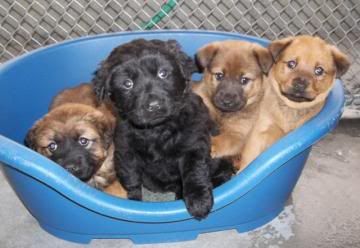
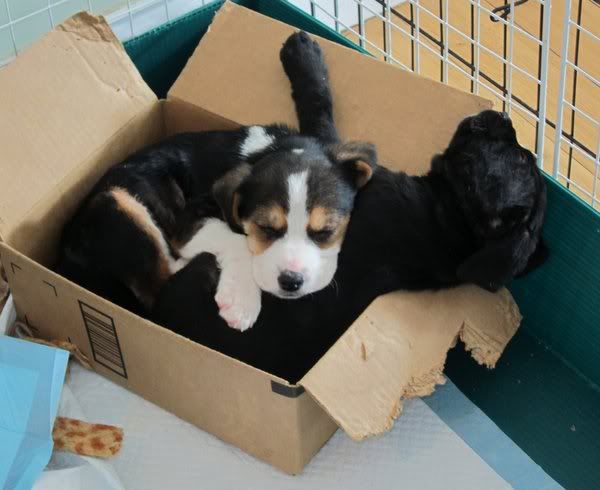
After Crooky joined us as a permanent dog, I did puppies for a while because I didn't think I could handle three full-sized dogs. Little did I know that puppies are actually a WAY bigger pain in the ass. Jackie and Erin, the two on the right in that picture, were the first of our foster puppies. They were "found" in a cardboard box in a trailer park (in reality, the person who claimed to have "found" them was probably their owner who just didn't want to be held responsible for dumping a litter of puppies).
Because dogs in Robeson County frequently get no preventative care or vaccinations whatsoever, both of these puppies came down with parvo a few days after I pulled them. They had to go into the doggy ICU and get IVs for a few days. All told, their vet care cost about a thousand bucks, and Erin died anyway. Jackie survived and made it to Philly. She got adopted two days later.
4 and 5. Cerise and Razzmatazz (March - April 2012)
The Burnout Babies
I'll tell you a secret: even the best foster parents don't always love all their dogs.
These two were my least favorite fosters ever. It wasn't their fault, but I still never liked them very much. They had sarcoptic mange and were being treated with lime-sulfur dips, so they smelled terrible and I had to give them medicine four times a day and wash my hands every time I touched them and Dog Mob had to take preventative medicine too. Because they were itchy and miserable, they just wailed constantly and scratched all the time and were basically impossible to train. Because they were hound mixes, their wailings were LOUD, which did not endear them to me, as we live in a condo and our next-door neighbor was a doctor who was eight or nine months pregnant at the time and already not sleeping well.
We had these puppies for two weeks, then Cerise got adopted and Razz went to go stay with a lady who was fostering one of her other littermates.
6 and 7. Indy and Little Fox (April - May 2012)
The Melon Collies
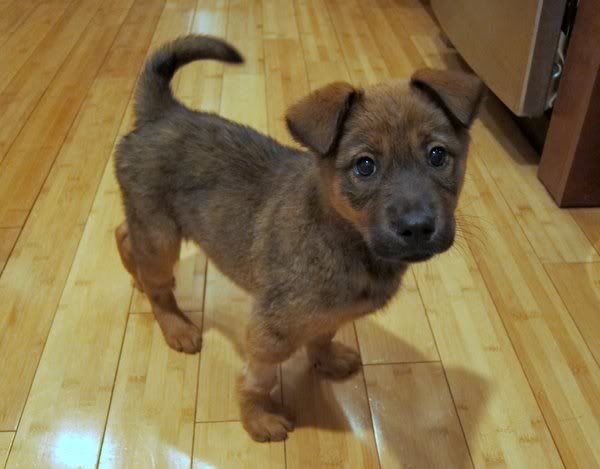
These two little monsters were a couple of collie mixes that I pulled from North Carolina. Their mother was a collie mix; their fathers were probably two different dogs. Little Fox's father was definitely a German Shepherd (her owners were kind enough to tell the shelter staff that as they were dumping the mother), but Indy's father was most likely a yellow Lab or Lab mix.
A friend of ours decided to adopt Indy (the beige one), so I kept her a couple more weeks for basic training and put Little Fox up for adoption. Little Fox got adopted by a very nice older couple in Bucks County. Indy lives in Alabama with our friend now, where she eats his furniture and destroys his remote controls and is generally a massive troublemaker. I told him that was going to happen, but he insisted he wanted the tomboy and not the polite little lady, so that's what he gets.
After those two left, I decided I was never doing puppies again. NEVER.
8. Mab (June - July 2012)
The Smart One
That summer, some more friends decided that they wanted to adopt a dog, so they contacted us for help picking one out. I sent them a couple of possible candidates and they chose Mab, a little black border collie in RCAS. Mab got out of the shelter with about 90 minutes to spare. She turned out to be the smartest foster we've ever had -- just ridiculously quick to learn and easy to train. If she hadn't already been promised to our friends, I would have been sorely tempted to keep her, but as is I'm just delighted that she went on to such a good home. She lives in Vermont now and has a wonderful extended family of dogs.
9. Eldwin/Etta (August 2012)
The Happy One
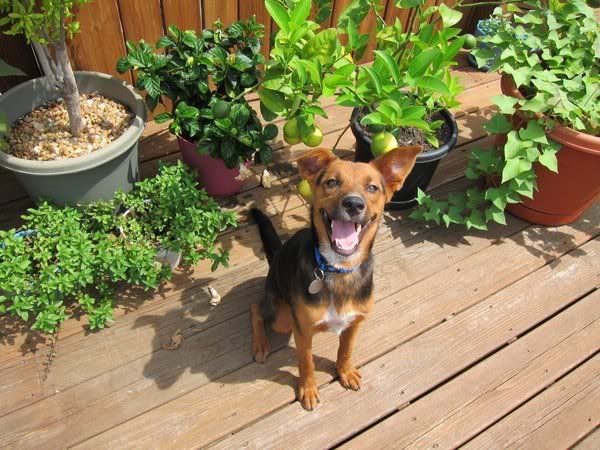
Eldwin, who was later renamed Etta, was another foster dog that I was briefly tempted to keep. She was a little shepherd mix who came out of RCAS and also proved to be super smart, as well as happy and smiley and instantly endearing. Luckily she got an adoption commitment from a dream home with a young couple in Philly within two or three days of arrival, so I could file her away mentally as "taken" and stop myself from getting too attached. She was only with us for ten days, and it's a good thing, too. Any longer and she might never have left.
10. Tulip (August 2012)
The Short-Term Pee Sprinkler
I barely got to know Tulip, a beagle mix from SCAS who was in and out of here in less than 48 hours. She was sweet, but really timid and a major submissive urinator. Crookytail helped bring her around, and she showed a good bit of improvement in the short time she was here, but we didn't really have enough time to fix that issue, because Tulip got adopted almost immediately. Hooray, less pee mopping for me.
11. April (August - September 2012)
The Good Mama
April was a soft-hearted, gentle black Lab/border collie mix from rural Tennessee, where she had been found outside a branch bank with her daughter Scarlett. The local rescue hadn't been able to get her adopted, so they sent her and a few other dogs to my rescue group. Scarlett got adopted immediately (puppies always go first), one of our friends and his wife decided to adopt April soon after she got here, and I got to deal with the toughest potty-training case I've been faced with so far.
I owe a lot to the magic powers of Crookytail on this one. With his help, April was brought out of her depression and given a crash course in remedial socialization and successfully started on potty-training. She now lives with two cats in Wisconsin and is a very lucky dog. It turns out that she loves snow, which is good, because she'll be getting a lot of it out there.
12. Shelby/Sydney (October - November 2012)
The Box Dog
Shelby, later renamed Sydney, was yet another mama dog who sat in the shelter after her puppies had been adopted (although in Sydney's case, only one of her puppies actually got adopted -- the other died, probably of hookworms, before his adopters could pick him up). Although she was smart and sweet and blessed with exotic markings, no one seemed to want her. On her last day, the shelter director sent out a plea across Facebook for someone to pull this special little dog.
She was in rough shape when I pulled her; she was severely underweight and had a massive parasite load, including heartworms. Luckily, other generous people had been touched by the director's plea and donated hundreds of dollars to cover Sydney's medical bills. Even so, she had to spend a full month on crate rest before she could go up for adoption.
But Sydney came through heartworm treatment like a champ and proved to be an adaptable, friendly, quick-learning dog who went on to a great home in upstate New York with three other dogs. She was another one that I wanted to keep, because she was smart and had great hind-end awareness and a really nice natural side pass, but alas, I can't have three dogs. And she scored an excellent home, so I'm pretty happy with that.
And that is the recap of 2012 in foster dogs. In just a few more weeks, we'll saddle up to start again in 2013. Crookytail is excited and Pongu is filled with loathing at the prospect of bringing in some new foster fuzzbutts. I'm already scouting for prospects.
Just like in 2011, all our fosters came from Southern states: Georgia, Tennessee, and North Carolina. They were adopted out all across the country: Pennsylvania, New Jersey, Alabama, Wisconsin, and Vermont are homes to our fosters now.
Here are the fosters we housed in the past twelve months.
1. Crookytail the Benevolent, RL1 (January 2012)
The One Who Stayed
Crookytail was my first pull from Robeson County, North Carolina. RCAS and neighboring Sampson County became the focus of my rescue efforts in 2012, in part because Liberty County's rescue team became so successful that their shelter's save rate went from 2% to 98%, and thus all the dogs I wanted to pull were spoken for before I got to them. Also, I'd gotten more confident about my ability to pick out good dogs instead of relying on other people to choose them for me.
Thus began the Era of Crookytail, in which he added his considerable talents to our fostering team, and everything got way better than it had ever been before. All the fosters start smiling in their pictures a lot more once Crooky joins the team.
This year, Crookytail went from a dog with absolutely no formal training to a titled Rally Obedience dog. Granted, he didn't love the sport and is retiring as a RL1, but I'm still proud of him, and in 2013 he'll be able to get back to his real job: guidance counselor to foster dogs.
2 and 3. Jackie and Erin (March 2012)
The Trailer Park Kids
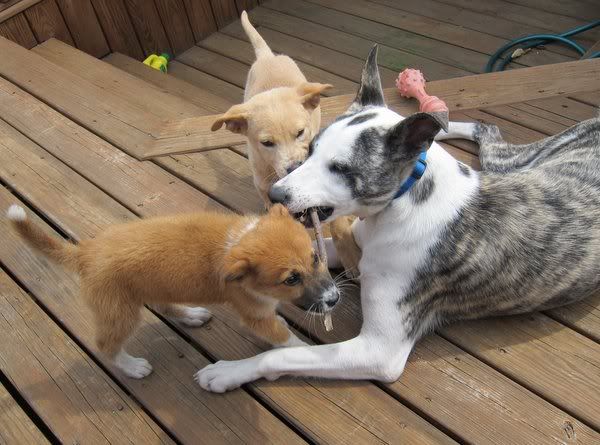
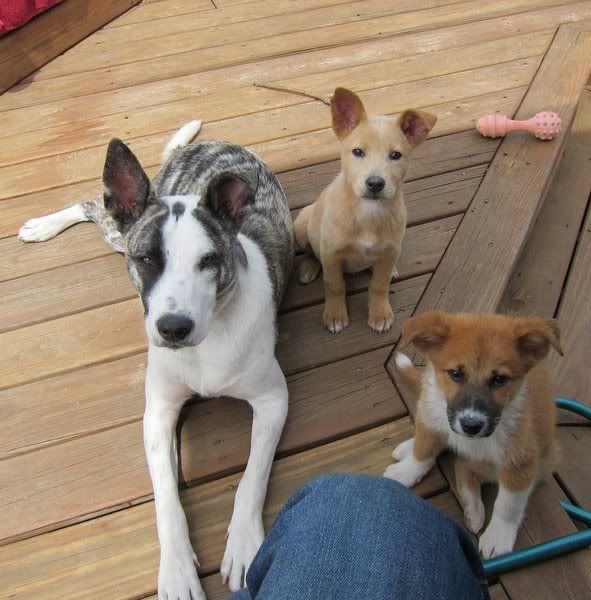
After Crooky joined us as a permanent dog, I did puppies for a while because I didn't think I could handle three full-sized dogs. Little did I know that puppies are actually a WAY bigger pain in the ass. Jackie and Erin, the two on the right in that picture, were the first of our foster puppies. They were "found" in a cardboard box in a trailer park (in reality, the person who claimed to have "found" them was probably their owner who just didn't want to be held responsible for dumping a litter of puppies).
Because dogs in Robeson County frequently get no preventative care or vaccinations whatsoever, both of these puppies came down with parvo a few days after I pulled them. They had to go into the doggy ICU and get IVs for a few days. All told, their vet care cost about a thousand bucks, and Erin died anyway. Jackie survived and made it to Philly. She got adopted two days later.
4 and 5. Cerise and Razzmatazz (March - April 2012)
The Burnout Babies
I'll tell you a secret: even the best foster parents don't always love all their dogs.
These two were my least favorite fosters ever. It wasn't their fault, but I still never liked them very much. They had sarcoptic mange and were being treated with lime-sulfur dips, so they smelled terrible and I had to give them medicine four times a day and wash my hands every time I touched them and Dog Mob had to take preventative medicine too. Because they were itchy and miserable, they just wailed constantly and scratched all the time and were basically impossible to train. Because they were hound mixes, their wailings were LOUD, which did not endear them to me, as we live in a condo and our next-door neighbor was a doctor who was eight or nine months pregnant at the time and already not sleeping well.
We had these puppies for two weeks, then Cerise got adopted and Razz went to go stay with a lady who was fostering one of her other littermates.
6 and 7. Indy and Little Fox (April - May 2012)
The Melon Collies
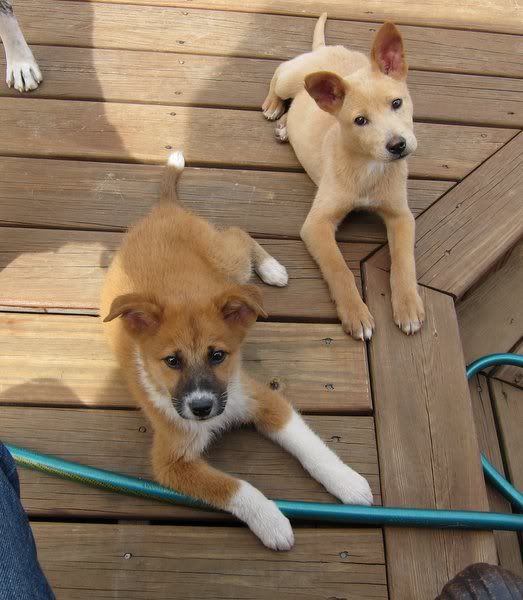
These two little monsters were a couple of collie mixes that I pulled from North Carolina. Their mother was a collie mix; their fathers were probably two different dogs. Little Fox's father was definitely a German Shepherd (her owners were kind enough to tell the shelter staff that as they were dumping the mother), but Indy's father was most likely a yellow Lab or Lab mix.
A friend of ours decided to adopt Indy (the beige one), so I kept her a couple more weeks for basic training and put Little Fox up for adoption. Little Fox got adopted by a very nice older couple in Bucks County. Indy lives in Alabama with our friend now, where she eats his furniture and destroys his remote controls and is generally a massive troublemaker. I told him that was going to happen, but he insisted he wanted the tomboy and not the polite little lady, so that's what he gets.
After those two left, I decided I was never doing puppies again. NEVER.
8. Mab (June - July 2012)
The Smart One
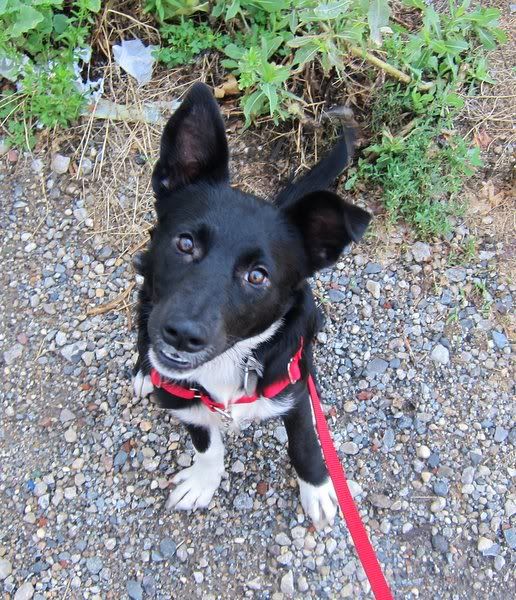
That summer, some more friends decided that they wanted to adopt a dog, so they contacted us for help picking one out. I sent them a couple of possible candidates and they chose Mab, a little black border collie in RCAS. Mab got out of the shelter with about 90 minutes to spare. She turned out to be the smartest foster we've ever had -- just ridiculously quick to learn and easy to train. If she hadn't already been promised to our friends, I would have been sorely tempted to keep her, but as is I'm just delighted that she went on to such a good home. She lives in Vermont now and has a wonderful extended family of dogs.
9. Eldwin/Etta (August 2012)
The Happy One
10. Tulip (August 2012)
The Short-Term Pee Sprinkler
I barely got to know Tulip, a beagle mix from SCAS who was in and out of here in less than 48 hours. She was sweet, but really timid and a major submissive urinator. Crookytail helped bring her around, and she showed a good bit of improvement in the short time she was here, but we didn't really have enough time to fix that issue, because Tulip got adopted almost immediately. Hooray, less pee mopping for me.
11. April (August - September 2012)
The Good Mama
I owe a lot to the magic powers of Crookytail on this one. With his help, April was brought out of her depression and given a crash course in remedial socialization and successfully started on potty-training. She now lives with two cats in Wisconsin and is a very lucky dog. It turns out that she loves snow, which is good, because she'll be getting a lot of it out there.
12. Shelby/Sydney (October - November 2012)
The Box Dog
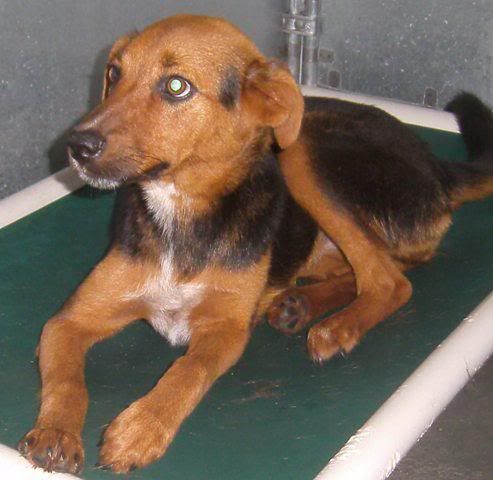
Shelby, later renamed Sydney, was yet another mama dog who sat in the shelter after her puppies had been adopted (although in Sydney's case, only one of her puppies actually got adopted -- the other died, probably of hookworms, before his adopters could pick him up). Although she was smart and sweet and blessed with exotic markings, no one seemed to want her. On her last day, the shelter director sent out a plea across Facebook for someone to pull this special little dog.
She was in rough shape when I pulled her; she was severely underweight and had a massive parasite load, including heartworms. Luckily, other generous people had been touched by the director's plea and donated hundreds of dollars to cover Sydney's medical bills. Even so, she had to spend a full month on crate rest before she could go up for adoption.
But Sydney came through heartworm treatment like a champ and proved to be an adaptable, friendly, quick-learning dog who went on to a great home in upstate New York with three other dogs. She was another one that I wanted to keep, because she was smart and had great hind-end awareness and a really nice natural side pass, but alas, I can't have three dogs. And she scored an excellent home, so I'm pretty happy with that.
And that is the recap of 2012 in foster dogs. In just a few more weeks, we'll saddle up to start again in 2013. Crookytail is excited and Pongu is filled with loathing at the prospect of bringing in some new foster fuzzbutts. I'm already scouting for prospects.
Labels:
April,
Burnout Babies,
Crookytail,
Etta,
fostering,
Jackie,
Mab,
Melon Collies,
Pongu,
Sydney,
Tulip
Tuesday, December 11, 2012
Pongu Off Prozac
After many months of behavioral rehabilitation, I finally took Pongu off Prozac a couple of weeks ago.
Almost 18 months ago, he started on 20 mg/day of Prozac. A few months later, after consulting with several trainers and behaviorists, we upped that dose to 30 mg/day. At the same time we embarked upon the long, slow process of teaching Pongu how to cope with everyday life and handle his anxiety in safer and more productive ways. This took many, many months of very small steps.
We had some setbacks and we had some delays (and I got to learn firsthand about how much fun it is to try regular counter-conditioning protocols with a dog too fearful to accept even the tastiest treats anywhere outside his safe zone), but eventually we reached a point where Pongu could tolerate more noise and chaos than I ever imagined possible, and could even focus well enough to do Rally practice sessions on city sidewalks.
I don't think we would have made it without the medication. I doubt Pongu could have coped with his daily anxieties without Prozac, and I doubt he'd have gotten past his terror of training facilities without Xanax. The medications not only made it possible for him to calm down enough to focus, but enabled him to have fun -- and once he learned that he could have fun while working, the work itself became fun, and that built into a spiral of positive reinforcement that eventually gave him the ability to self-control and self-calm by doing something as simple as a Heel Sit. The familiarity of the exercise, and (I believe) its strong association with feelings of pride and accomplishment, really seem to enable Pongu to mentally regroup and switch from fearful mode to thinking mode.
Once he earned his RL1 with an Award of Excellence -- a goal that I honestly was not sure this fearful little mutt would ever accomplish, since back in the early days all the trainers we'd consulted had cautioned me not to expect Pongu to ever trial in any sport (which, looking back on it with the benefit of what I know now, I believe was mostly hedging against the great uncertainty of owner compliance) -- I decided that it was time to phase out the Prozac. He was doing well enough that I didn't think we needed it anymore, and even though he'd been on it for a long time, I was and still am a little uncomfortable about using behavioral medications longer than strictly necessary.
Besides, there were some slight side effects. The biggest one was that Prozac gave Pongu a dry mouth, which in turn caused his teeth to get dirty a lot faster than Crookytail's did. I was worried that longterm use might compromise his dental health.
So I spent a month weaning him off the medication, dropping his daily dose from 30 mg to 20 mg to 10 to nothing. I noticed no behavioral changes during the period of decreased doses, but 4 or 5 days after he was totally off the medication, his behavior did start to change a little.
Pongu is now quicker to startle at unexpected noises or movements. He seems more vigilant when out on walks. He is noticeably more reactive to strange people and dogs; he'll go into barking/lunging episodes at longer threshold distances and more frequently than when he was on Prozac. It's not such a tremendous change that I feel a need to put him back on the medication, but it's a noticeable change.
He doesn't sleep through the night as soundly; he will wake up and rush to the door barking when the neighbor leaves for work around 6:30, which he didn't do before, and sometimes he wakes up and barks at strange noises outside. He seems more insistent about pushing against me for petting and cuddles (and won't go back to sleep until I pet him a little), which I interpret as linked to anxiety.
However, not all the behavioral changes are bad. Pongu used to be somewhat anorexic -- he'd regularly refuse meals if he was bored with a particular kind of food -- and his appetite seems better since he went off Prozac. His reaction times are faster and he's more responsive during practice sessions (sometimes overly responsive, in fact; I'm having to adjust my cues to compensate). He seems more athletic; he's more energetic during jumpwork sessions and while practicing on stairs. The overall effect seems to be like lifting off a layer of cotton wool that had been muffling certain aspects of his personality, for good and ill.
It seems like we've settled into the new reality, and it's not bad. Pongu can still focus in environments that would previously have overwhelmed him, and he can still trial successfully in APDT Rally. So, for the time being, the plan is to keep him drug-free and see where the new year takes us.
Almost 18 months ago, he started on 20 mg/day of Prozac. A few months later, after consulting with several trainers and behaviorists, we upped that dose to 30 mg/day. At the same time we embarked upon the long, slow process of teaching Pongu how to cope with everyday life and handle his anxiety in safer and more productive ways. This took many, many months of very small steps.
We had some setbacks and we had some delays (and I got to learn firsthand about how much fun it is to try regular counter-conditioning protocols with a dog too fearful to accept even the tastiest treats anywhere outside his safe zone), but eventually we reached a point where Pongu could tolerate more noise and chaos than I ever imagined possible, and could even focus well enough to do Rally practice sessions on city sidewalks.
I don't think we would have made it without the medication. I doubt Pongu could have coped with his daily anxieties without Prozac, and I doubt he'd have gotten past his terror of training facilities without Xanax. The medications not only made it possible for him to calm down enough to focus, but enabled him to have fun -- and once he learned that he could have fun while working, the work itself became fun, and that built into a spiral of positive reinforcement that eventually gave him the ability to self-control and self-calm by doing something as simple as a Heel Sit. The familiarity of the exercise, and (I believe) its strong association with feelings of pride and accomplishment, really seem to enable Pongu to mentally regroup and switch from fearful mode to thinking mode.
Once he earned his RL1 with an Award of Excellence -- a goal that I honestly was not sure this fearful little mutt would ever accomplish, since back in the early days all the trainers we'd consulted had cautioned me not to expect Pongu to ever trial in any sport (which, looking back on it with the benefit of what I know now, I believe was mostly hedging against the great uncertainty of owner compliance) -- I decided that it was time to phase out the Prozac. He was doing well enough that I didn't think we needed it anymore, and even though he'd been on it for a long time, I was and still am a little uncomfortable about using behavioral medications longer than strictly necessary.
Besides, there were some slight side effects. The biggest one was that Prozac gave Pongu a dry mouth, which in turn caused his teeth to get dirty a lot faster than Crookytail's did. I was worried that longterm use might compromise his dental health.
So I spent a month weaning him off the medication, dropping his daily dose from 30 mg to 20 mg to 10 to nothing. I noticed no behavioral changes during the period of decreased doses, but 4 or 5 days after he was totally off the medication, his behavior did start to change a little.
Pongu is now quicker to startle at unexpected noises or movements. He seems more vigilant when out on walks. He is noticeably more reactive to strange people and dogs; he'll go into barking/lunging episodes at longer threshold distances and more frequently than when he was on Prozac. It's not such a tremendous change that I feel a need to put him back on the medication, but it's a noticeable change.
He doesn't sleep through the night as soundly; he will wake up and rush to the door barking when the neighbor leaves for work around 6:30, which he didn't do before, and sometimes he wakes up and barks at strange noises outside. He seems more insistent about pushing against me for petting and cuddles (and won't go back to sleep until I pet him a little), which I interpret as linked to anxiety.
However, not all the behavioral changes are bad. Pongu used to be somewhat anorexic -- he'd regularly refuse meals if he was bored with a particular kind of food -- and his appetite seems better since he went off Prozac. His reaction times are faster and he's more responsive during practice sessions (sometimes overly responsive, in fact; I'm having to adjust my cues to compensate). He seems more athletic; he's more energetic during jumpwork sessions and while practicing on stairs. The overall effect seems to be like lifting off a layer of cotton wool that had been muffling certain aspects of his personality, for good and ill.
It seems like we've settled into the new reality, and it's not bad. Pongu can still focus in environments that would previously have overwhelmed him, and he can still trial successfully in APDT Rally. So, for the time being, the plan is to keep him drug-free and see where the new year takes us.
Monday, December 10, 2012
Crookytail Titles and Retires (Temporarily?)
Dog Mob had another Rally trial yesterday. It was just one run each: Pongu moved up to Level 1B (championship division), while Crookytail was trying to get his last leg in Level 1A (titling division) and earn his RL1.
Spoiler: They both did very well and I am so, so proud of them.
Pongu, my little crazypants spazzlebutt, turned in his best run ever and scored 208 out of a possible 210 points. Going in, I was a little worried: this was Pongu's first trial since getting off Prozac, and while he's generally coping quite well without the medication, he's become noticeably more reactive and quick to startle. I wasn't sure how he'd do in the trial environment.
Obviously, I needn't have worried. He was confident, happy, and focused throughout, and although we did make a couple of tiny errors (partly my fault -- my handling is not as clear as it should be!), I could not be happier with Pongu's performance. This is just his fourth trial experience of any kind ever, and in my opinion he's doing brilliantly.
We are going to rock some trials next year. Pongu needs another nine Qs in Level 1B to earn his RL1X title, and 82 points plus 5 Level 1B/2B QQs at 190 or higher to earn his ARCH (which is the one I really want, because doesn't that just look impressive?). I'm hoping to get the remaining Level 2 exercises to a comfortable level of proficiency by the end of the month, so we can start competing in that level right away next year. The next trial in our area is in January, and I'm hoping to be ready by then. With luck, we may have Pongu's first championship title by August or September.
It'll just be me and Pongu, though, because Crookytail is retiring from Rally after completing his first title.
Crooky has never enjoyed competitions. This is the face he made for almost the entire time he was waiting on his turn in the ring:
Crookytail generally enjoys practice, I think, although he has always been inconsistent in his performances. One day he'll be brilliant, the next day he's completely deaf to my requests and would much rather stare at the Squirrel Tree in hopes of spotting a furry gray snackbite.
But most of the time, at home and on the street, he seems to like playing the game.
This enjoyment vanishes instantly in the trial venue. Even before we set foot in the ring, Crookytail gets anxious and stressy and starts pleading to leave. Once in the ring, he really does try hard, but he doesn't seem to like it. I never get the sense that Crookytail is having fun, as opposed to dutifully trying to make me happy.
Crookytail earned a score of 188 at yesterday's run. It was the second-lowest qualifying score of any dog in the division. Again, some of the errors were my fault for sloppy handling, but a lot of it was that Crooky just wasn't that into it. He had his moments of brilliance and stretches of good heeling, but overall it was just... adequate.
Adequate is still good enough, though. I promised Crooky that if he earned his title, I'd let him quit doing competitions (at least for a while). He did it, so he gets an honorable discharge from the ring.
I may bring him back down the road. Crookytail does show promise, and when he's on his game, he can execute the movements with great flair and precision. For him, it's just a matter of building value into the exercises, so that they become fun and rewarding in and of themselves. I don't think that this would be too difficult; I'm just not sure I should make it a priority. I don't need him to love Rally -- or any sport, for that matter. He has a job already. And when I'm actively fostering, I honestly do not have time to train Crooky to a competition level. So, at least for the time being, I'm content to let him retire.
Crookytail's career scores reflect his general inconsistency: 186, 198 (and third place!), 188.
Pongu's reflect his steady gain of confidence in the ring: 196, 198, 201, 208.
And so we close out Dog Mob's run in APDT Rally for 2012. Both dogs entered the sport for the first time this year, and both of them earned their beginner titles in short order. Not bad for a couple of muttly pound dogs. I do believe they're the only dogs in our neighborhood who have any title (other than maybe a couple of CGCs, and I'm honestly not sure we even have any of those around), and I am inordinately proud of them for that.
All hail Crookytail the Benevolent, RL1, and Pongu the Insane, RL1 (AOE).
Spoiler: They both did very well and I am so, so proud of them.
Pongu, my little crazypants spazzlebutt, turned in his best run ever and scored 208 out of a possible 210 points. Going in, I was a little worried: this was Pongu's first trial since getting off Prozac, and while he's generally coping quite well without the medication, he's become noticeably more reactive and quick to startle. I wasn't sure how he'd do in the trial environment.
Obviously, I needn't have worried. He was confident, happy, and focused throughout, and although we did make a couple of tiny errors (partly my fault -- my handling is not as clear as it should be!), I could not be happier with Pongu's performance. This is just his fourth trial experience of any kind ever, and in my opinion he's doing brilliantly.
We are going to rock some trials next year. Pongu needs another nine Qs in Level 1B to earn his RL1X title, and 82 points plus 5 Level 1B/2B QQs at 190 or higher to earn his ARCH (which is the one I really want, because doesn't that just look impressive?). I'm hoping to get the remaining Level 2 exercises to a comfortable level of proficiency by the end of the month, so we can start competing in that level right away next year. The next trial in our area is in January, and I'm hoping to be ready by then. With luck, we may have Pongu's first championship title by August or September.
It'll just be me and Pongu, though, because Crookytail is retiring from Rally after completing his first title.
Crooky has never enjoyed competitions. This is the face he made for almost the entire time he was waiting on his turn in the ring:
Crookytail generally enjoys practice, I think, although he has always been inconsistent in his performances. One day he'll be brilliant, the next day he's completely deaf to my requests and would much rather stare at the Squirrel Tree in hopes of spotting a furry gray snackbite.
But most of the time, at home and on the street, he seems to like playing the game.
This enjoyment vanishes instantly in the trial venue. Even before we set foot in the ring, Crookytail gets anxious and stressy and starts pleading to leave. Once in the ring, he really does try hard, but he doesn't seem to like it. I never get the sense that Crookytail is having fun, as opposed to dutifully trying to make me happy.
Crookytail earned a score of 188 at yesterday's run. It was the second-lowest qualifying score of any dog in the division. Again, some of the errors were my fault for sloppy handling, but a lot of it was that Crooky just wasn't that into it. He had his moments of brilliance and stretches of good heeling, but overall it was just... adequate.
Adequate is still good enough, though. I promised Crooky that if he earned his title, I'd let him quit doing competitions (at least for a while). He did it, so he gets an honorable discharge from the ring.
I may bring him back down the road. Crookytail does show promise, and when he's on his game, he can execute the movements with great flair and precision. For him, it's just a matter of building value into the exercises, so that they become fun and rewarding in and of themselves. I don't think that this would be too difficult; I'm just not sure I should make it a priority. I don't need him to love Rally -- or any sport, for that matter. He has a job already. And when I'm actively fostering, I honestly do not have time to train Crooky to a competition level. So, at least for the time being, I'm content to let him retire.
Crookytail's career scores reflect his general inconsistency: 186, 198 (and third place!), 188.
Pongu's reflect his steady gain of confidence in the ring: 196, 198, 201, 208.
And so we close out Dog Mob's run in APDT Rally for 2012. Both dogs entered the sport for the first time this year, and both of them earned their beginner titles in short order. Not bad for a couple of muttly pound dogs. I do believe they're the only dogs in our neighborhood who have any title (other than maybe a couple of CGCs, and I'm honestly not sure we even have any of those around), and I am inordinately proud of them for that.
All hail Crookytail the Benevolent, RL1, and Pongu the Insane, RL1 (AOE).
Tuesday, December 4, 2012
Motivation
Our dogs don't always want to do what we want them to do.
It doesn't mean they're being willful or stupid or (shudder) "dominant." It (sometimes -- more on this later) means that whatever you want them to do is not intrinsically fun for them, and whatever you're offering in exchange for the not-intrinsically-fun activity is just not good enough to be worth it. Put simply, they're not sufficiently motivated to play along.
I made this clip while practicing cavaletti with Dog Mob the other day. It's not a particularly good cavaletti clip, but it is a good illustration of a decidedly unmotivated dog.
Crookytail does not like practicing cavaletti. He doesn't especially care for most formal sports exercises, in fact. Like a lot of dogs, he just doesn't see the point. Dog sports involve a lot of really arbitrary and inefficient activities; it's not for nothing that people often say titles demonstrate that your dog loves you enough to do a bunch of really stupid stuff for your sake.
Crookytail believes, quite reasonably, that if the goal is for him to go to the mat, it is faster and more sensible to go around the cavaletti poles than high-step over them. He is a forgiving dog, and I think he feels uncomfortable expressing this too forcefully, but it's pretty clear he thinks I'm nuts for insisting that he take the annoying inefficient route of going over the poles instead of around them.
So, by the time I made this clip, he had just tuned out. The exercise appeared pointless to him and he didn't have enough motivation to do it, so he wasn't about to go through the hassle. (Pongu, on the other hand, is more willing to humor me -- but Pongu has been working with me for longer, so for him, the work itself and the reward of interacting with me is sufficient motivation to run the poles.)
Whenever a dog refuses to do an exercise, I find it helpful to rule out a few possible reasons for the refusal.
(1) Confusion -- does the dog understand the exercise? Perhaps my request is unclear, and the dog just isn't sure what he's supposed to do with all those poles.
In this case I know there's no confusion because Crookytail has been working cavaletti for weeks and knows what the goal of the exercise is. But often this is the first stumbling block, and indicates that I need to go back and break the exercise down into smaller, simpler pieces -- perhaps just one pole on the ground in front of the mat.
(2) Ability -- is the dog capable of the exercise? Perhaps I'm asking for more than the dog is physically able to give. Some dogs will actually strain to the point of injuring themselves in an effort to comply with their humans' requests, so it's vital to keep a close watch on our dogs for signs of injury or illness and never ask for more than they can do.
Here, I know that the height and spacing of the poles makes the exercise difficult but not impossible. The first pole is 8" high, the second one is 1/2" high and deliberately crooked, and the last one is 4" high. The poles are placed at intervals that discourage jumping (which would probably be more fun) and encourage careful high-stepping (much less fun). There's very little physical strain involved here, but the pole setup does require a fair amount of concentration to navigate, and that can be tedious for the dog.
(3) Stress and Distraction -- is the environment one that the dog is able to work within, or is there too much going on for the dog to focus? If the dog is too stressed or distracted, it's not a good teaching environment. It may be a good proofing environment, but if the dog isn't at that level yet or is being asked to learn a novel behavior, practicing in a high-distraction environment is just setting your partner up for failure.
In this clip, however, we're practicing in our boring old living room where we always practice. Nothing else is competing for his attention, and it's not a new behavior anyway; Crooky is thoroughly familiar with these poles. Stress and distraction are not in play.
So after considering and ruling out those factors, it becomes clear that this is purely a question of motivation. Crookytail is just not interested in playing the game: it's boring to him, and the payoff for sludging through that boredom is not good enough to get him moving.
Fair enough. I have to do a lot of things at my job that I think are boring, and I probably wouldn't do them without a paycheck. It doesn't mean I don't love my boss or coworkers (I do; they're awesome) or that I don't find the work generally rewarding (I do; it's important!)... but I'm honestly not that stoked about filling out proofs of service or formatting cover pages, and the only reason I bother is because I'm getting paid.
Same deal for Crooky. Therefore, as a trainer, there are two things I can do to help my dog succeed: (1) break the exercise down into smaller pieces, so he doesn't have to endure quite as much boredom (make it one or two poles instead of three, and make them straighter and lower instead of presenting him with such a tanglefoot maze); and (2) improve the payoff.
Instead of using the same bland soft treats that he's been getting all day, I might switch to higher-octane stuff: tiny bits of leftover bacon or his favorite cheese. I could give him more effusive praise and neck scratches instead of a murmured "good." If Crooky were more into toys than food, I might give him a ball toss or quick game of Tag or Tug after every run. I could even ask him to do one of his favorite tricks, like Spin, which not only acts as a motivator for the cavaletti poles, but reinforces a behavior he already knows and makes that one more enjoyable too. The more motivators you have, the better and more varied your rewards can be. Getting the same thing every time quickly becomes boring and predictable; most dogs prefer a little surprise now and then.
The subject of building motivation (or "drive," as it's sometimes called) is a much bigger one than this blog post can cover. Entire books -- and very good ones! -- have been written on that topic. But it's important to be able to recognize, and respect, when that's the issue you're facing.
Crookytail's lack of motivation in this clip is not an indication that he's untrainable or doesn't love me or is in any way a Bad Dog. It's just his way of telling me that he is not into this particular game right now, and I'd better make it more fun if I want him to keep playing. And that's fine. I can respect that -- and, just as importantly, I can use it to find a reward that does work for him, and to re-configure the exercise in a way that's more enjoyable for him.
It doesn't mean they're being willful or stupid or (shudder) "dominant." It (sometimes -- more on this later) means that whatever you want them to do is not intrinsically fun for them, and whatever you're offering in exchange for the not-intrinsically-fun activity is just not good enough to be worth it. Put simply, they're not sufficiently motivated to play along.
I made this clip while practicing cavaletti with Dog Mob the other day. It's not a particularly good cavaletti clip, but it is a good illustration of a decidedly unmotivated dog.
Crookytail does not like practicing cavaletti. He doesn't especially care for most formal sports exercises, in fact. Like a lot of dogs, he just doesn't see the point. Dog sports involve a lot of really arbitrary and inefficient activities; it's not for nothing that people often say titles demonstrate that your dog loves you enough to do a bunch of really stupid stuff for your sake.
Crookytail believes, quite reasonably, that if the goal is for him to go to the mat, it is faster and more sensible to go around the cavaletti poles than high-step over them. He is a forgiving dog, and I think he feels uncomfortable expressing this too forcefully, but it's pretty clear he thinks I'm nuts for insisting that he take the annoying inefficient route of going over the poles instead of around them.
So, by the time I made this clip, he had just tuned out. The exercise appeared pointless to him and he didn't have enough motivation to do it, so he wasn't about to go through the hassle. (Pongu, on the other hand, is more willing to humor me -- but Pongu has been working with me for longer, so for him, the work itself and the reward of interacting with me is sufficient motivation to run the poles.)
Whenever a dog refuses to do an exercise, I find it helpful to rule out a few possible reasons for the refusal.
(1) Confusion -- does the dog understand the exercise? Perhaps my request is unclear, and the dog just isn't sure what he's supposed to do with all those poles.
In this case I know there's no confusion because Crookytail has been working cavaletti for weeks and knows what the goal of the exercise is. But often this is the first stumbling block, and indicates that I need to go back and break the exercise down into smaller, simpler pieces -- perhaps just one pole on the ground in front of the mat.
(2) Ability -- is the dog capable of the exercise? Perhaps I'm asking for more than the dog is physically able to give. Some dogs will actually strain to the point of injuring themselves in an effort to comply with their humans' requests, so it's vital to keep a close watch on our dogs for signs of injury or illness and never ask for more than they can do.
Here, I know that the height and spacing of the poles makes the exercise difficult but not impossible. The first pole is 8" high, the second one is 1/2" high and deliberately crooked, and the last one is 4" high. The poles are placed at intervals that discourage jumping (which would probably be more fun) and encourage careful high-stepping (much less fun). There's very little physical strain involved here, but the pole setup does require a fair amount of concentration to navigate, and that can be tedious for the dog.
(3) Stress and Distraction -- is the environment one that the dog is able to work within, or is there too much going on for the dog to focus? If the dog is too stressed or distracted, it's not a good teaching environment. It may be a good proofing environment, but if the dog isn't at that level yet or is being asked to learn a novel behavior, practicing in a high-distraction environment is just setting your partner up for failure.
In this clip, however, we're practicing in our boring old living room where we always practice. Nothing else is competing for his attention, and it's not a new behavior anyway; Crooky is thoroughly familiar with these poles. Stress and distraction are not in play.
So after considering and ruling out those factors, it becomes clear that this is purely a question of motivation. Crookytail is just not interested in playing the game: it's boring to him, and the payoff for sludging through that boredom is not good enough to get him moving.
Fair enough. I have to do a lot of things at my job that I think are boring, and I probably wouldn't do them without a paycheck. It doesn't mean I don't love my boss or coworkers (I do; they're awesome) or that I don't find the work generally rewarding (I do; it's important!)... but I'm honestly not that stoked about filling out proofs of service or formatting cover pages, and the only reason I bother is because I'm getting paid.
Same deal for Crooky. Therefore, as a trainer, there are two things I can do to help my dog succeed: (1) break the exercise down into smaller pieces, so he doesn't have to endure quite as much boredom (make it one or two poles instead of three, and make them straighter and lower instead of presenting him with such a tanglefoot maze); and (2) improve the payoff.
Instead of using the same bland soft treats that he's been getting all day, I might switch to higher-octane stuff: tiny bits of leftover bacon or his favorite cheese. I could give him more effusive praise and neck scratches instead of a murmured "good." If Crooky were more into toys than food, I might give him a ball toss or quick game of Tag or Tug after every run. I could even ask him to do one of his favorite tricks, like Spin, which not only acts as a motivator for the cavaletti poles, but reinforces a behavior he already knows and makes that one more enjoyable too. The more motivators you have, the better and more varied your rewards can be. Getting the same thing every time quickly becomes boring and predictable; most dogs prefer a little surprise now and then.
The subject of building motivation (or "drive," as it's sometimes called) is a much bigger one than this blog post can cover. Entire books -- and very good ones! -- have been written on that topic. But it's important to be able to recognize, and respect, when that's the issue you're facing.
Crookytail's lack of motivation in this clip is not an indication that he's untrainable or doesn't love me or is in any way a Bad Dog. It's just his way of telling me that he is not into this particular game right now, and I'd better make it more fun if I want him to keep playing. And that's fine. I can respect that -- and, just as importantly, I can use it to find a reward that does work for him, and to re-configure the exercise in a way that's more enjoyable for him.
Subscribe to:
Posts (Atom)